Nebraska Quitclaim Deed
County Specific Legal Forms Validated as recently as October 21, 2026 by our Forms Development Team
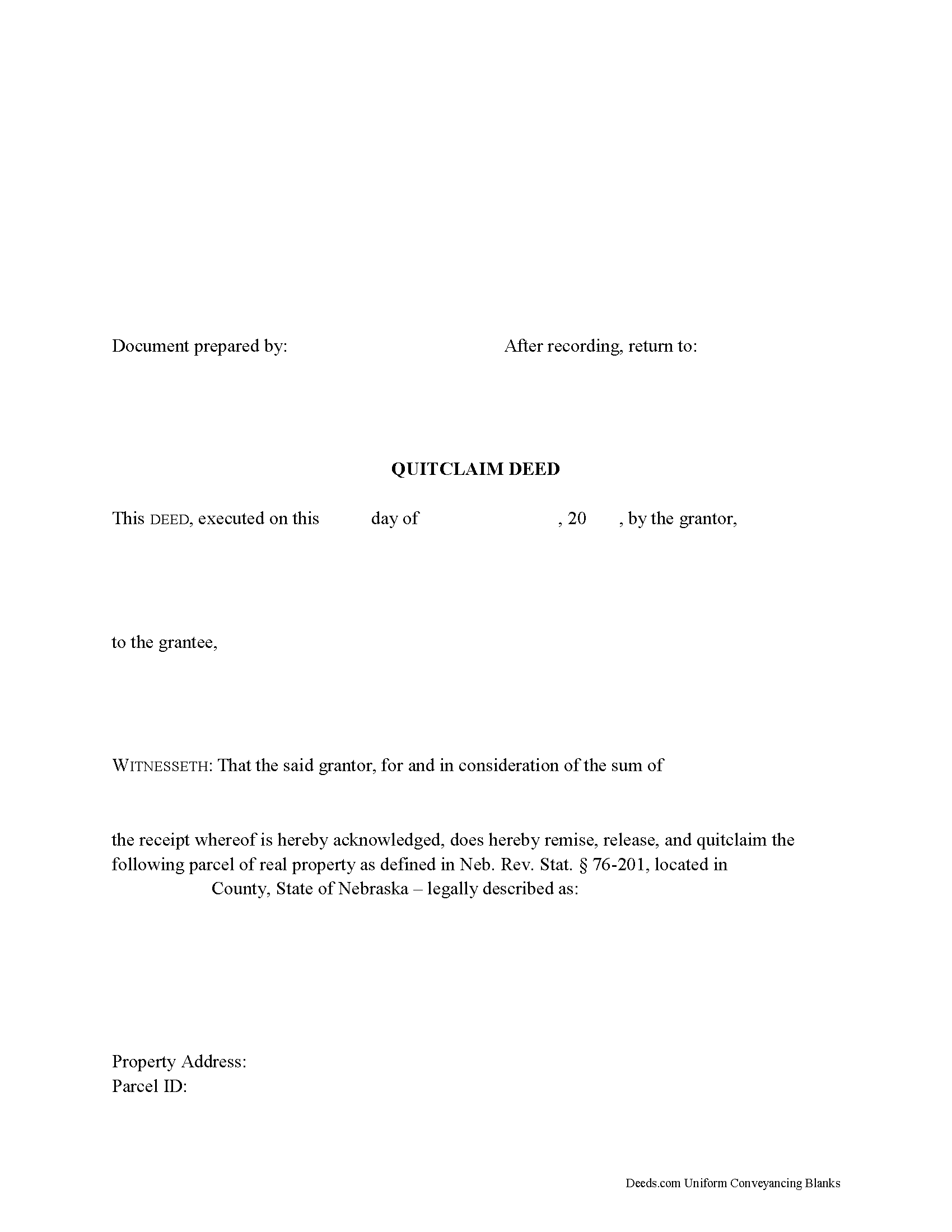
About the Nebraska Quitclaim Deed
How to Use This Form
- Select your county from the list
- Download the county-specific form
- Fill in the required information
- Have the document notarized if required
- Record with your county recorder's office
What Others Like You Are Saying
"Fast, reliable excellent service"
"This is a very valuable resource. It was user friendly and made transfer happen in a day!"
"I was overwhelmed with information about what forms I needed to complete the probate process, and th…"
"The form was just what I needed for the Circuit Court and Land Records office. The additional inform…"
"Seems easy enough, may have downloaded forms I don't need, however I'm hoping that these are the onl…"
4.8/5 from 4,836 reviews. Read all
Nebraska enacts no official deed form, so what an instrument is in the Nebraska record is settled by the words printed inside it. Neb. Rev. Stat. Section 76-205 construes a deed to effect the intent gathered from the whole instrument, and Section 76-206 turns language that a grantor is seized or lawfully seized into a covenant unless the instrument expressly negatives that intention. A quitclaim deed earns its character by saying, in terms, what it releases and what it does not promise. This form is that deed, written for individual owners and printed with the negation on its face.
The words that make a release a release
Section 9 carries the operative sentence with no blanks to complete: the grantor remises, releases, and forever quitclaims to the grantee every right, title, interest, claim, and demand in the described real estate, together with the improvements and appurtenances belonging to it. The same section states that only the interest held at delivery passes, that no covenant or warranty of title travels with it, and that the informational listing of encumbrances promises nothing. Section 76-209 attaches the consequence: an after-acquired interest reaches the grantee where a deed purports to convey more than the grantor held, except under a quitclaim or a special warranty deed. Title arriving to the grantor next year stays there, and mortgages, easements, judgment liens, and unpaid taxes ride through untouched.
One or two names on each side, and nothing preprinted
The party blocks are open. Section 1 takes one or two grantors with any status the parties state, Section 2 takes one or two grantees with whatever words describe how they hold together, and neither block prints a form of ownership in advance. Section 76-118 lists the estates a direct conveyance creates, and a deed to two grantees naming none of them leaves a tenancy in common, so survivorship exists only where the entry says so. Two signature blocks and two certificates follow, and a lone grantor leaves the second of each blank. Co-owners consolidating a jointly held parcel in one name, and two heirs releasing inherited fractional shares, present count patterns this architecture accommodates. Record title standing in a company, a trustee conveying trust ground, and a signature written by an agent under a power of attorney follow architectures this form is not set up as.
Where a marriage enters the page
Nebraska abolished dower and curtesy in Section 30-104 and recognizes no community property and no entireties estate, so the marital question on a deed narrows to one statute. Section 40-104 conditions a conveyance of the homestead of a married person on an instrument both spouses execute and acknowledge, and it follows the marriage rather than the grantor index, reaching a residence whose record title stands in one name. Mutual of Omaha Bank v. Watson requires both acknowledgments on the face of a homestead instrument. Two grantor blocks and two certificates absorb that case without a separate joinder layout, and the guide sets out the statute with its exceptions.
Arithmetic at the register of deeds
Pages are built to Nebraska's format statutes: three inches clear across the top of page one for recording information, the instrument title and return block printed underneath as Section 23-1510 directs, one inch side and bottom margins, 12 point type well above the eight point legibility presumption. Section 33-109 prices the filing at $10.00 for a first page and $6.00 for each page after. Two companions travel with the deed and are prepared outside this package: the grantee-signed Form 521 Real Estate Transfer Statement that Section 76-214 makes a condition of recording, and documentary stamp tax, charged to the grantor by Section 76-901 at $3.32 for each $1,000 of value and collected by the register before acceptance under Section 76-903. Section 76-902 carries the exempt transfers, each running on a signed certification. The completed example takes the taxable route, entering $713.80 on a $215,000 Madison County conveyance.
What the download contains
The package holds the Nebraska quitclaim deed as a fillable PDF, a completed Madison County example filled at full two-grantor capacity, and a plain language guide covering every section, both certificates, the estates a grantee may take, and each step at the counter. Search spellings wander to quit claim deed and quick claim deed; the Nebraska record indexes the instrument as a quitclaim deed. The materials are informational and are not legal advice.
Important: County-Specific Forms
Our quitclaim deed forms are specifically formatted for each of the 93 counties in Nebraska.
After selecting your county, you'll receive forms that meet all local recording requirements, ensuring your documents will be accepted without delays or rejection fees.