Nebraska Quitclaim Deed (Trustee Grantor)
County Specific Legal Forms Validated as recently as September 30, 2026 by our Forms Development Team
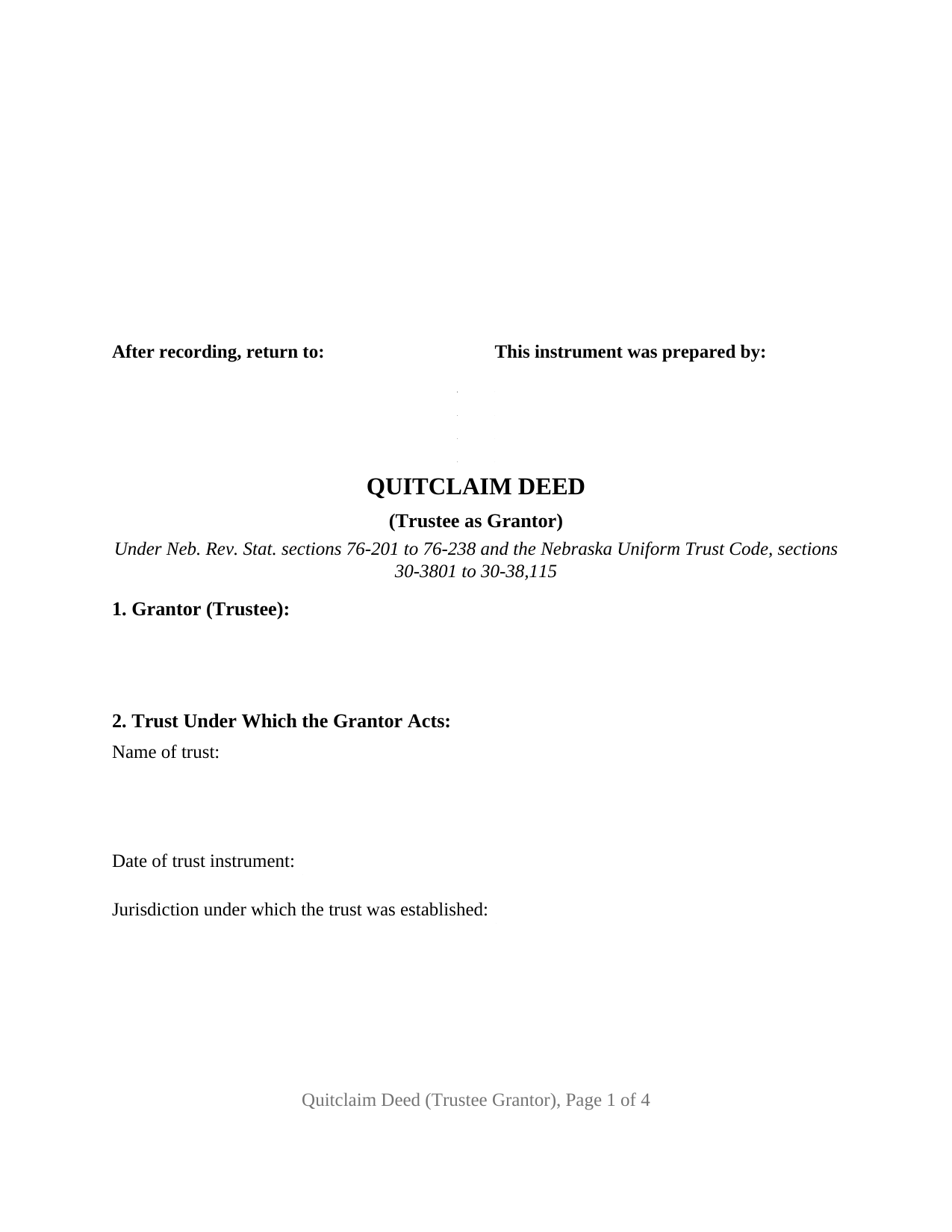
About the Nebraska Quitclaim Deed (Trustee Grantor)
How to Use This Form
- Select your county from the list
- Download the county-specific form
- Fill in the required information
- Have the document notarized if required
- Record with your county recorder's office
What Others Like You Are Saying
"Deeds.com was fast and easy and I got everything I needed in one stop!"
"Good organization and guidance."
"These guys saved the day! Very good at what they do and deliver AS ADVERTISED!! My county's recorder…"
"I thought the service was good"
"Received the forms as promised. Very satisfied."
4.8/5 from 4,829 reviews. Read all
The only signature on this Nebraska quitclaim deed belongs to a fiduciary, and it is made in a capacity rather than in a name alone. Record title stands in a trustee, the deed identifies the trust that trustee serves, and what the deed releases is the fiduciary interest as it stands: one grantor block reciting the trustee capacity, one signature line, one acknowledgment certificate.
Where a trustee's power to convey comes from
Nothing in the deed statutes gives a trustee authority to sign; that comes from the trust instrument and the Nebraska Uniform Trust Code. Neb. Rev. Stat. Section 30-3880 gives a trustee the powers the terms of the trust confer and, except as those terms limit them, all powers over the trust property that an unmarried competent owner has over individually owned property, every exercise subject to the fiduciary duties of Sections 30-3866 to 30-3882. Section 30-3881 lists specific powers, among them selling property and, in subdivision (25), signing and delivering instruments useful to exercising them. Nebraska also protects the far side of the closing: Section 30-38,101 shields a person other than a beneficiary who deals in good faith and for value with a trustee, without knowledge that a power is being exceeded, and relieves that person of any duty to inquire into the extent of the trustee's powers, as Junker v. Carlson applied it.
The section that names the trust
Section 2 collects the trust's identity in three blanks: what the trust is called, when its instrument was signed, and the jurisdiction whose law it was established under. Section 30-38,103 lists those same items among the recitals of a certification of trust, the affidavit that all acting trustees sign and acknowledge so that someone dealing with a trust can establish its existence and terms; that affidavit is prepared separately and is no part of this package. Carrying the three on the deed lets a title examiner match this conveyance to the right trust years later, and Section 3 names the instrument that put title in the trustee.
One trustee, one signature, one certificate
The architecture is fixed at a single trustee on the grantor side. A trustee distributing trust real estate to the beneficiaries as an administration closes, a successor trustee clearing a parcel after the settlor's death, and a trustee releasing a residual interest so record title stands in one name arrive in the shape this deed recites. Two cotrustees signing together, a grantor conveying individually, and a deed running to a trustee rather than from one follow architectures this version is not set up as. Beneath the signature sits the printed name line Section 23-1503.01(3) requires, commonly carrying the capacity with the name; a grantee takes without signing, so the certificate is the trustee's alone.
Quitclaim words, measured against trust title
The conveyance section remises, releases, and forever quitclaims the grantor's right, title, interest, claim, and demand as trustee, passing only what is held at delivery, with no covenant or warranty and none at all individually. Section 76-209 keeps a quitclaim deed outside the after-acquired-title rule, so an interest reaching the trust later stays with the trustee, and mortgages, easements, judgment liens, and unpaid taxes ride through untouched.
An exemption that turns on who receives
Section 76-901 lays documentary stamp tax on the grantor, collected by the register of deeds before a deed is accepted, at $3.32 per $1,000 of value or fractional part until 2032. Out of a trust, the exemption analysis follows the recipient: Section 76-902(20) exempts a transfer from a trustee to a beneficiary of the trust, while Department of Revenue regulations state that a transfer to someone who is not a beneficiary is taxable whether or not the sale proceeds reach the beneficiaries. Section 6 takes either the computed tax or the exemption subdivision, backed by the certification Section 76-902 describes, and the example enters subdivision 20 on a Madison County distribution. A grantee-signed Form 521 Real Estate Transfer Statement still travels to the counter under Section 76-214.
What the download contains
The package holds the trustee grantor version of the Nebraska quitclaim deed as a fillable PDF, a completed Madison County example, and a plain language guide covering each blank, the certificate, the estates a grantee may take, and the recording steps. Searches reach it as a trustee deed, a deed out of a trust, a quit claim deed, or a quick claim deed; the Nebraska record calls it a quitclaim deed. The materials are informational and are not legal advice.
Important: County-Specific Forms
Our quitclaim deed (trustee grantor) forms are specifically formatted for each of the 93 counties in Nebraska.
After selecting your county, you'll receive forms that meet all local recording requirements, ensuring your documents will be accepted without delays or rejection fees.