Nebraska Quitclaim Deed (Corrective)
County Specific Legal Forms Validated as recently as October 5, 2026 by our Forms Development Team
About the Nebraska Quitclaim Deed (Corrective)
How to Use This Form
- Select your county from the list
- Download the county-specific form
- Fill in the required information
- Have the document notarized if required
- Record with your county recorder's office
What Others Like You Are Saying
"Amazing customer service, I greatly appreciate their help and understanding. Will always come back t…"
"So quick. So easy. Worth every penny!"
"Forms were great ! Cancelled my lawyer's appointment & utilized your forms."
"The site was quick and easy to find information I needed. It also provided extra paperwork that woul…"
"Great service and easy to purchase exactly what you want."
4.8/5 from 4,833 reviews. Read all
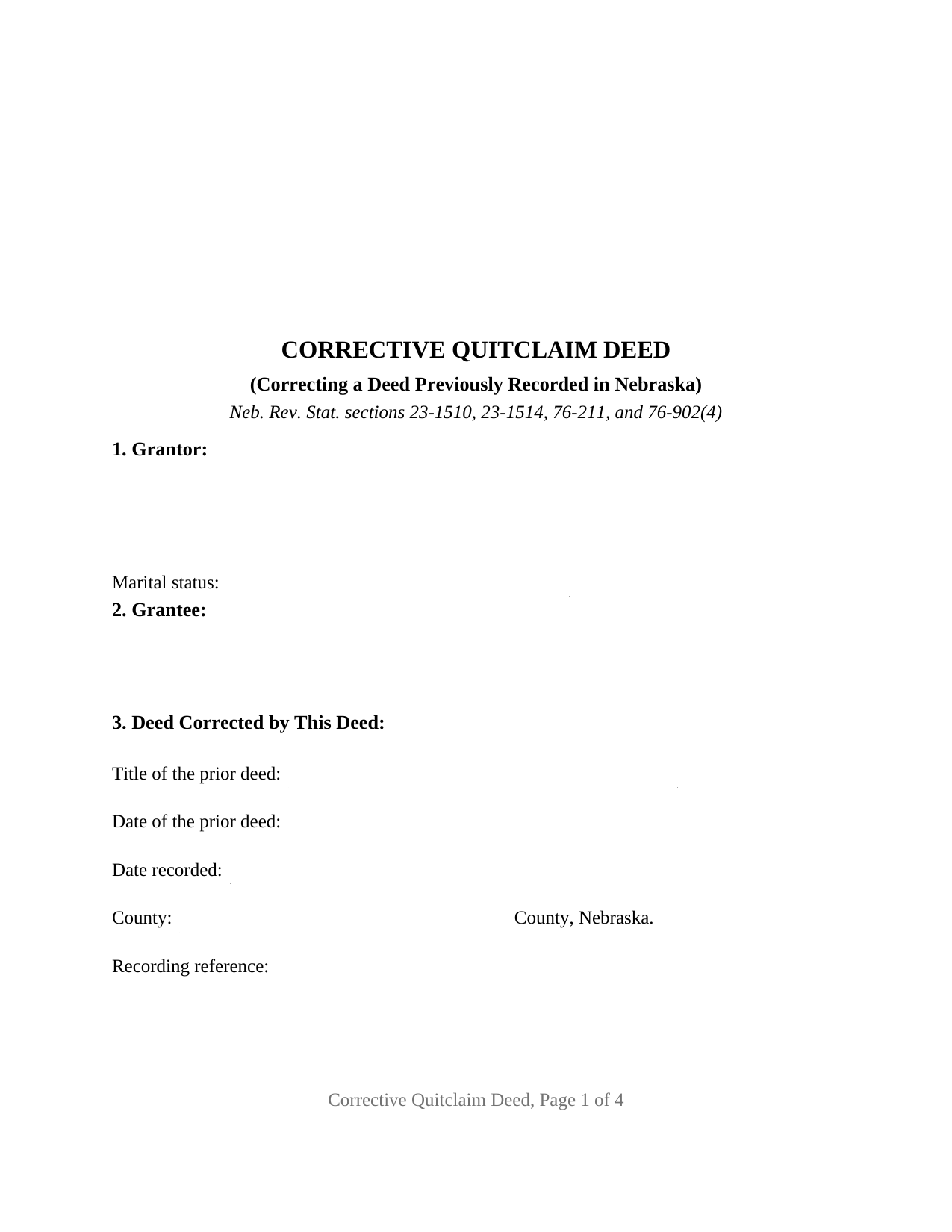
A Nebraska corrective quitclaim deed is written about another document. It names a deed already recorded in a Nebraska county, sets the wording of record beside the wording as corrected, and quitclaims to the grantee on the corrected terms: one grantor, one signature line, one acknowledgment certificate.
The section that names the deed being corrected
Neb. Rev. Stat. Section 23-1514 governs how a county enters an instrument on its numerical index, and it carries the content rule this deed answers. An instrument purporting to release, assign, or amend a conveyance previously recorded must contain the book and page number or the microfilm or computer reference of that earlier instrument, together with a full legal description of the realty affected. Section 3 gathers the title the earlier deed carries, the date it was signed, the date it went of record, the county, and that recording reference; Section 4 supplies the description. The correcting deed is filed in the county holding the deed it corrects, at the Section 33-109 rate of $10.00 for a first page plus $6.00 per page after.
Two lines that show the whole change
Section 6 holds the correction itself, in two blanks and nothing more: the wording as it stands in the recorded deed, and the wording as corrected. A transposed lot or block number in a platted description, a misspelled surname, an omitted marital status, a stray digit in a source recording reference; each arrives as a pair of entries compared in one glance. The completed example runs a Saunders County pattern, a recorded deed reading Block 14 where the plat reads Block 4.
What the deed says it is not
Section 8 carries no blanks. The grantor remises, releases, and forever quitclaims for the purpose of correcting the deed identified in Section 3, and the same section states that except as corrected the earlier deed stands in full force, that this instrument is not a new or additional conveyance, and that it neither extends nor limits the title or interest the earlier deed passed. Section 76-209 keeps a quitclaim deed outside the after-acquired-title rule. No covenant or warranty travels with it, and mortgages, easements, judgment liens, and unpaid taxes ride through the correction unchanged.
The exemption written for correcting deeds
Documentary stamp tax falls on the grantor under Section 76-901 at $3.32 for each $1,000 of value. Correcting deeds have a line of their own: Section 76-902(4) reaches deeds which, without additional consideration, confirm, correct, modify, or supplement a deed previously recorded but which do not extend or limit existing title or interest. Section 7 prints that ground on the face of the deed and takes the exemption number beside a blank for tax. The regulations draw the boundary: 350 Neb. Admin. Code Chapter 52, Reg-52-003.02D denies this exemption to a deed moving owners between tenancy in common and joint tenancy. A grantee-signed Form 521 Real Estate Transfer Statement, prepared separately and not included here, stays a condition of recording under Section 76-214.
One grantor, one certificate, and the shapes that arrive this way
The form is fixed at a single grantor and a single grantee, with a marital status line under the grantor block and a printed name line under the signature answering Section 23-1503.01(3). One signer draws one certificate; Section 64-204 accepts any certificate carrying the words acknowledged before me or a substantial equivalent, so the count follows the signing architecture rather than a Nebraska demand. An owner fixing a scrivener's error in a deed delivered weeks earlier, a grantor restating a platted description the way the plat reads, and a party clearing a name variance out of a chain of title present the pattern this deed recites. Two owners signing together, an entity or a fiduciary on the grantor side, and a married grantor correcting a deed of the homestead, which Section 40-104 conditions on both spouses executing and acknowledging the instrument, follow architectures this version is not set up as.
What the download contains
The package holds this corrective version of the Nebraska quitclaim deed as a fillable PDF, the completed Saunders County example, and a plain language guide covering every blank, the acknowledgment, the ways a Nebraska grantee may hold title, and the recording steps. Searches reach the instrument as a correction deed, a scrivener's error deed, a quit claim deed, or a quick claim deed; the Nebraska record calls it a quitclaim deed. The materials are informational and are not legal advice.
Important: County-Specific Forms
Our quitclaim deed (corrective) forms are specifically formatted for each of the 93 counties in Nebraska.
After selecting your county, you'll receive forms that meet all local recording requirements, ensuring your documents will be accepted without delays or rejection fees.