Nebraska Quitclaim Deed (Interspousal)
County Specific Legal Forms Validated as recently as October 14, 2026 by our Forms Development Team
About the Nebraska Quitclaim Deed (Interspousal)
How to Use This Form
- Select your county from the list
- Download the county-specific form
- Fill in the required information
- Have the document notarized if required
- Record with your county recorder's office
What Others Like You Are Saying
"Very helpful and informative. It has saved me time going to get the forms at county recorder / clerk…"
"Easy peezy."
"I was able to download the forms and I needed and fill out quickly. There were examples to review if…"
"This is a great service. It was easy to find and the instructions were complete and easy to follow."
"Easy way to get forms that I needed. Would buy again from you if needed."
4.8/5 from 4,829 reviews. Read all
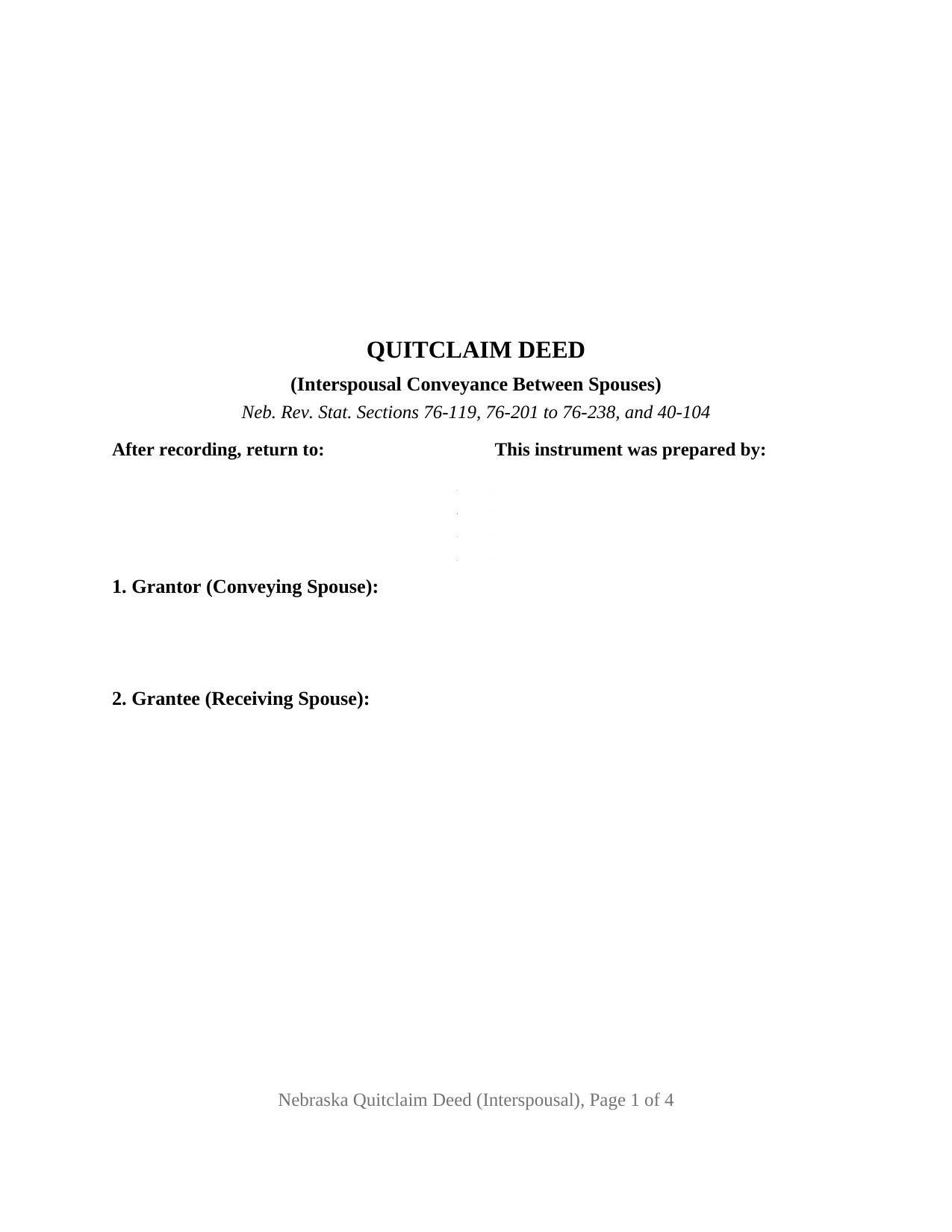
An interspousal quitclaim deed puts one marriage on both sides of the conveyance. One spouse, named as grantor, releases an interest in Nebraska real estate; the other spouse, named as grantee, receives it. This version fixes that shape at one conveying spouse and one receiving spouse, each with a signature line and an acknowledgment certificate, because here the person taking the property signs too.
The statute that lets a deed run straight across a marriage
Neb. Rev. Stat. Section 76-119 supplies the authority: a married person may convey property effectively and directly to that person's spouse in the same manner and to the same extent as if the grantor were unmarried, so no straw party is needed. The same section adds the sentence that shapes what the deed accomplishes: property conveyed this way stays subject to the rights of the grantor as spouse of the grantee, to the same extent as property the grantee acquired some other way. Record title changes hands; the conveying spouse remains a spouse with respect to the parcel, and Section 9 prints that rule in the conveyance language.
Why the grantee signs too
Section 40-104 conditions a conveyance of the homestead of a married person on an instrument both spouses execute and acknowledge, and Mutual of Omaha Bank v. Watson requires both acknowledgments on the face of the instrument. An annotation under Section 40-104, the Eighth Circuit's decision in Troyer v. Mundy, states that a homestead conveyance running from one spouse to the other does not call for both to execute and acknowledge it, while the Nebraska Supreme Court has stated the general rule without reaching that case. This form leaves that gap closed: the receiving spouse signs and acknowledges as a named party, and Section 10 records that this second signer conveys nothing and warrants nothing by signing.
One conveying spouse, one receiving spouse, two certificates
The grantor and grantee blocks each hold one name, a mailing address, and a marital status line, and Section 3 states the marriage between the parties with no blanks to complete. The certificates are split one per signer, so the spouses need not appear together or on the same day. Section 64-204 directs acceptance of any certificate that carries the words acknowledged before me or a substantial equivalent, so the split is this form's architecture and not a statutory command. A printed name line under each signature answers Section 23-1503.01(3). Patterns arriving in this shape include a house owned before the wedding moving into the other spouse's name, and one spouse stepping off a jointly held parcel so title stands alone for a refinance. A deed to a grantee outside the marriage, and a deed two owners sign together, follow architectures this version is not set up as.
Quitclaim words, and what rides through them
The operative sentence remises, releases, and forever quitclaims the grantor's right, title, interest, claim, and demand, and the deed says it passes only what the grantor holds at delivery, without covenant or warranty. Section 76-209 excludes a quitclaim deed from the after-acquired-title rule: an interest reaching the conveying spouse later stays with that spouse. A loan secured against that spouse's interest keeps running by its own terms, and easements, judgment liens, and unpaid taxes are untouched.
A transfer the exemption list usually reaches
Documentary stamp tax falls on the grantor under Section 76-901 at $3.32 per $1,000 of value, and the register of deeds collects it before accepting a deed. Spouse-to-spouse transfers are the classic exemption: Section 76-902(5)(a)(i) covers deeds between spouses without actual consideration, claimed by stating the ground on the face of the deed and furnishing the signed certification that section requires. Section 5 prints that statutory ground and takes the exemption number, and the completed example enters exemption 5 on a Buffalo County transfer. A grantee-signed Form 521 Real Estate Transfer Statement still accompanies the deed under Section 76-214, and page one keeps the three inch recording space clear under Section 23-1510.
What the download contains
The package holds this interspousal version of the Nebraska quitclaim deed as a fillable PDF, the completed Buffalo County example, and a plain language guide that walks each blank, both certificates, the estates a Nebraska grantee may take, and the trip to the counter. Searches reach the instrument as a deed between spouses, an interspousal transfer, a quit claim deed, or a quick claim deed; the Nebraska record calls it a quitclaim deed. The materials are informational and are not legal advice.
Important: County-Specific Forms
Our quitclaim deed (interspousal) forms are specifically formatted for each of the 93 counties in Nebraska.
After selecting your county, you'll receive forms that meet all local recording requirements, ensuring your documents will be accepted without delays or rejection fees.