New Jersey Quitclaim Deed (Two Grantors)
County Specific Legal Forms Validated as recently as September 21, 2026 by our Forms Development Team
About the New Jersey Quitclaim Deed (Two Grantors)
How to Use This Form
- Select your county from the list
- Download the county-specific form
- Fill in the required information
- Have the document notarized if required
- Record with your county recorder's office
What Others Like You Are Saying
"Definitely 5 Stars !"
"I love how easy it is to understand and complete."
"I have been using Deeds.com for the last 2 years and find them very easy to use and expedient on all…"
"I wish the quick claim dead would have had letterhead that said, State South Carolina."
"Wonderful forms! Thanks for making this available."
4.8/5 from 4,824 reviews. Read all
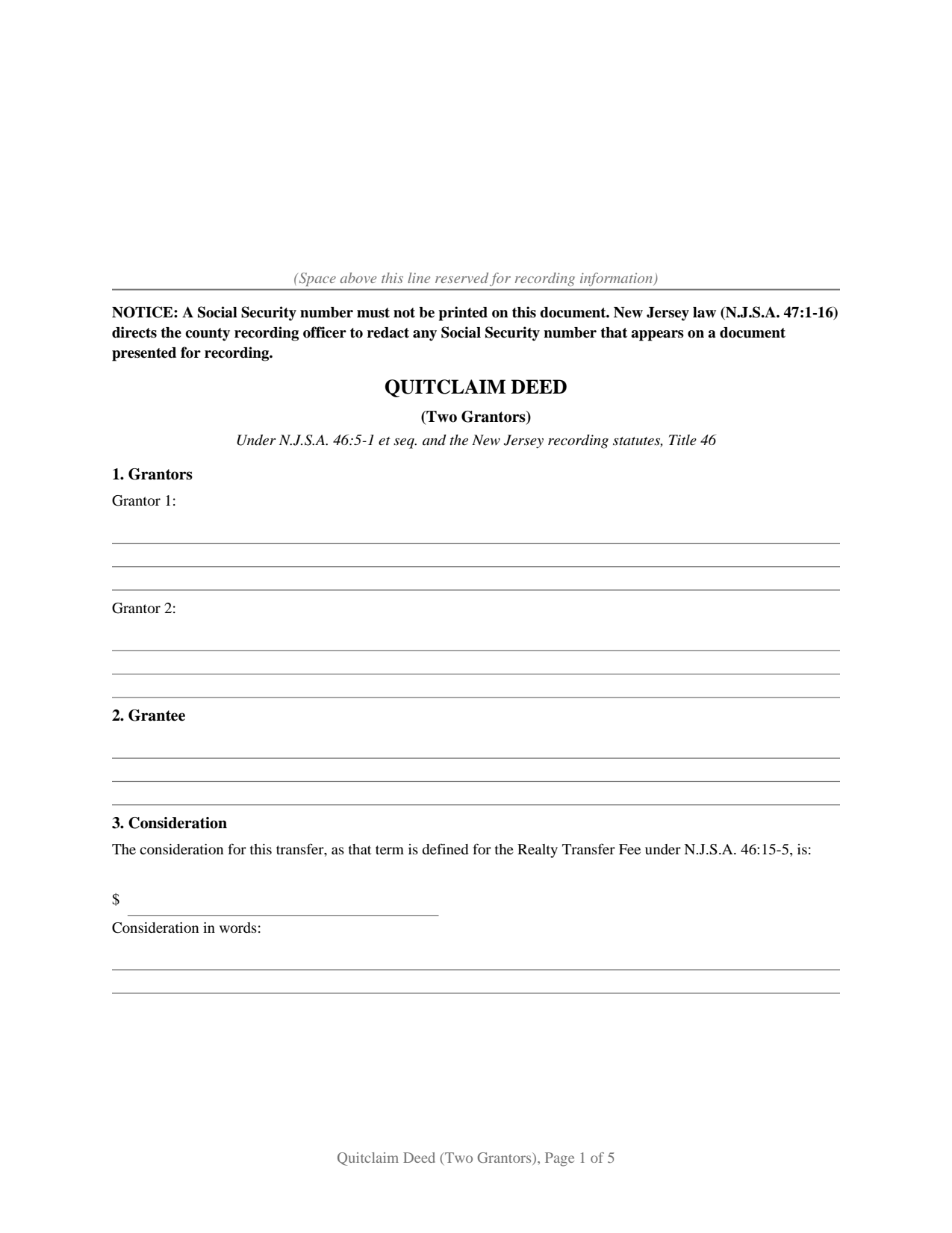
A New Jersey quitclaim deed for two grantors is the instrument two record owners reach for when both must release their interests together and neither is making a warranty. The form recites exactly two grantor positions, with separate name blocks, separate signature lines, and separate acknowledgment certificates, so co-owners who hold title together can release it together in one recorded instrument without any covenant of title between them.
One Instrument, Two Releases
The two-grantor configuration carries a specific legal architecture. Each grantor has a separate acknowledgment certificate, which means the two may acknowledge on different dates, before different notaries or other authorized officers, and in different states, and the deed still works as one instrument. The form gives each grantor the same full text-width by-line in the certificate, so a name as long as a legal name and address does not truncate. N.J.S.A. 46:5-3 governs the effect: a quitclaim made without a reservation passes all the estate the grantors could lawfully convey by deed of bargain and sale. Whatever interest the two grantors hold, they release here together.
Marital Property on Both Sides
The two-grantor deed touches New Jersey marital property law in two directions. On the grantor side, when both grantors are spouses or civil union partners and the property is their jointly occupied principal matrimonial residence, N.J.S.A. 3B:28-3 gives each a statutory joint right of possession. The bold-caps notice in the conveyance section states on the face of the deed that the joint possession right is addressed only if both sign or the right is otherwise released. On the grantee side, when a married couple or civil union couple takes title without words of vesting specifying a different ownership form, N.J.S.A. 46:3-17.2 creates a tenancy by the entirety by operation of law. The guide's How the Grantees May Hold Title section covers all four forms of New Jersey co-ownership: tenancy in common, joint tenancy with right of survivorship, tenancy by the entirety, and sole ownership by a single grantee.
No Covenant, No Warranty
What the form does not carry is as important as what it does. N.J.S.A. 46:4-6 creates the covenant against the grantors' acts when a deed recites that the grantor has done no act to encumber the lands. N.J.S.A. 46:4-3 through 46:4-10 create the other statutory deed covenants, from seisin through general warranty. This quitclaim deed recites none of them. The instrument states its no-covenant character expressly so neither the grantee nor a later reader misreads it as something it is not. Two co-owners passing title to a family member, two siblings releasing inherited fractional interests, or former spouses conveying jointly held property as part of a dissolution settlement present the two-grantor pattern this deed recites.
Recording Is a Package
Recording in New Jersey requires more than the deed alone. The deed states its consideration or annexes the Affidavit of Consideration, Form RTF-1, when the full consideration is not recited or an exemption from the Realty Transfer Fee under N.J.S.A. 46:15-6 is claimed. Transfers with total consideration over $1,000,000 on qualifying property classes may also require the Graduated Percent Fee affidavit, Form RTF-1EE, under P.L.2025, c.69. No county recording officer may accept the deed without the applicable Gross Income Tax form under N.J.S.A. 54A:8-9. Under N.J.S.A. 46:26A-3, the deed additionally shows the grantee's mailing address, identifies the lot and block or states that none is assigned, names the person who prepared it, and carries each signer's printed name beneath the signature.
The package includes the deed as a fillable PDF, a completed example on a realistic Middlesex County fact pattern with two individual grantors and one individual grantee, and a plain-language guide covering every section, the vesting choices for grantees, the no-warranty effect, and the full recording picture. The materials are informational and are not legal advice.
Important: County-Specific Forms
Our quitclaim deed (two grantors) forms are specifically formatted for each of the 21 counties in New Jersey.
After selecting your county, you'll receive forms that meet all local recording requirements, ensuring your documents will be accepted without delays or rejection fees.