New Jersey Quitclaim Deed (Corrective)
County Specific Legal Forms Validated as recently as October 21, 2026 by our Forms Development Team
About the New Jersey Quitclaim Deed (Corrective)
How to Use This Form
- Select your county from the list
- Download the county-specific form
- Fill in the required information
- Have the document notarized if required
- Record with your county recorder's office
What Others Like You Are Saying
"Deeds.com made the recording of our Deed in a county where we do not reside, VERY easy! Customer ser…"
"very easy to use, and comprehensive...I like the e-recording package"
"Hassle free, easy access to form and instructions include on how to complete."
"5 star review. Was able to order and download what I wanted in just a few minutes without any glitch…"
"I was vey pleased with this service. It offered all of the necessary step by step information guides…"
4.8/5 from 4,836 reviews. Read all
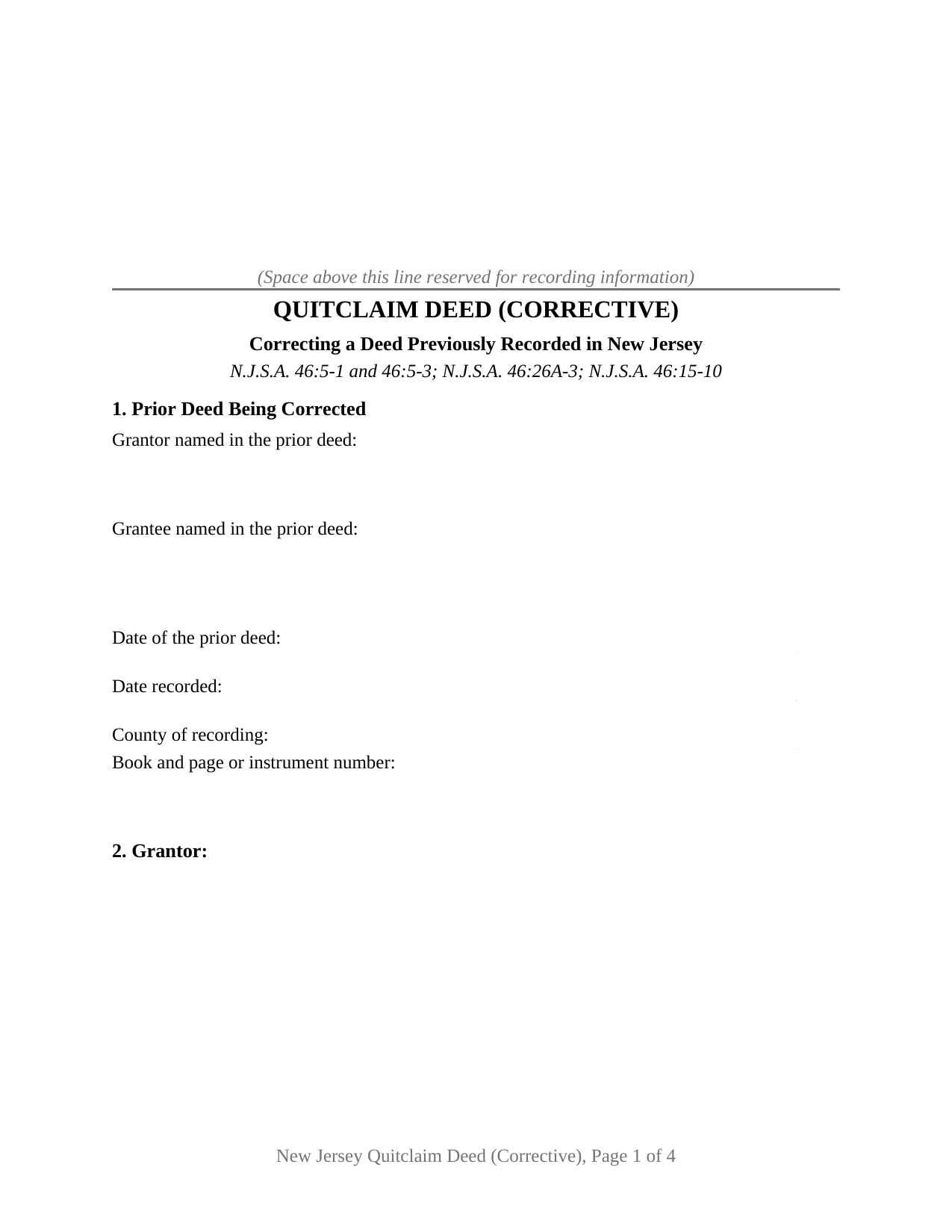
A recorded deed is permanent. New Jersey land records take additions, not erasures, so an error in a deed that has already passed the recording counter is answered by a second instrument rather than by a change to the first. This fillable New Jersey corrective quitclaim deed is that second instrument: it names the deed on record, prints what that deed got wrong, prints the correction, and releases the grantor's interest again as corrected.
Where the Re-Recording Counter Stops
Counties publish another route, and where it ends is what sends a correction here. Sussex and Atlantic County take an already recorded document back for re-recording on conditions: the reason stated on the first page, every change initialed, and the document acknowledged again with the current date. Then both stop at the same line. A document will not be accepted for re-recording where the changes are substantial enough to call for a new document, and both name the same examples, adding or removing names and a spelling correction that significantly changes a name. A separately signed correction deed is the route that stays open past that line.
The Section That Prints the Error
Most deed sections take one entry. Section 5 here takes two: the matter as the prior deed has it, and the matter as this deed corrects it. That pairing is what lets a title examiner read the two documents together years later. Section 1 above it anchors the instrument to one recorded entry, naming the prior deed's parties, its date, its recording date, its county, and its book and page.
Corrected, Not Warranted
Remise, release and forever quitclaim carry an interest under N.J.S.A. 46:5-1, and the reach of those words is fixed by N.J.S.A. 46:5-3: absent a reservation, the grantor passes the estate a bargain and sale deed from that grantor could have passed, and no covenant of title comes along. That is a deliberate fit. A corrective deed makes the record say what the parties meant the first time; it adds no assurance the first deed never carried. Section 8 prints in capitals the covenant words of N.J.S.A. 46:4-3 through 46:4-10 that are missing, so judgments, easements, and municipal charges ride through untouched.
When Agreement Runs Out
A corrective deed decides nothing; the party who granted before simply signs again. Where the two sides disagree about what the earlier deed was meant to say, New Jersey sends the question to court on narrow grounds. St. Pius X House of Retreats, Salvatorian Fathers v. Diocese of Camden, 88 N.J. 571 (1982), restates them as mutual mistake, or unilateral mistake by one party with fraud or unconscionable conduct by the other. A deed of confirmation signed by one side of a real dispute is no substitute for that judgment.
How the Corrective Form Is Configured
The form recites one grantor, one grantee, and one prior deed. It carries a grantor block, a grantee block with a mailing address and the ownership form, a property section, the paired correction entries, a consideration entry, one signature block, and one certificate, the grantor being the only signer. It is not set up as a deed from two record owners, a deed signed for an entity or under a power of attorney, a deed signed by a trustee, a deed joined by a spouse or civil union partner off title, or a deed carrying covenants. Patterns presenting this configuration fill every county index: a misspelled surname in a grantee line, a description carrying the wrong lot off a tax map.
The Fee That Does Not Apply
Two Division of Taxation filings treat a correction differently from a sale. N.J.S.A. 46:15-10 lists the deeds the Realty Transfer Fee does not touch, and subsection (d) reaches a deed which confirms or corrects a deed previously recorded; the claim is made on the Affidavit of Consideration, Form RTF-1. No county may accept a deed without the applicable seller residency form, and one exists for this instrument alone: Form GIT/REP-4A, the waiver for a corrected deed with no consideration, on which the title owner declares that the attached deed is corrective or confirmatory only. Each is prepared separately and is not included here.
The download holds the corrective quitclaim deed as a blank fillable PDF, a completed example worked through a Hunterdon County parcel whose recorded deed carried the wrong lot number, and a plain-language guide to the numbered sections, the statutes behind them, and the recording filings. The materials are informational and are not legal advice.
Important: County-Specific Forms
Our quitclaim deed (corrective) forms are specifically formatted for each of the 21 counties in New Jersey.
After selecting your county, you'll receive forms that meet all local recording requirements, ensuring your documents will be accepted without delays or rejection fees.