New Jersey Quitclaim Deed to a Trustee
County Specific Legal Forms Validated as recently as October 8, 2026 by our Forms Development Team
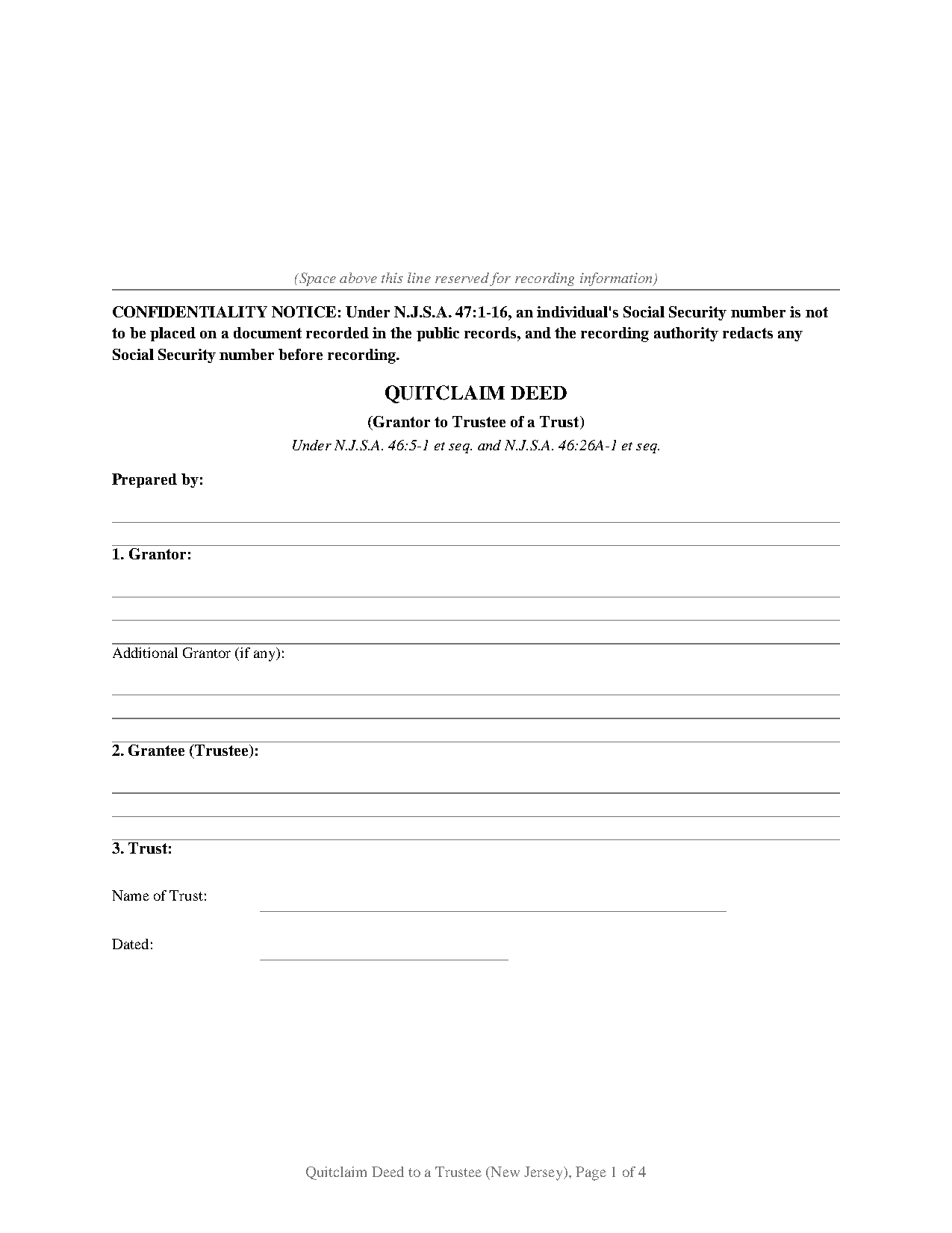
About the New Jersey Quitclaim Deed to a Trustee
How to Use This Form
- Select your county from the list
- Download the county-specific form
- Fill in the required information
- Have the document notarized if required
- Record with your county recorder's office
What Others Like You Are Saying
"Our firm is working remotely and a lot of court services are limited with the corona-virus shutdowns…"
"My first time using eRecording. Excellent user friendly service."
"The Personal Representatives Deed is definitely a helpful document for my files. I find it need just…"
"Service was very convenient; I received prompt assistance with my document - staff was very helpful."
"Thanks for the service which was excellent and timely. Instructions were easy to follow and results …"
4.8/5 from 4,824 reviews. Read all
Funding a trust with real estate takes a deed that moves title out of the owner's name and into the name of the trustee. This form prepares that deed for New Jersey property as a quitclaim: it releases whatever interest the grantor holds to a trustee who will hold the property under the terms of a trust, governed by N.J.S.A. 46:5-1 and the New Jersey Title Recordation Act.
What the Quitclaim Words Do
New Jersey gives the quitclaim its effect through statute. Under N.J.S.A. 46:5-1, a deed in which the grantor does remise, release and forever quitclaim unto the grantee is construed as a grant and conveyance of the grantor's interest. N.J.S.A. 46:5-3 fixes the limit: a quitclaim passes all the estate the grantor could lawfully convey by deed of bargain and sale, but it creates no covenant that the grantor holds title. New Jersey courts treat the result as a deed without covenants, so the trustee takes exactly the interest the grantor has and no assurance beyond it. The deed states that no-covenant character on its face so it is not misread as a warranty.
Title in a Trustee Capacity
The defining feature of this deed is who receives the property. The grantee block names a trustee, in the style of a named individual, as Trustee of the named trust dated a stated date, and the deed recites that the grantee takes solely as Trustee and not in an individual capacity. Trustee title is not a co-ownership interest with survivorship; the trustee holds legal title and the trust terms govern the beneficial interests. A frequent pattern is an owner who deeds property into that owner's own revocable living trust, signing as grantor and holding afterward as trustee.
Proving the Trust Behind the Deed
The deed is the conveyance, but a recorder or title company often wants to see the trustee's authority. N.J.S.A. 46:26A-4(a) lets a document evidencing a trust under which a fiduciary acquired real property be recorded with a fiduciary affidavit. The Uniform Trust Code at N.J.S.A. 3B:31-81 provides a certification of trust, a signed summary that states the trust's terms relevant to the transaction without disclosing the full instrument. The guide describes both.
Recording and the Companion Tax Forms
A deed conveying title is recorded with the county recording officer where the property sits, and recording protects the trustee's title under the race-notice rule of N.J.S.A. 46:26A-12. A New Jersey deed also travels with separate state forms that are not part of the deed itself: an Affidavit of Consideration, Form RTF-1, where the full consideration is not recited or an exemption is claimed, and a Gross Income Tax GIT/REP form. A trust funding made for no real price commonly relies on the Realty Transfer Fee exemption for consideration of less than $100.
The download includes the blank deed as a fillable PDF, a completed example for a realistic New Jersey trust funding, and a plain-language guide covering every section, the governing statutes, the signing rules, and the recording steps. The materials are informational and are not legal advice. A New Jersey Certificate of Trust documents the trustee's authority under N.J.S.A. 3B:31-81, prepared separately and not included in this package. A grantor who wants to give title assurances uses a Bargain and Sale Deed with Covenant against Grantor's Acts instead of a quitclaim.
Important: County-Specific Forms
Our quitclaim deed to a trustee forms are specifically formatted for each of the 21 counties in New Jersey.
After selecting your county, you'll receive forms that meet all local recording requirements, ensuring your documents will be accepted without delays or rejection fees.