New Jersey Quitclaim Deed (Divorce)
County Specific Legal Forms Validated as recently as October 20, 2026 by our Forms Development Team
About the New Jersey Quitclaim Deed (Divorce)
How to Use This Form
- Select your county from the list
- Download the county-specific form
- Fill in the required information
- Have the document notarized if required
- Record with your county recorder's office
What Others Like You Are Saying
"The forms were easy and convenient to use"
"Easy but a little overpriced"
"good service but pricey."
"I ended up loading the same file twice and was unable to delete one of them. I did send e request in…"
"I thought your site was focused on my specific county, but it wasn't. Therefore, I did not complete …"
4.8/5 from 4,833 reviews. Read all
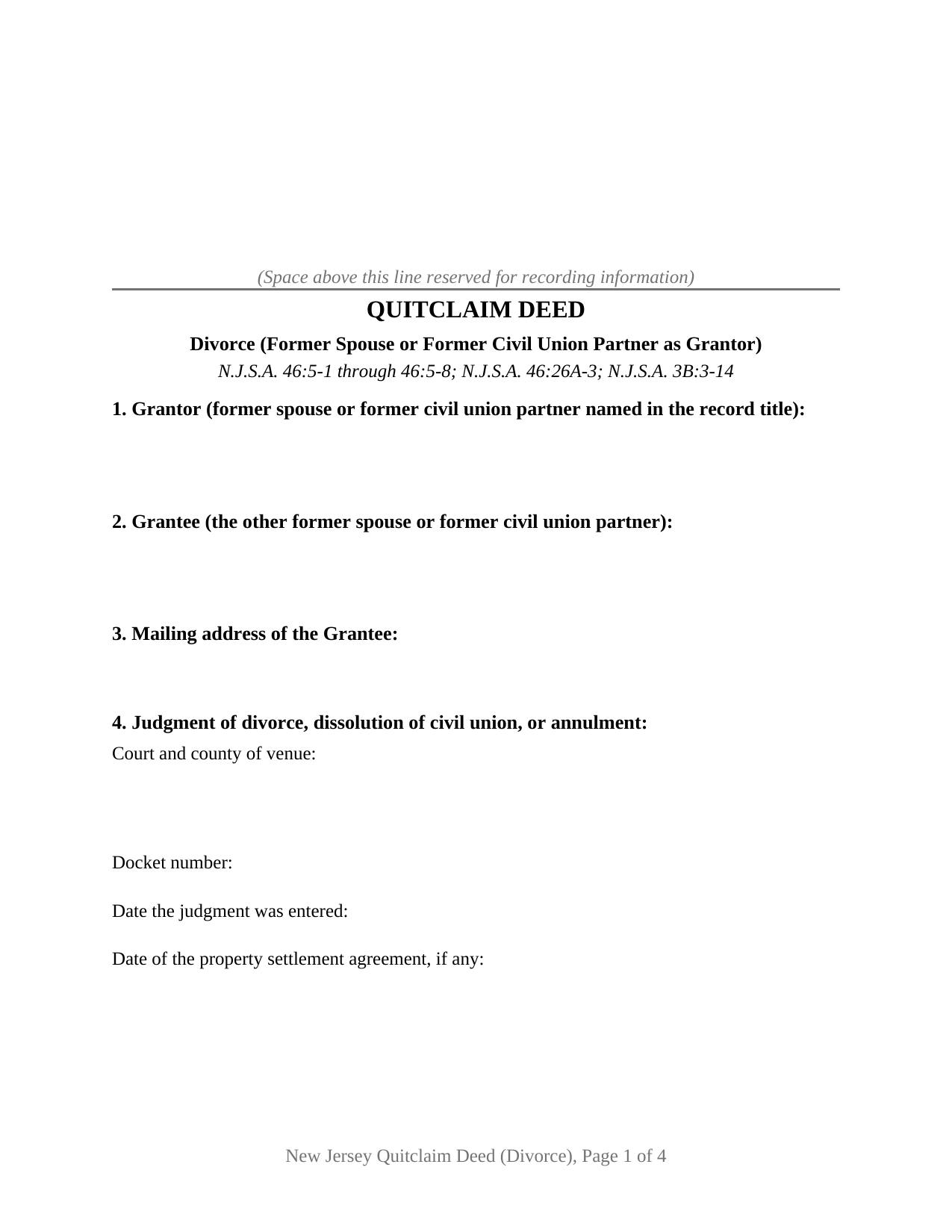
Ninety days. New Jersey puts a clock on a deed between former spouses, and this fillable New Jersey quitclaim deed is drawn for that transfer: the former spouse or civil union partner named in the record title releases that interest to the other after a judgment of divorce, dissolution, or annulment. One signature, one certificate, no covenant of title.
The Clock the Transfer Fee Runs On
N.J.S.A. 46:15-10 lists the deeds the Realty Transfer Fee does not reach, and subsection (p) is written for this conveyance: a deed recorded within 90 days following the entry of a divorce decree which dissolves the marriage between the grantor and grantee. Section 4 takes that date with the court, venue county, and docket number. The claim rides on Form RTF-1, the Affidavit of Consideration, which Division of Taxation instructions say cannot rest on an exemption symbol alone. Past ninety days, the exemption for consideration under one hundred dollars remains available.
What the Judgment Did Before the Deed Was Drawn
Title shifts at the judgment. Under N.J.S.A. 3B:3-14, a divorce or annulment severs the interests of former spouses in property held by the entirety or in joint tenancy with right of survivorship, converting them into a tenancy in common unless a governing instrument, court order, or contract provides otherwise. That is why one signature does the work here: the conveying party holds an undivided share, not an entireties interest, which N.J.S.A. 46:3-17.4 locks against one spouse acting alone. The same section protects a purchaser or lender without notice unless a writing declaring the severance is of record, and Section 10 states it.
The Marital Right an Examiner Cannot See
N.J.S.A. 3B:28-3 gives a married individual a right of joint possession in the principal matrimonial residence the couple occupies together, binding on anyone taking an interest from the owner spouse until it is released, subordinated, or extinguished. A judgment extinguishes it, and the land record shows nothing either way, since occupancy and marriage never reach the deed index. Section 11 answers in writing, releasing that right and any dower or curtesy N.J.S.A. 3B:28-1 preserves, as to this property alone.
Released, Not Warranted, and Not Refinanced
N.J.S.A. 46:5-1 recognizes the words of release, and N.J.S.A. 46:5-3 measures them: absent a reservation, the deed passes the estate a bargain and sale deed from this grantor could have passed, and no covenant of title. The covenant phrases of N.J.S.A. 46:4-3 through 46:4-10 appear nowhere, and the deed prints their absence in capitals. A second capitalized statement answers the question trailing most divorce deeds: the instrument moves an interest in land and releases nobody from a mortgage debt.
How This Form Is Configured
One grantor entry for the former spouse or former civil union partner in the record title; one grantee entry for the other, with a mailing address; the judgment entries; a prior deed reference; a property section carrying the description and tax designation; one signature block; one certificate. Timing belongs to the configuration: built for a deed made after entry of the judgment, the form carries no second signature line of the kind the N.J.S.A. 46:3-17.4 consent rule reaches while an entireties estate stands. It is not set up as a deed from two record owners, one signed for an entity, under a power of attorney, or by a trustee or personal representative, or one carrying covenants. Two patterns fill the county indexes: a former marital home released to the party buying the other out, and an undivided share of vacant ground released once the family file closes.
What Travels to the County
Consideration is stated under N.J.S.A. 46:15-6, in the deed or an annexed affidavit. No county recording officer accepts a deed without the applicable GIT/REP seller residency form, and Form GIT/REP-3 carries an assurance for real property transferred between spouses or incident to a divorce decree or property settlement agreement under 26 U.S. Code section 1041. Index data rides a cover sheet or electronic synopsis, and N.J.S.A. 22A:4-4.1 sets the recording fees. Those tax forms are completed apart from this package.
Under the race-notice rule of N.J.S.A. 46:26A-12, a later purchaser or mortgagee for value and without notice, recording first, prevails over a deed that never reached the counter. The download holds the deed as a blank fillable PDF, a completed example worked through a Middlesex County release of a former marital home, and a plain-language guide to the sections, the statutes, notarization, and recording. The materials are informational and are not legal advice.
Important: County-Specific Forms
Our quitclaim deed (divorce) forms are specifically formatted for each of the 21 counties in New Jersey.
After selecting your county, you'll receive forms that meet all local recording requirements, ensuring your documents will be accepted without delays or rejection fees.