New Jersey Quitclaim Deed (Interspousal)
County Specific Legal Forms Validated as recently as October 2, 2026 by our Forms Development Team
About the New Jersey Quitclaim Deed (Interspousal)
How to Use This Form
- Select your county from the list
- Download the county-specific form
- Fill in the required information
- Have the document notarized if required
- Record with your county recorder's office
What Others Like You Are Saying
"The best site ever. Easy to navigate. Love it!!"
"I ordered my gift deed forms one evening, filled them out the next day, and registered them with the…"
"This site makes filing documents so easy and effortless. The response time is phenomenally fast, whi…"
"sweet & easy"
"I found the process of downloading and completing the documents very user friendly. Thank you for th…"
4.8/5 from 4,828 reviews. Read all
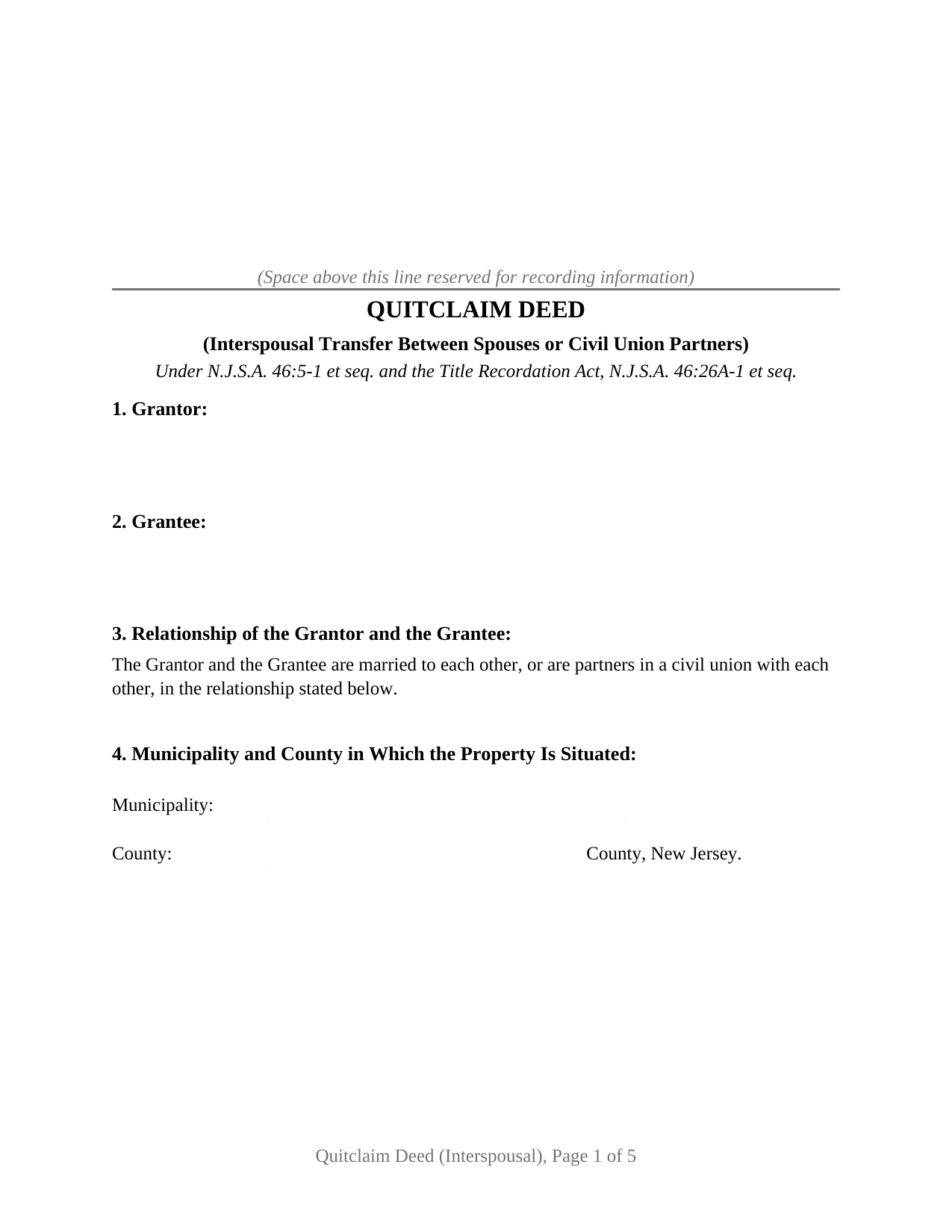
The unusual thing about a deed between spouses is that the grantee signs it too. This New Jersey quitclaim deed prepares an interspousal transfer: the spouse or civil union partner named on the record title releases that interest to the other one, who signs the same instrument to give the written consent N.J.S.A. 46:3-17.4 describes. Two signatures, two acknowledgment certificates, and title moving in one direction.
Why the Receiving Spouse Signs
Spouses who take New Jersey title together as married hold by the entirety, the estate N.J.S.A. 46:3-17.2 builds and N.J.S.A. 46:3-17.5 completes by treating the survivor as owner of the whole from its creation. Sitting between those provisions is a lock: under N.J.S.A. 46:3-17.4, an act that severs, alienates, or otherwise affects a spouse's interest in that estate calls for the written consent of both spouses. A deed running from one of them to the other does exactly that, so this form gives the receiving spouse a consent section and a signature line, and states that the consenting signature transfers nothing and warrants nothing.
The Marital Right That Would Otherwise Stay Behind
Ownership is not the only marital interest in a New Jersey home. During life, N.J.S.A. 3B:28-3 gives a married individual joint possession of the residence the couple occupies together, and anyone taking an interest from the titled spouse takes subject to that right until it is released, subordinated, extinguished, or ended by a court. It leaves no trace in the deed index, and it does not vanish when the titled spouse stops holding title. So the deed devotes a numbered section to it: the conveying spouse releases the joint possession right, along with any dower or curtesy preserved for pre-1980 interests by N.J.S.A. 3B:28-1, by the written instrument route the statute allows, and the release reaches that property alone.
Interest Released, Title Not Promised
The conveyance runs on the release words N.J.S.A. 46:5-1 recognizes, and what N.J.S.A. 46:5-3 supplies is a ceiling rather than an assurance: the grantee ends up with the estate a bargain and sale deed from this grantor would have produced, with no covenant that the grantor held anything. None of the short covenant phrases of N.J.S.A. 46:4-3 through 46:4-10 appear in the instrument, which prints that fact in capitals, so a mortgage, judgment, easement, or unpaid municipal charge stays where the record left it.
How the Interspousal Form Is Configured
The form recites one grantor entry for the spouse or civil union partner on the record title, one grantee entry for the other, and a line stating the relationship the two assert. It carries a consent section, a possession release section, two signature blocks, and one acknowledgment certificate per signer, so the two may appear before notarial officers on different days and in different states. It is not set up as a deed from two record owners, a deed to someone outside the marriage or civil union, or a deed whose grantee takes in a fiduciary capacity. Patterns that present this configuration include a parcel one spouse received by gift or inheritance during the marriage moving to the other, a transfer arranged so that record title matches a refinancing standing in one name, and an entireties interest released so the title rests with the spouse keeping the property.
Two Consequences Worth Knowing
A transfer between spouses is treated kindly by the transfer tax and harshly by creditor law. Form RTF-1 lists a deed between husband and wife or partners in a civil union couple among the transfers exempt from the Realty Transfer Fee, and that affidavit rides with the deed to claim the exemption, while the county still cannot record without the applicable GIT/REP seller form. On the creditor side, property that lands in one spouse's name is no longer entireties property, so the rule of Jimenez v. Jimenez, 454 N.J. Super. 432 (App. Div. 2018), which keeps a creditor of one spouse from forcing partition and sale during the marriage, has nothing left to protect.
Recording matters: N.J.S.A. 46:26A-12 lets a later purchaser or mortgagee for value without notice, recording first, defeat a deed left in a drawer. The package holds the interspousal quitclaim deed as a fillable PDF, a completed example worked through a fictional Morris County transfer between spouses, and a plain-language guide to every numbered section, the marital statutes behind the consent and the release, the notarization rules, and the affidavits and fees a county collects at the counter. The materials are informational and are not legal advice.
Important: County-Specific Forms
Our quitclaim deed (interspousal) forms are specifically formatted for each of the 21 counties in New Jersey.
After selecting your county, you'll receive forms that meet all local recording requirements, ensuring your documents will be accepted without delays or rejection fees.