New Jersey Quitclaim Deed (Married Grantor with Non-Owner Spouse Joinder)
County Specific Legal Forms Validated as recently as September 7, 2026 by our Forms Development Team
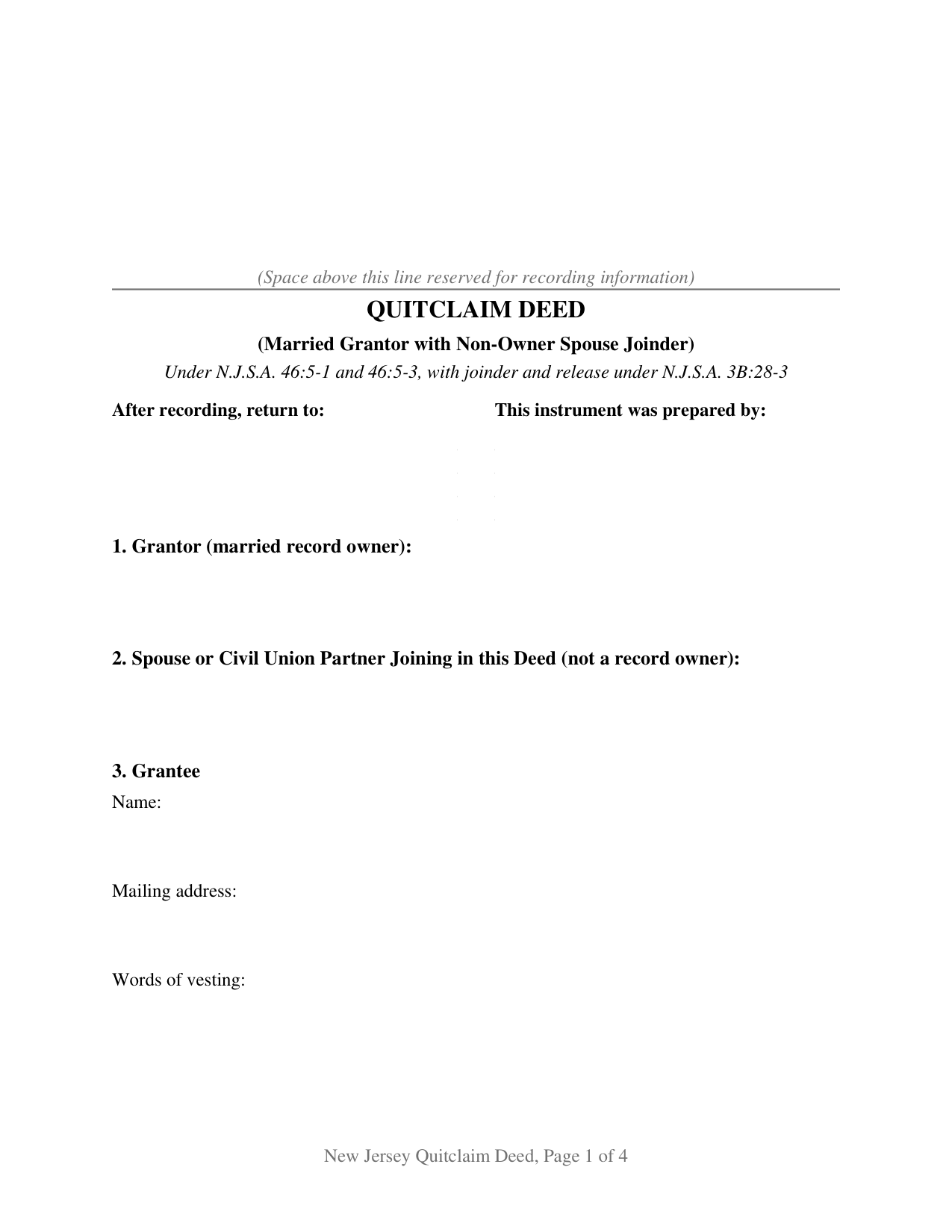
About the New Jersey Quitclaim Deed (Married Grantor with Non-Owner Spouse Joinder)
How to Use This Form
- Select your county from the list
- Download the county-specific form
- Fill in the required information
- Have the document notarized if required
- Record with your county recorder's office
What Others Like You Are Saying
"Down to the point,covers every angle with great tips:Don't forget Probate."
"Had the correct forms I needed with guides and examples to follow on filling them out. Very easy to …"
"Outstanding service! So efficient and easy! Within 2 hours my document was reviewed, invoiced and fo…"
"Excellent service, easy to follow instructions."
"Easy and informative site. Helped me figure out what I was looking for."
4.8/5 from 4,832 reviews. Read all
One name on the record title, two signatures on the deed. This New Jersey quitclaim deed is built for a married record owner who conveys alone, joined in the same instrument by a spouse or civil union partner who holds no ownership interest and who signs for one purpose: to release the statutory right of joint possession in the home the couple occupies. The deed does two jobs, a conveyance and a release, and says which signature does which.
The Marital Right That Never Reaches the Title
New Jersey retired dower and curtesy going forward in N.J.S.A. 3B:28-2, for marriages and ownership arising on or after May 28, 1980, and put something narrower in their place. N.J.S.A. 3B:28-3 entitles a married individual, during life, to joint possession with the spouse of real property the two of them occupy jointly as their principal matrimonial residence. The same subsection states the consequence: a person taking an estate or interest from an owner whose spouse holds that possessory right takes subject to it, unless the right has been released, extinguished, or subordinated by that spouse, or terminated by a court. Nothing in the chain of title announces the right: it rides on occupancy and marriage rather than on the deed index.
What the Joining Signature Actually Does
Subsection b. of the same statute supplies the cure, and it is deliberately broad: the right of joint possession may be released, subordinated, or extinguished by either spouse by premarital agreement, separation agreement, or other written instrument. A deed the non-owner spouse signs for that purpose is such an instrument, and the joinder section of this form states the release in those words, naming N.J.S.A. 3B:28-3 and adding any dower or curtesy preserved by N.J.S.A. 3B:28-1 for pre-1980 interests. The same section fences the signature in: the joining party conveys no ownership interest, takes no consideration, makes no covenant, and gives up no elective share, equitable distribution, or support right. Civil union partners hold identical rights under N.J.S.A. 37:1-31 and 37:1-32, so every party block and certificate names a spouse or civil union partner.
A Release of Interest, Not a Promise of Title
The conveyance itself is a quitclaim, with the effect New Jersey gives those words. N.J.S.A. 46:5-1 treats remise, release, and forever quitclaim as words of conveyance, and N.J.S.A. 46:5-3 measures how far they reach: without a reservation, they carry whatever estate the grantor could lawfully pass by a deed of bargain and sale, and they raise no covenant that the grantor held title at all. The statutory covenant phrases that would supply assurance, seisin through general warranty in N.J.S.A. 46:4-3 through 46:4-10, are absent by design, and the deed prints that fact in capitals.
One Grantor Entry, One Joining Party Entry
The architecture follows the split. The form provides a single grantor block for the record owner, a separate block identifying the spouse or civil union partner who is not on title, a grantee block with a mailing address and words of vesting, and two acknowledgment certificates, one per signer, so the two may appear before a notarial officer on different days or in different states. Record title standing in one spouse's name alone is the ordinary setting: a house inherited from a parent, a property bought before the marriage or civil union, a parcel titled in one name at closing. A deed following an earlier conveyance the non-owner spouse did not sign presents the same configuration. What this form is not set up as is a deed from two record owners, or one whose grantee takes in a fiduciary capacity.
What Travels With the Deed to the County
A New Jersey deed reaches the record as a package. The consideration is stated in the deed or by annexed affidavit under N.J.S.A. 46:15-6, and Form RTF-1 carries any Realty Transfer Fee exemption, commonly the one for consideration under a hundred dollars or a transfer not made in connection with a sale. The county cannot accept the deed without the applicable GIT/REP seller form, and it indexes from a cover sheet or electronic synopsis. Recording promptly is what protects the grantee under N.J.S.A. 46:26A-12.
The download contains the blank fillable deed, a completed example worked through a Monmouth County family transfer, and a plain-language guide covering every numbered section, the marital property statutes behind the joinder, the notarization rules, and the filings a county collects at recording. The materials are informational and are not legal advice.
Important: County-Specific Forms
Our quitclaim deed (married grantor with non-owner spouse joinder) forms are specifically formatted for each of the 21 counties in New Jersey.
After selecting your county, you'll receive forms that meet all local recording requirements, ensuring your documents will be accepted without delays or rejection fees.