New Jersey Quitclaim Deed (Individual)
County Specific Legal Forms Validated as recently as September 23, 2026 by our Forms Development Team
About the New Jersey Quitclaim Deed (Individual)
How to Use This Form
- Select your county from the list
- Download the county-specific form
- Fill in the required information
- Have the document notarized if required
- Record with your county recorder's office
What Others Like You Are Saying
"I really appreciated Deeds.com. It was quick and easy to use. Saved me substantial time completing m…"
"Excellent! I was worried because I saw some negative reviews online but I really needed an e-recordi…"
"Arrived at your site from my county's government site. Saw that all the forms I think I need were in…"
"So far so good. It was reasonably easy to download and complete the form using information found in …"
"The Deeds.com site made is relatively simple to download a Beneficiary Deed form specific to St Loui…"
4.8/5 from 4,824 reviews. Read all
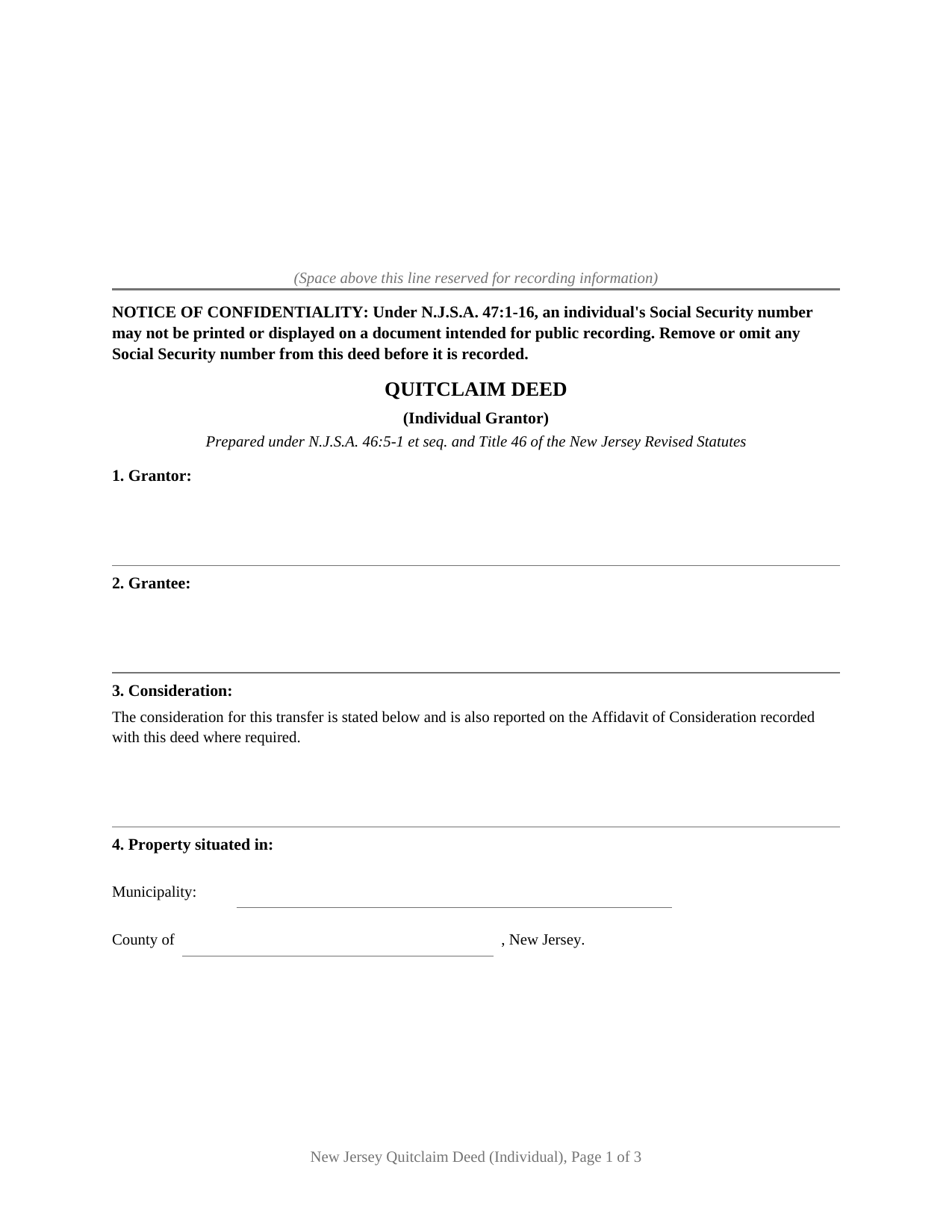
One owner, one signature, one deed. This form prepares a New Jersey quitclaim deed for a single individual grantor: a person who conveys to the grantee whatever interest the grantor holds in the property, under N.J.S.A. 46:5-1, with no covenant of title standing behind the transfer. The form is the deed; the interest passes on delivery, and the no-warranty character is stated plainly on the face of the instrument so neither party mistakes it for something else.
What a Release Conveys
New Jersey describes the quitclaim conveyance in N.J.S.A. 46:5-1 through 46:5-8. The statute recognizes the words remise, release, and forever quitclaim as words of release, and N.J.S.A. 46:5-3 supplies the legal effect: a quitclaim made without a reservation in favor of the grantor passes all the estate the grantor could lawfully convey by deed of bargain and sale, and the grantee is presumed a bona fide purchaser to the same extent. The grantor passes the interest actually held. If that interest is full ownership, full ownership passes; if it is a fractional or uncertain interest, that is what the grantee receives.
The Covenants That Are Missing
New Jersey gives short covenant phrases real legal weight in N.J.S.A. 46:4-3 through 46:4-10. A deed reciting that the grantor has done no act to encumber the lands carries the covenant against the grantor's acts, the operative covenant in the common bargain and sale deed with covenant. A deed reciting that the grantor will warrant generally carries a full warranty of title. A quitclaim deed recites none of them. Because it warrants nothing, the grantee gains no contract claim against the grantor if the title later proves flawed, and the grantee takes the property subject to every mortgage, lien, easement, and other matter already affecting it.
Where the Quitclaim Deed Fits in New Jersey
The form provides for a single individual grantor, whether a sole owner or a co-owner releasing one undivided share. Quitclaim deeds appear most where the grantor and grantee already understand the title and accept it as it stands: a transfer between former spouses or civil union partners under a divorce or dissolution settlement, a change in who is named on title within a family, a move of property into or out of a revocable trust, the release of a possible or uncertain interest, and a deed correcting an earlier one. A purchaser paying full value at arm's length generally receives a deed with covenants instead, and the guide names the bargain and sale, general warranty, and special warranty companions for those situations.
A Present Transfer, Not a Death Plan
A quitclaim deed releases the grantor's interest now, on delivery, not at the grantor's death. New Jersey has no transfer on death deed or beneficiary deed for real property, so an owner planning for death works through a will, a trust, or a survivorship vesting rather than this deed. Where co-owners take title together, the words after their names control the result: survivorship language creates a joint tenancy under N.J.S.A. 46:3-17.1, and a married couple or civil union partners designated as such take as tenants by the entirety under N.J.S.A. 46:3-17.2.
Signing and Recording
The grantor signs before a notary public or other officer authorized under N.J.S.A. 46:14-6.1, and New Jersey also allows acknowledgment by a remotely located individual through communication technology. To be recordable, a deed conveying title carries the names printed beneath the signatures, the grantee's mailing address, the lot and block or a statement that none is assigned, and the name of the person who prepared it, all under N.J.S.A. 46:26A-3. The county indexes the deed from a cover sheet or electronic synopsis, collects the Realty Transfer Fee with the Affidavit of Consideration where it applies, and accepts the deed only with the seller residency GIT/REP form. Recording matters for another reason: under the race-notice rule of N.J.S.A. 46:26A-12, a later purchaser for value without notice who records first can defeat an unrecorded deed, so a quitclaim grantee records promptly.
This package includes the quitclaim deed as a fillable PDF, a completed example filled in for a realistic Essex County transfer, and a plain language guide that walks through every numbered section, the signing and notarization rules, and the Realty Transfer Fee, GIT/REP, and cover sheet documents that accompany the deed at recording. The materials are informational and are not legal advice.
Important: County-Specific Forms
Our quitclaim deed (individual) forms are specifically formatted for each of the 21 counties in New Jersey.
After selecting your county, you'll receive forms that meet all local recording requirements, ensuring your documents will be accepted without delays or rejection fees.