Ohio Quitclaim Deed (Married Couple as Grantors)
County Specific Legal Forms Validated as recently as October 5, 2026 by our Forms Development Team
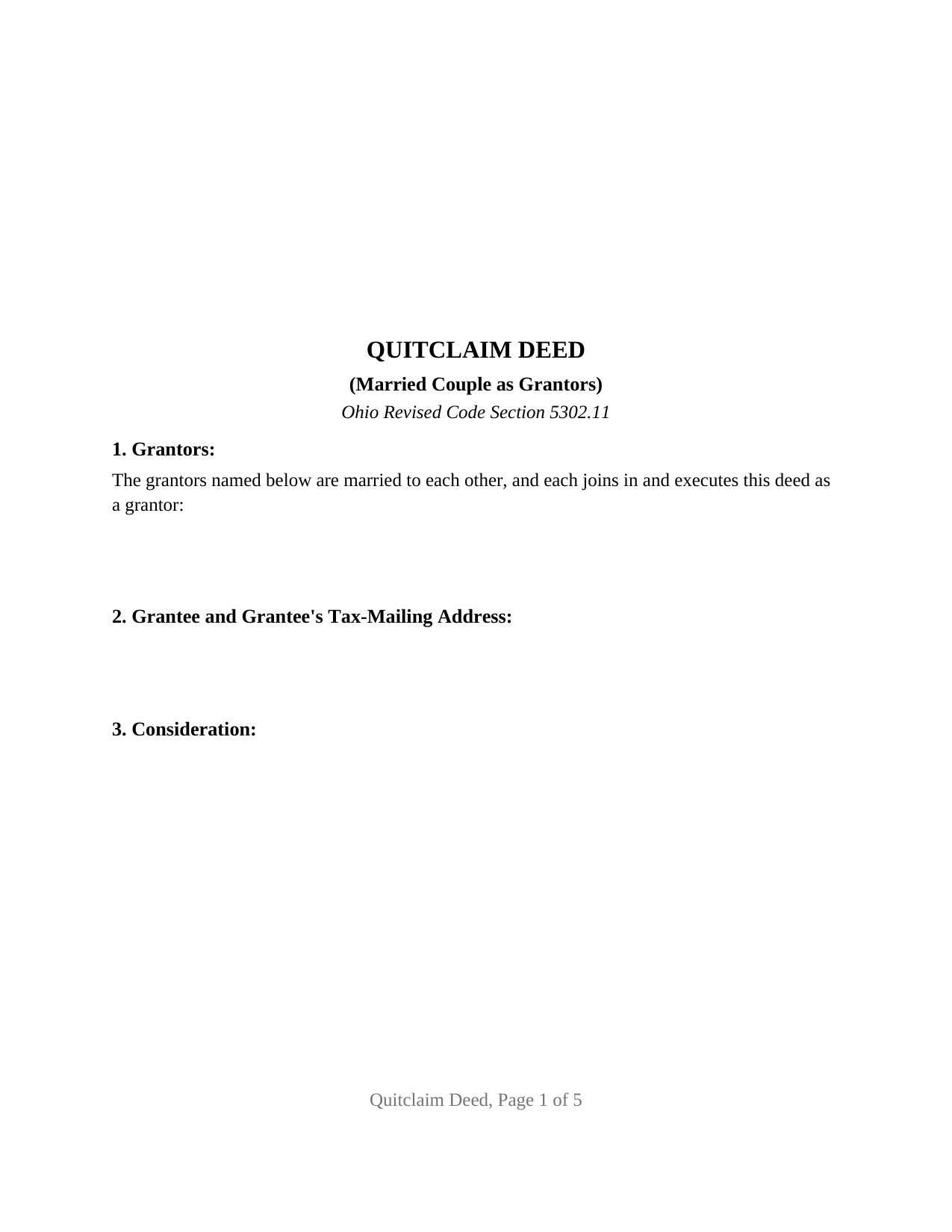
About the Ohio Quitclaim Deed (Married Couple as Grantors)
How to Use This Form
- Select your county from the list
- Download the county-specific form
- Fill in the required information
- Have the document notarized if required
- Record with your county recorder's office
What Others Like You Are Saying
"Very easy to use, found the forms I needed right away. Downloaded and paid for within minutes! Excel…"
"Comforting that you include an example of a completed TOD Deed form. Just downloaded all forms for m…"
"Deeds.com made a very difficult time in our lives much easier to deal with. So happy that we found t…"
"Great service and documents that solved my legal issues I was frustrated with my inability to safe m…"
"So far this looks like exactly what I need and at a reasonable price. Glad it was so easy to find on…"
4.8/5 from 4,828 reviews. Read all
Ohio still recognizes dower, and a deed from a married couple answers the dower question twice. This quitclaim deed form is arranged for exactly that execution: two grantors who are married to each other convey Ohio real property together under Ohio Revised Code Section 5302.11, and each spouse's signature does double duty, conveying that spouse's own interest and releasing dower in the interest the other spouse conveys.
Two signatures, each doing double work
Section 2103.02 of the Revised Code gives each spouse a life estate in one third of the real property of which the other spouse holds an estate of inheritance during the marriage, and Section 5301.04 folds a married owner's conveyance into the ordinary signing and acknowledgment rules. On a deed whose two grantors are married to each other, that statutory picture collapses into something simple: the release of dower needs no third signer, no separate spouse signature line, and no extra certificate, because everyone whose dower could attach is already a grantor. The deed recites the marriage once and releases dower in both directions in a single sentence, the arrangement county transfer offices expect when a couple conveys together; Montgomery County's transfer checklist, for one, expressly asks after the grantor's marital status and the spouse's dower release on the face of a deed.
A quitclaim's reach when a couple conveys
The operative words stay statutory: for valuable consideration paid, the grantors grant to the grantee, whose tax-mailing address follows the name. A deed in substance following Section 5302.11 takes effect as a deed in fee simple but without covenants of any kind, so the grantee receives whatever the couple holds, however the couple holds it, whether the spouses took title as survivorship tenants, as tenants in common, or with record title standing in one name and dower attaching in the other. Spouses conveying a strip of their lot to the adjoining owner after a lot line survey, and a couple deeding unimproved acreage to a relative in a transfer the auditor treats as an exempt gift, present the married couple record this deed recites; the same instrument answers searches for a quit claim deed or the hyphenated quit-claim spelling. A sole grantor's deed, and deeds by co-owners with no marriage between them, follow other execution patterns.
Entries the transfer counter reads first
An Ohio deed earns recording in two stops, and this form carries the entry each stop reads. For the county auditor there are the tax-mailing address of the grantee and the reference to the prior recorded instrument, both under Section 319.20, plus a parcel number line and a consideration entry; the conveyance fee statement, DTE 100, or the exemption statement, DTE 100EX, travels alongside, and Section 317.22 holds the deed out of the record until the auditor's stamp appears on it. For the recorder, the page layout tracks the Section 317.114 standard document format, and the Section 5301.25(B) survey sentence has its own line for a conveyance following a fresh boundary survey. A printed name sits beneath each signature per Section 317.11, and the preparer statement of Section 317.111 closes the final page.
Notarization on the couple's schedule
Both spouses sign before a notary public or another officer Section 5301.01 authorizes, with no subscribing witnesses anywhere on the deed. The form carries an acknowledgment certificate for each grantor, so a couple may acknowledge at one sitting or separately, one spouse signing before a different notary in a different state while the other signs at home. Ohio permits a single certificate to name both signers; the per-grantor certificate layout is the form's own accommodation for signatures gathered apart, and Ohio's online notarization statutes, Sections 147.60 through 147.66, reach a deed like this one as well.
What arrives with the purchase
The download contains the married couple Ohio quitclaim deed as a fillable PDF, a completed example presenting a Hamilton County conveyance by two spouses to their adult daughter, and a plain language guide walking the numbered sections, the dower release mechanics, the forms in which grantees may take Ohio title, and the auditor and recorder steps in order. The materials describe this form and Ohio law in general terms and are not legal advice.
Important: County-Specific Forms
Our quitclaim deed (married couple as grantors) forms are specifically formatted for each of the 88 counties in Ohio.
After selecting your county, you'll receive forms that meet all local recording requirements, ensuring your documents will be accepted without delays or rejection fees.