Ohio Quitclaim Deed (Trustee Grantor)
County Specific Legal Forms Validated as recently as October 19, 2026 by our Forms Development Team
About the Ohio Quitclaim Deed (Trustee Grantor)
How to Use This Form
- Select your county from the list
- Download the county-specific form
- Fill in the required information
- Have the document notarized if required
- Record with your county recorder's office
What Others Like You Are Saying
"I'm not certain yet that this is all I need to do what I need to do. Marion Co. Clerk's office has n…"
"Seems easy enough, may have downloaded forms I don't need, however I'm hoping that these are the onl…"
"Everything that was stated to be included in my order was complete. Very satisfied"
"Record retrieval by staff is very prompt!!! Great customer service for sure!"
"It took me a while to locate my documents. Check out was a breeze."
4.8/5 from 4,828 reviews. Read all
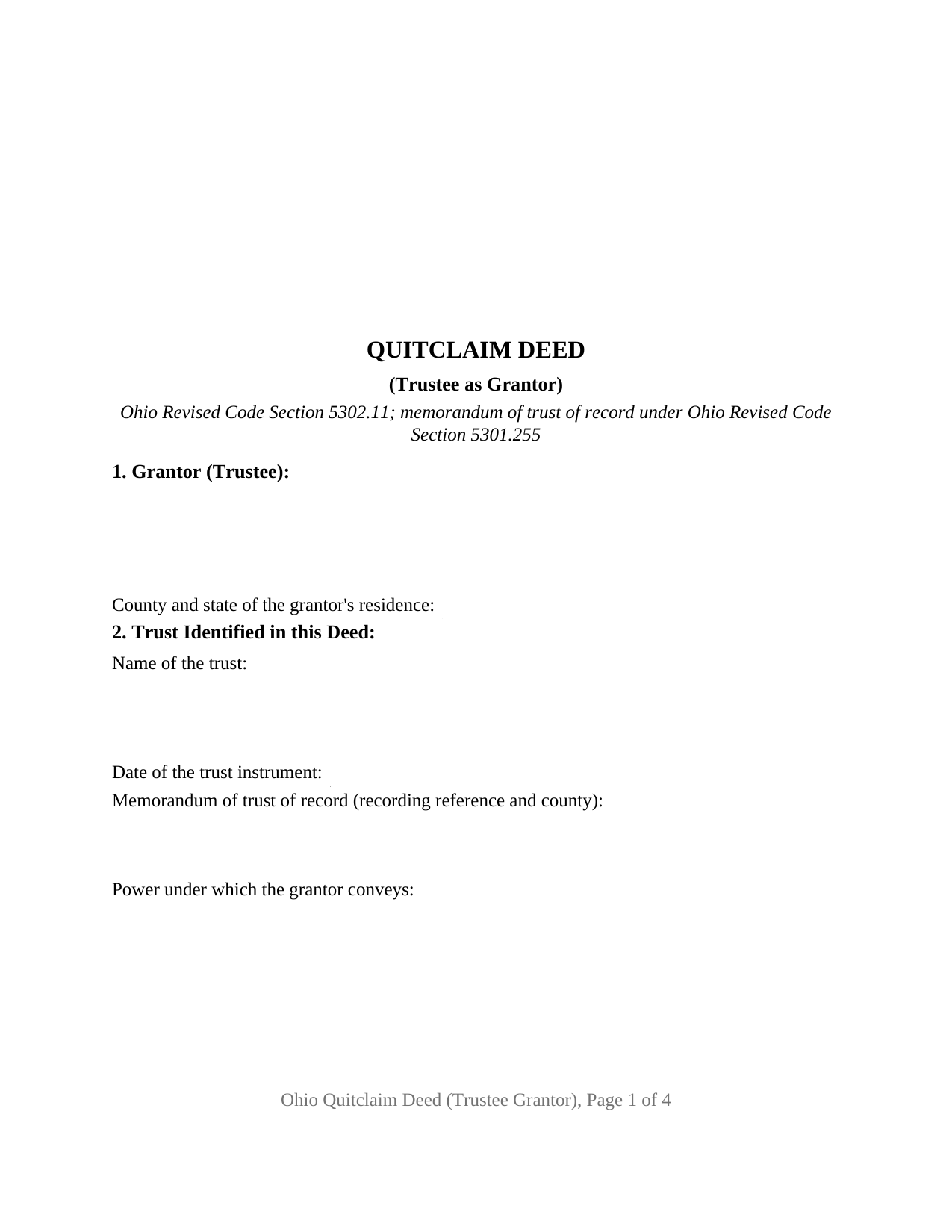
When an Ohio trustee conveys trust real property, the public record has to carry the trust's own paperwork alongside the deed. Ohio Revised Code Section 5301.255, as amended effective June 16, 2026, has a memorandum of trust or other qualifying instrument of record when any interest in real property is conveyed by the trustee of a disclosed trust. This quitclaim deed form is built around that sequence: one trustee grants Ohio real property under Section 5302.11, and the grantor side names the trust, its date, the power relied on, and where the memorandum is recorded.
The entry that answers Section 5301.255
A trust holds no title of its own in Ohio; a trustee does. So Section 2 asks for four entries: the name of the trust, the date of the trust instrument, the source of the trustee's power to convey, and the recording reference of the memorandum. That memorandum is signed and acknowledged by the trustee, states the trust's execution date and the trustee's powers over the sale, encumbering, and conveyance of real property, and gives notice only of what it contains; it is recorded on its own, apart from this package. Ohio Title Standard 3.18 treats a disclosed trust with nothing of record as a title objection, so the reference printed here is what a later examiner reads first.
A trustee's deed that promises nothing
Ohio prints two deeds a trustee may sign, and they differ on covenants. The fiduciary form in Section 5302.09 uses the words grants, with fiduciary covenants, which Section 5302.10 turns into promises that the grantor is duly appointed, is authorized to make the conveyance, and has complied with the governing statutes. A deed following Section 5302.11 takes effect in fee simple without covenants of any kind, and Section 5302.03 confirms that the word grant implies none. This form recites that no fiduciary covenants within the meaning of Section 5302.10 arise from it. A buyer searching for a quit claim deed, for the hyphenated quit-claim spelling Ohio's code prints, or for a trustee deed moving property out of a living trust arrives at this one.
One trustee, signing in a capacity
The form recites exactly one grantor, and every entry beneath the conveyance belongs to that trustee and the notarial officer: one signature block, one printed name line per Section 317.11, and one acknowledgment certificate. Section 1 takes the trustee's name with the signing capacity, and Section 9 grants solely as trustee of the trust identified in Section 2 and not individually. No marital status entry and no dower release block appear, following the shape of the statutory fiduciary deed, which prints neither. A successor trustee distributing a parcel to the beneficiaries after the settlor's death, a trustee conveying property back to a settlor exercising a reserved power to revoke, and a trustee selling a surveyed tract out of a larger trust holding present the record this deed recites. Two co-trustees signing together take two signature blocks, and an owner conveying property titled in an individual name signs the ordinary form with its marital status line.
Two exemption items that point outward
A trustee's deed meets the county auditor first, and the fee schedule treats a conveyance out of a trust on its own terms. Section 319.54(G)(3) charges ten cents per hundred dollars of value, never under a dollar, and form DTE 100EX lists the exemptions: item (u) reaches a transfer back to the grantor of a trust made under the power to revoke it, and item (v) reaches a transfer to the beneficiaries where the fee was paid going in or the trust provisions became irrevocable at the grantor's death. A sale to a third party sits outside both, and the auditor may ask for trust documents before allowing one. Section 317.22 holds the deed out of the record until the auditor's stamp and transfer endorsement appear.
The page geometry answers Section 317.114, from the three inch recording reserve atop page one to the print size floor, and Sections 319.20 and 317.111 account for the grantee tax-mailing address, the prior instrument reference, and the preparer name. The download holds three files: the deed as a fillable PDF, a completed example worked through a Licking County distribution of trust real property, and a plain language guide covering the numbered sections, the trust and execution statutes, the ways an Ohio grantee may hold title, and the route from the auditor's window to the recorder's file number. The materials are informational and are not legal advice.
Important: County-Specific Forms
Our quitclaim deed (trustee grantor) forms are specifically formatted for each of the 88 counties in Ohio.
After selecting your county, you'll receive forms that meet all local recording requirements, ensuring your documents will be accepted without delays or rejection fees.