Ohio Quitclaim Deed (Trustee Grantee)
County Specific Legal Forms Validated as recently as October 8, 2026 by our Forms Development Team
About the Ohio Quitclaim Deed (Trustee Grantee)
How to Use This Form
- Select your county from the list
- Download the county-specific form
- Fill in the required information
- Have the document notarized if required
- Record with your county recorder's office
What Others Like You Are Saying
"fast and easy."
"wonderful service, docs recorded with no issues."
"This is fast and easy."
"So quick and easy! No searching for a parking place or waiting in line. Thank you!"
"All is well that ends well and this form service seemed to work quite smoothly, even though my print…"
4.8/5 from 4,828 reviews. Read all
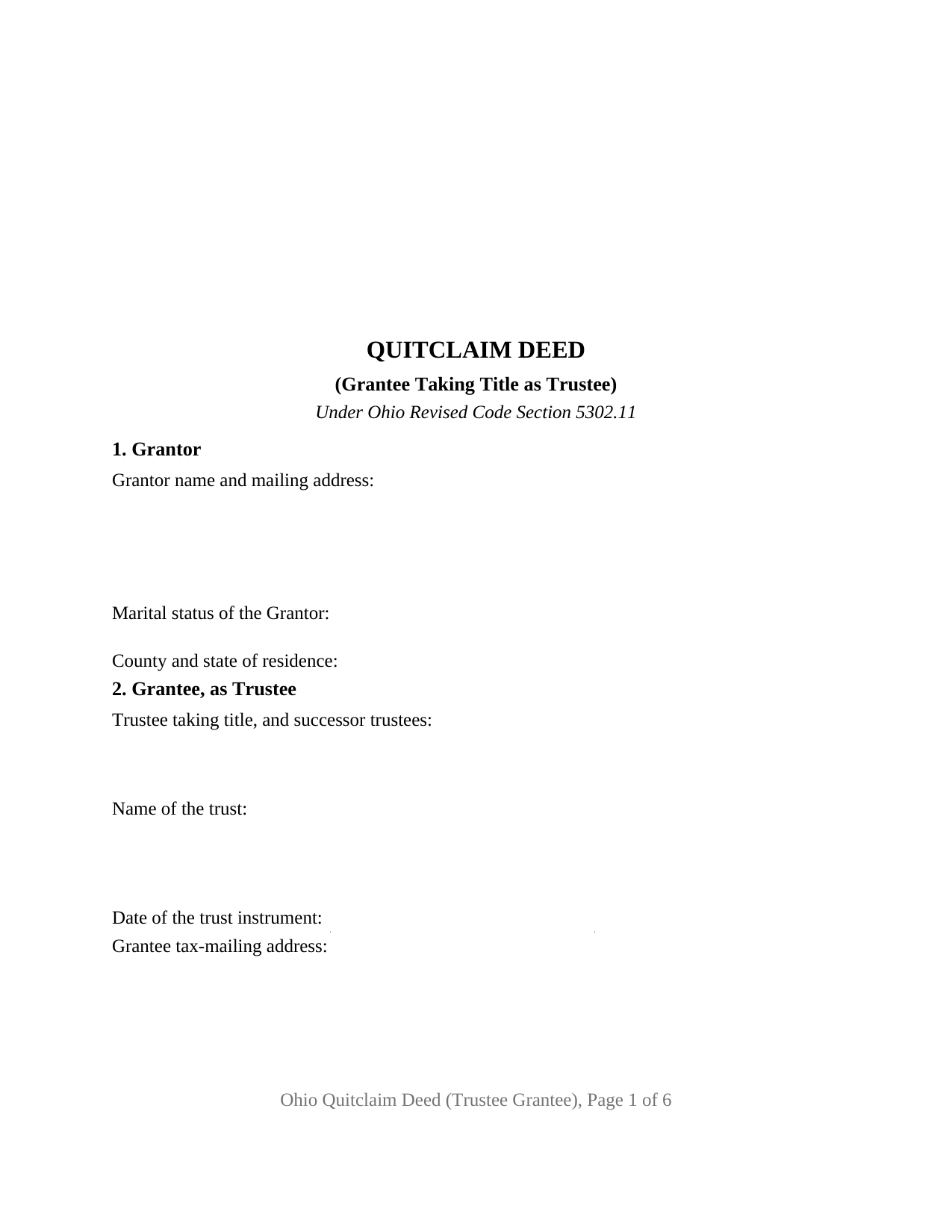
Ohio real property is not titled in a trust. It is titled in the trustee of one, and a deed saying so on its face saves the next title examiner a phone call. This quitclaim deed form is arranged around that point: one grantor signs, the parcel moves under Ohio Revised Code Section 5302.11 to a grantee taking as trustee, and the grantee section asks for three entries, the trustee taking title, the name of the trust, and the date of the trust instrument.
Where the trustee designation lands in the record
Section 5301.03 of the Revised Code, captioned grantee as trustee or agent, is why those three entries matter. The words trustee, as trustee, or agent after a grantee's name, standing alone with no other language showing a trust and no recorded instrument showing its terms, give no notice to anyone dealing with the land that a trust exists or that limits sit on the grantee's power to convey. Naming the trust and its date turns a bare designation into a disclosed one. Section 5301.071(E) answers the opposite drafting habit: a deed naming the trust itself rather than its trustee is treated as a conveyance to the trustee, provided the trust was duly created and a memorandum of trust complying with Section 5301.255 and describing the property is recorded in the same county.
A deed the statute strips of promises
The operative language stays statutory. Under Section 5302.11 a deed in substance following Ohio's quit-claim form takes effect in fee simple but without covenants of any kind, and Section 5302.03 confirms that the word grant implies none. Whatever the grantor holds is what arrives: moving a parcel to a trustee changes the name on the tax duplicate, not the mortgage lien or the easement under it. Searches for a quit claim deed, the hyphenated quit-claim spelling the Revised Code prints, or a deed transferring a house into a living trust reach this instrument.
One grantor, one trustee, and the dower line underneath
The form recites exactly one individual grantor, with a marital status entry and a numbered release of dower carrying its own signature block and certificate: Section 2103.02 still gives a spouse a one third life estate in property the other spouse was seized of during the marriage, and a transfer into a trustee's name is an ordinary lifetime conveyance for that purpose. An owner who set up a revocable living trust years after buying the house and now moves the parcel into the trustee's name, and an owner making a completed gift to the trustee of an irrevocable trust, present the record this deed recites. Its edges follow from its entries. A deed signed by two or more record owners takes a different signature arrangement, and a deed made by a trustee rather than to one is a fiduciary conveyance under Section 5302.09, the point at which Section 5301.255 requires a memorandum of trust to be of record. That memorandum is executed and acknowledged by the trustee, recorded on its own, and not part of this package.
The trust line on the auditor's exemption list
Every Ohio deed clears the county auditor before the recorder sees it, and trust transfers have their own entry in the fee schedule. Section 319.54(G)(3)(t) exempts a conveyance to a trustee of a trust when the grantor of the trust reserved an unlimited power to revoke it, and form DTE 100EX carries that language as item (t); a transfer to the trustee of an irrevocable trust sits outside it and answers to the ten cents per hundred dollars fee, plus any county transfer tax under Chapter 322. Those auditor filings are prepared separately from the deed. Section 317.22 then holds the instrument out of the record until the auditor's stamp and transfer endorsement appear.
What the download holds
The page layout answers Section 317.114, keeping the endorsement space clear atop page one, while Section 319.20 accounts for the grantee tax-mailing address and the prior instrument reference, and Section 317.111 for the preparer statement. The purchase delivers three files: the Ohio quitclaim deed to a trustee grantee as a fillable PDF, a completed example worked through a Delaware County transfer into a revocable living trust, and a plain language guide covering each numbered section, the trustee and memorandum of trust statutes, the ways an Ohio grantee may hold title, and the auditor and recorder steps. The materials describe Ohio law and this form in general terms; they are not legal advice.
Important: County-Specific Forms
Our quitclaim deed (trustee grantee) forms are specifically formatted for each of the 88 counties in Ohio.
After selecting your county, you'll receive forms that meet all local recording requirements, ensuring your documents will be accepted without delays or rejection fees.