Ohio Quitclaim Deed (Married Grantor with Non-Owner Spouse Joinder)
County Specific Legal Forms Validated as recently as October 9, 2026 by our Forms Development Team
About the Ohio Quitclaim Deed (Married Grantor with Non-Owner Spouse Joinder)
How to Use This Form
- Select your county from the list
- Download the county-specific form
- Fill in the required information
- Have the document notarized if required
- Record with your county recorder's office
What Others Like You Are Saying
"Found this site very easy to navigate and customer service very supportive and quickly answers any q…"
"Once I found this site the rest was easy. I read through the guide but the example really helped the…"
"Very convenient and quick. I will definitely use it again."
"The form cost was reasonable - it helped me organize my thoughts and write things down to help minim…"
"It was quick and easy to download the forms I need to modify a property deed. No problems n the leas…"
4.8/5 from 4,828 reviews. Read all
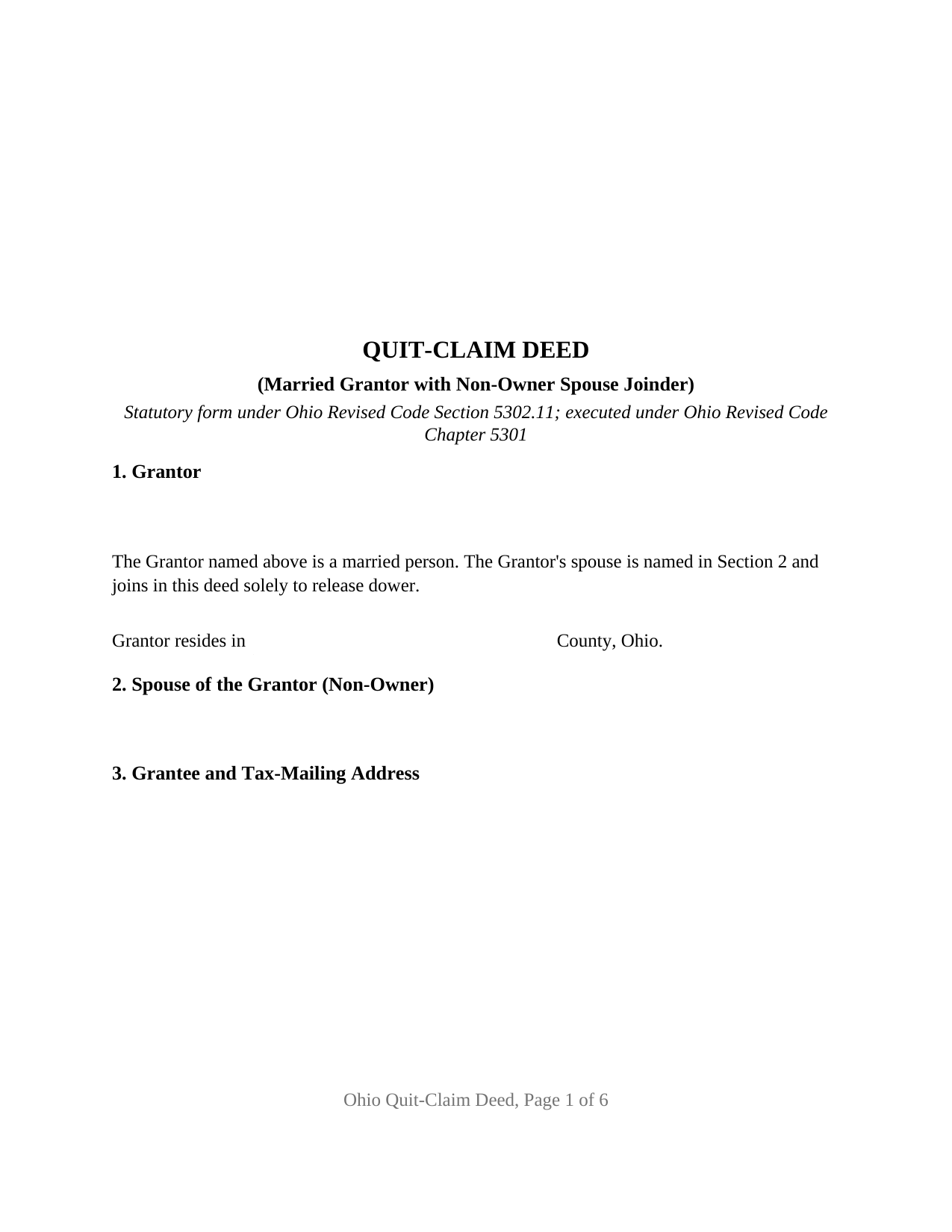
A married Ohio owner whose spouse appears nowhere in the chain of title still has a second signature to gather. This quitclaim deed form is arranged for that record: one grantor, married, conveying Ohio real property under Ohio Revised Code Section 5302.11, with a numbered joinder section where the non-owner spouse signs for one purpose only, releasing dower, and takes on none of a grantor's obligations.
The signature that transfers nothing
Dower is why Ohio deeds ask about marriage. Section 2103.02 of the Revised Code endows a spouse who has not relinquished or been barred from it with a life estate in one third of the real property of which the other spouse was seized as an estate of inheritance during the marriage. The interest attaches to a parcel titled in one name alone, including one bought years before the wedding, and no index carries it under the spouse's name. Section 5301.04 puts a married person's conveyance under the signing and acknowledgment rules of Section 5301.01, and the statutory quit-claim form answers dower in one sentence: the named spouse of the grantor releases all rights of dower therein. Here that sentence occupies its own numbered section, backed by a signature block and certificate, and the deed adds that the spouse holds no record title, conveys no ownership interest, and signs solely to release dower.
One married grantor, and what the deed passes
The operative words stay statutory: for valuable consideration paid, the grantor grants to the grantee, whose tax-mailing address follows the name. Section 5302.03 confirms that no covenant is implied from the word grant, and Section 5302.11 gives a deed following the statutory form the force of a fee simple conveyance without covenants of any kind, so the grantee takes the grantor's interest as it stands. An owner who took title before the marriage deeding a parcel to an adult child, an owner passing land received through a certificate of transfer to a sibling, and an owner moving a separately titled rental into an entity all present the married sole owner record this deed recites; searches for a quit claim deed, the hyphenated quit-claim spelling Ohio's code uses, or a spousal dower release land on the same instrument. The form recites exactly one record owner; a deed signed by two or more owners carries a different arrangement.
Where a joinder shows up at the counter
Ohio deeds clear two county offices, and a joinder matters at the first. Montgomery County's document preparation checklist, for one, asks after the grantor's marital status and the spouse's dower release on the face of a deed. The auditor takes the conveyance fee statement, DTE 100, or the exemption statement, DTE 100EX, under Section 319.202, collects the state conveyance fee and any county transfer tax levied under Chapter 322, and endorses the transfer using the grantee tax-mailing address and prior instrument reference Section 319.20 requires. Only then may the recorder take it: Section 317.22 holds a deed of absolute conveyance out of the record until the auditor's stamp and endorsement appear on it, legibly.
Two signers, two schedules
Each signature is acknowledged before a notary public or another officer named in Section 5301.01, and no subscribing witnesses appear on an Ohio deed. Because a grantor and a joining spouse do not always sign in the same room, each gets a certificate carrying the venue, date, notary printed name, and commission expiration that Section 147.542 lists as certificate content. Ohio law does not require separate certificates; one certificate naming everyone who appeared before the officer satisfies the statute, so the per-signer layout is this form's own accommodation. Sections 147.60 through 147.66 reach this deed through online notarization.
Page geometry, and what the download holds
The layout follows the standard document format of Section 317.114: three blank inches atop page one for recording endorsements, an inch at the sides and bottom, an inch and a half atop later pages, and type above the statutory 10 point floor, keeping the twenty dollar nonstandard format charge out of the arithmetic. The purchase delivers the fillable Ohio quitclaim deed for a married grantor with a non-owner spouse joinder, a completed example worked through a Lorain County transfer whose two acknowledgments fall three days apart, and a plain language guide covering the numbered sections, the dower and execution statutes, the ownership forms an Ohio grantee may take, and the auditor and recorder steps. The materials describe Ohio law and this form in general terms; they are not legal advice.
Important: County-Specific Forms
Our quitclaim deed (married grantor with non-owner spouse joinder) forms are specifically formatted for each of the 88 counties in Ohio.
After selecting your county, you'll receive forms that meet all local recording requirements, ensuring your documents will be accepted without delays or rejection fees.