Ohio Quitclaim Deed (Two Grantors)
County Specific Legal Forms Validated as recently as September 14, 2026 by our Forms Development Team
About the Ohio Quitclaim Deed (Two Grantors)
How to Use This Form
- Select your county from the list
- Download the county-specific form
- Fill in the required information
- Have the document notarized if required
- Record with your county recorder's office
What Others Like You Are Saying
"Needed a Limited Power of Attorney form for a real estate transaction in another state. Proper form …"
"East, fast, reliable. Great service!"
"Clear directions. Giving a sample filled-in set of forms was great! Economical cost. Will refer othe…"
"Very happy, thanks."
"Can you also make a search that includes the parcel number because that is all I had to go with and …"
4.8/5 from 4,828 reviews. Read all
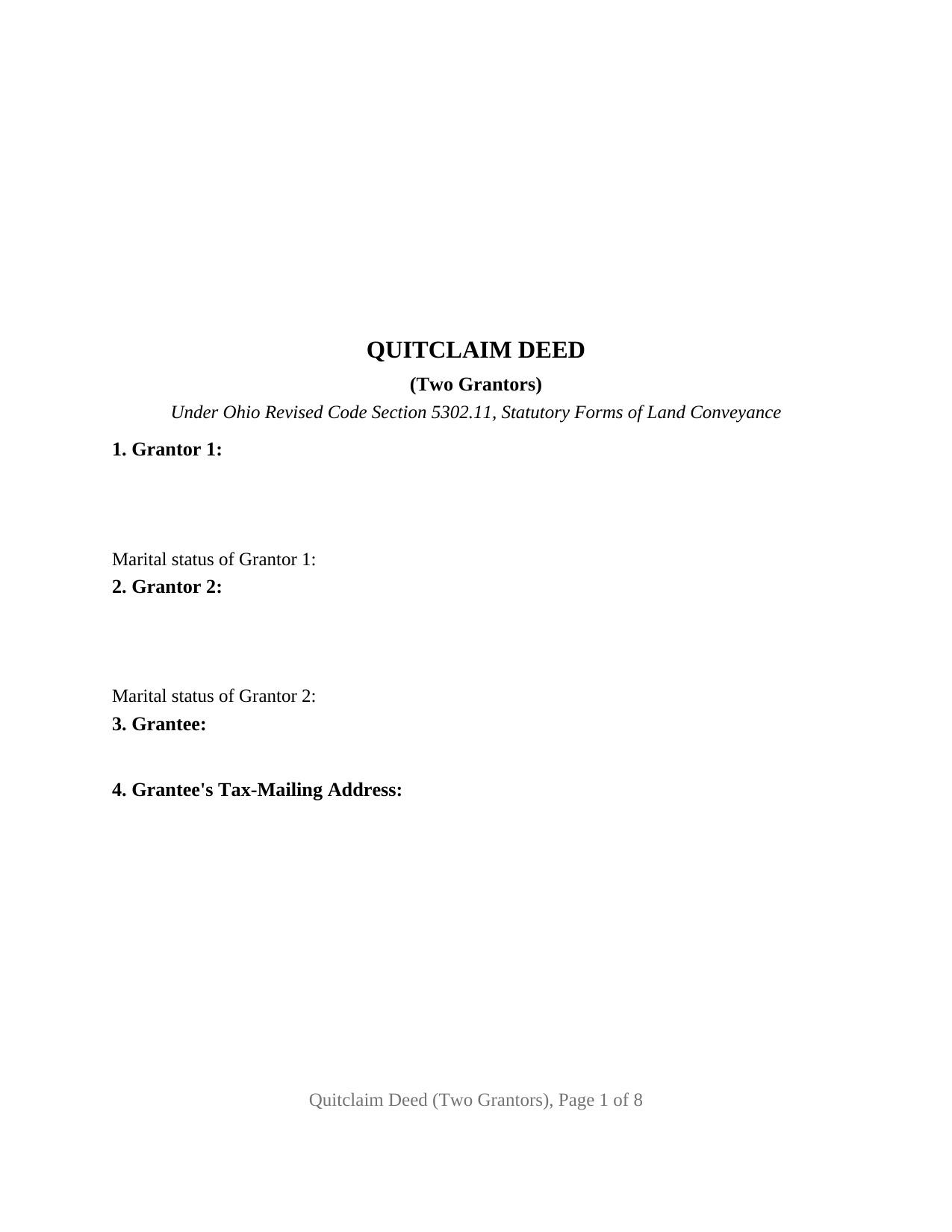
Ohio real property held in two names leaves the record in one instrument when both owners join a single deed. This quitclaim deed form is built for that execution pattern: two grantors conveying together under Ohio Revised Code Section 5302.11, each with a marital status entry, a signature block, and an acknowledgment certificate of their own, plus release of dower entries covering the spouse of either grantor. The grantee takes whatever interest the two grantors hold, without covenants of any kind.
Two grantors, one conveyance
Section 5302.11 supplies Ohio's statutory quitclaim form, and Section 5302.01 lets the statutory forms be altered as circumstances require, which is exactly what a two-owner conveyance calls for. The operative words stay statutory: for valuable consideration paid, the grantors grant to the grantee, and under Section 5302.03 the word grant implies no covenant, so the deed passes each grantor's interest as it stands. Buyers searching for a quit claim deed, or for the hyphenated quit-claim spelling Ohio's code itself uses, find the same instrument under every spelling. Two siblings conveying inherited acreage to a single buyer, co-owners winding up a shared rental, and a couple moving jointly held land into a family trust all present the two-grantor record this deed recites; a sole owner's conveyance, and entity or fiduciary grantors, follow different execution patterns than the two-individual pattern set up here.
Two marital status lines, two dower questions
Because dower survives in Ohio under Section 2103.02 of the Revised Code, a deed with two grantors asks the marital question twice. Each grantor's section carries its own marital status entry, and the release of dower section provides a signature block and a matching certificate for the spouse of each married grantor, who joins under Section 5301.04 to release the statutory life estate in one third of the real property of which a married owner held an estate of inheritance during the marriage. Where a grantor is unmarried, that grantor's spouse blocks simply stay empty. The face of the deed also carries the entries Ohio's transfer statutes expect: the grantee's tax-mailing address and the prior instrument reference under Section 319.20, and the survey statement line of Section 5301.25(B).
Four certificates, gathered on any schedule
Ohio law does not require a separate acknowledgment certificate for each signer; one certificate naming every person who appeared before the officer satisfies Section 147.542. The form nevertheless carries a certificate for each of its four possible signers, two grantors and two releasing spouses, so signatures can be collected on different days, before different notaries, or in different states, a practical matter when co-owners no longer live in the same place. No subscribing witnesses appear anywhere on the deed, Section 5301.01 asking only for signing and acknowledgment, and a printed name line under each signature keeps Section 317.11 satisfied.
Built for the auditor's counter and the recorder's scanner
An Ohio deed earns its auditor stamp before it earns a file number. The county auditor processes the conveyance fee statement, DTE 100, or the DTE 100EX exemption statement under Section 319.54(G)(3), collects the statewide fee of one dollar per thousand dollars of value together with any county transfer tax of up to three dollars per thousand, and endorses the transfer; Section 317.22 holds an unstamped deed of absolute conveyance out of the record. The recorder's charge starts at thirty-four dollars covering two pages, eight dollars each page after, and a handful of counties stack a preservation surcharge of as much as five dollars on top. The document geometry tracks Section 317.114 throughout, from the three inch recording reserve on page one down to the type size floor, so the twenty dollar nonstandard format fee never enters the math.
Inside the package
The download holds three items: the two-grantor Ohio quitclaim deed as a fillable PDF, a completed example recording a Summit County transfer by one married and one unmarried co-owner, and a section-by-section guide covering the entries, the dower release mechanics, the forms of ownership Ohio grantees may take, and the path from auditor to recorder. The materials describe the form and Ohio law generally; they are not legal advice.
Important: County-Specific Forms
Our quitclaim deed (two grantors) forms are specifically formatted for each of the 88 counties in Ohio.
After selecting your county, you'll receive forms that meet all local recording requirements, ensuring your documents will be accepted without delays or rejection fees.