Ohio Quitclaim Deed
County Specific Legal Forms Validated as recently as October 16, 2026 by our Forms Development Team
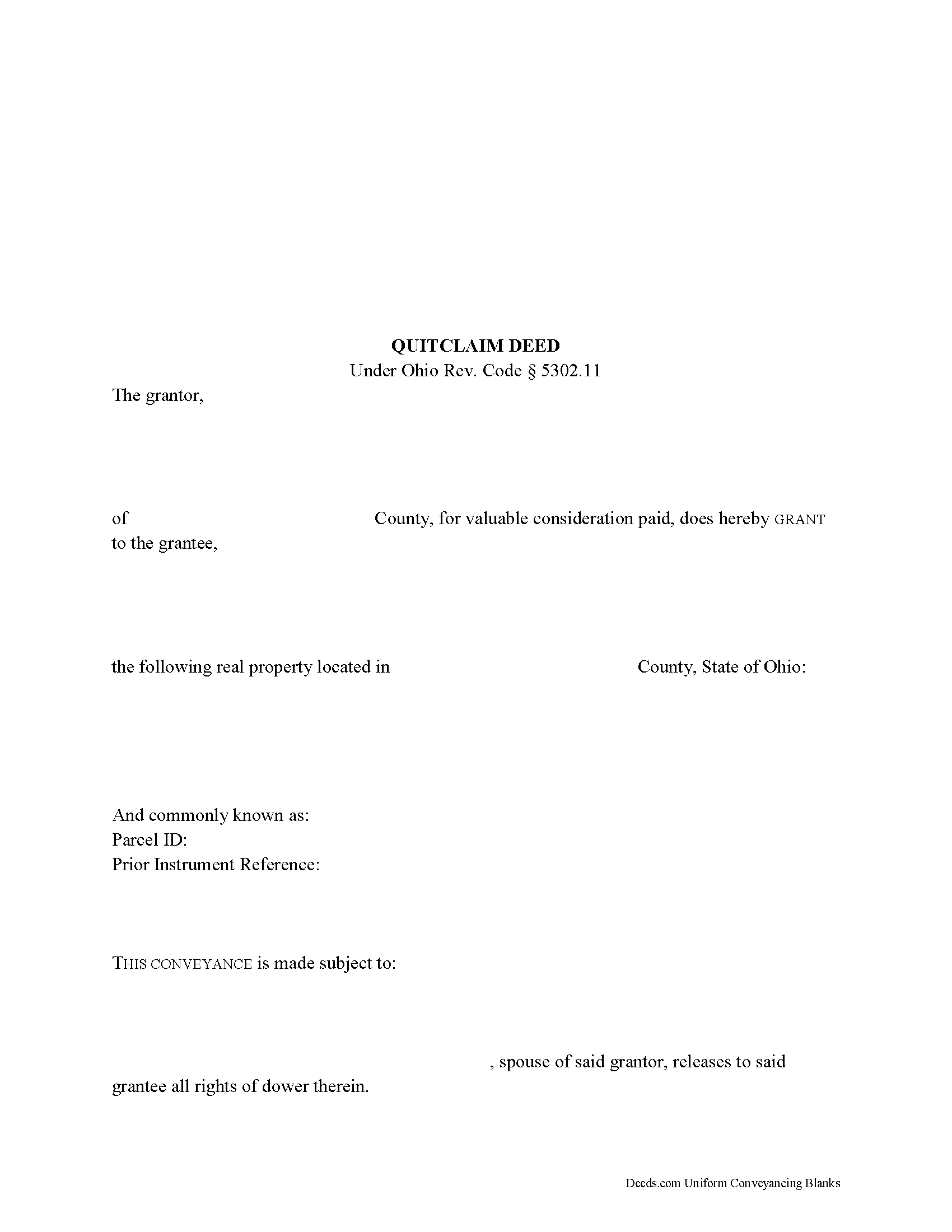
About the Ohio Quitclaim Deed
How to Use This Form
- Select your county from the list
- Download the county-specific form
- Fill in the required information
- Have the document notarized if required
- Record with your county recorder's office
What Others Like You Are Saying
"The form I needed was perfect!"
"Excellent service. Pay your fee, download the form and fill out according to specific instructions. …"
"Great process and very easy to complete"
"if i could give this site ten stars i would"
"This a seamless way to get a beneficiary deed recorded. Everything was easier than I imagined includ…"
4.8/5 from 4,828 reviews. Read all
Ohio prints its deed forms in the Revised Code, and the quit-claim form runs on a single verb: grant. That same verb opens the general warranty form at Section 5302.05 and the limited warranty form at Section 5302.07. What separates the three is the phrase printed after the verb, and Section 5302.11 prints nothing there at all.
One verb, and the words that do not follow it
Section 5302.05 reads grant(s), with general warranty covenants. Section 5302.07 reads grant(s), with limited warranty covenants. Section 5302.11 reads grant(s) to, and stops. Section 5302.03 finishes the thought: grant is a sufficient word of conveyance, and no covenant is implied from using it. So this deed moves a grantor's interest with the force of a fee simple conveyance while promising nothing whatever about that interest, and a grantee steps into the position the record already describes, recorded mortgage and easement included. Section 5302.01 supplies the latitude the rest of the form uses: the Statutory Forms may be altered as circumstances require, and authorizing them does not prevent other forms. Searches for a quit claim deed, for the hyphenated quit-claim spelling the code itself prints, or for an Ohio property transfer without warranty reach this instrument.
Open blanks where a narrower form prints a pattern
This is the base configuration of the Ohio quitclaim line, and its party entries are blanks rather than fixed arrangements. The Grantor entry takes one or two natural persons signing in their own names, with the marital status and county of residence the statutory form calls for. The Grantee entry takes one or two persons and whatever co-ownership words they use: the joint lives and remainder to the survivor phrasing of Section 5302.17, or nothing at all, in which case Section 5302.19 supplies an estate in common. No status, vesting, or capacity language sits preprinted on the face of the deed, so the record says what the parties say. Two signature blocks appear, headed GRANTOR and SECOND GRANTOR, each carrying an acknowledgment certificate of its own; where one grantor conveys, the second block and its certificate stay blank. A conveyance signed for a corporation, a company, a partnership, a trust, or an absent owner under a power of attorney answers to its own authority chapter, and three or more owners on either side outrun the blocks drawn here.
Dower, and the second signature it can produce
Section 2103.02 keeps dower alive in Ohio. A spouse who has not relinquished or been barred from it holds a life estate in one third of the real property the other spouse was seized of as an estate of inheritance at any time during the marriage, and Section 2103.09 abolished curtesy, so the interest now reads identically for both spouses. It attaches to a parcel standing in one name, which is why the statutory quit-claim form ends with a release sentence. Here that release rides inside the operative section and runs from every grantor who signs, so the second signature block does double work on a one-owner conveyance: it takes the signature that clears dower. Where nobody is married, and where two grantors married to each other sign together, the arithmetic closes with no further signer at all.
The auditor endorses before the recorder records
Section 319.202 routes an Ohio deed to the county auditor ahead of the recorder, alongside form DTE 100, or the DTE 100EX exemption statement, filings prepared apart from this package. The auditor charges the conveyance fee of Section 319.54(G)(3), collects any permissive transfer tax a county levies under Chapter 322, reads the grantee tax-mailing address and the prior instrument reference of Section 319.20, and endorses the transfer that Section 317.22 makes a precondition of recording. At the recorder, Sections 317.32 and 317.36 together produce thirty-four dollars covering two pages and eight dollars for each page beyond, with a county preservation surcharge of up to five dollars in some counties. The layout answers the standard document format of Section 317.114, whose three inch reserve tops page one, so the twenty dollar nonstandard charge never attaches.
Three files come with the purchase: this Ohio quitclaim deed as a fillable PDF, a completed example worked through a Delaware County conveyance of surveyed acreage, and a plain language guide to the eleven numbered sections, the execution and dower statutes, the ways Ohio grantees may hold title, and the two county offices in order. Everything here describes Ohio law and this form in general terms and is not legal advice.
Important: County-Specific Forms
Our quitclaim deed forms are specifically formatted for each of the 88 counties in Ohio.
After selecting your county, you'll receive forms that meet all local recording requirements, ensuring your documents will be accepted without delays or rejection fees.