Yamhill County Trustee Deed Form
Last validated September 15, 2026 by our Forms Development TeamFormatted for recording in Yamhill County, for property anywhere in the county: rural and unincorporated areas as well as Amity, Carlton, Dayton, Dundee, Lafayette, Mcminnville, Newberg, Sheridan and 2 more.
- 3 documents included
- Immediate PDF download
- Formatting guarantee
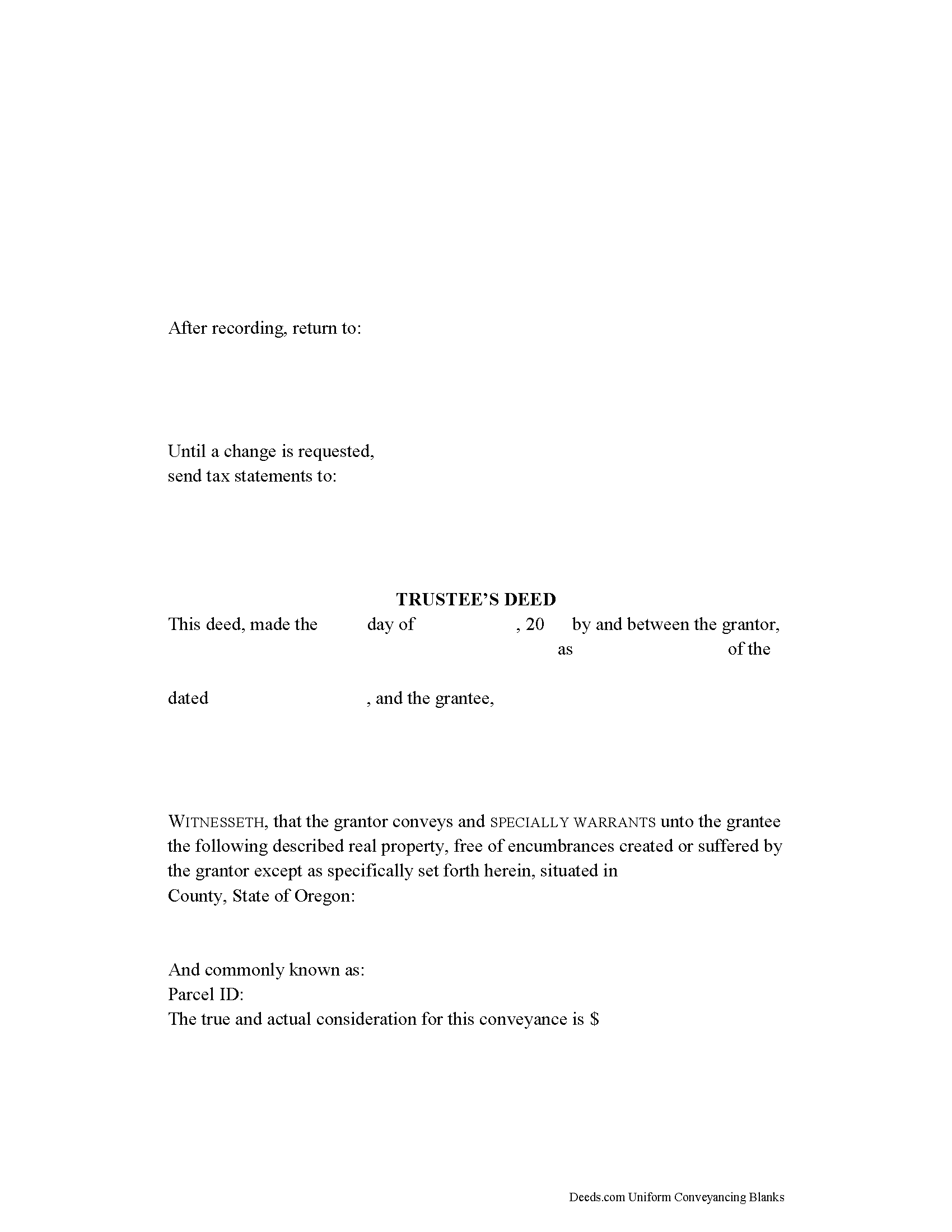
Yamhill County Trustee Deed Form
Fill in the blank form formatted to comply with all recording and content requirements.
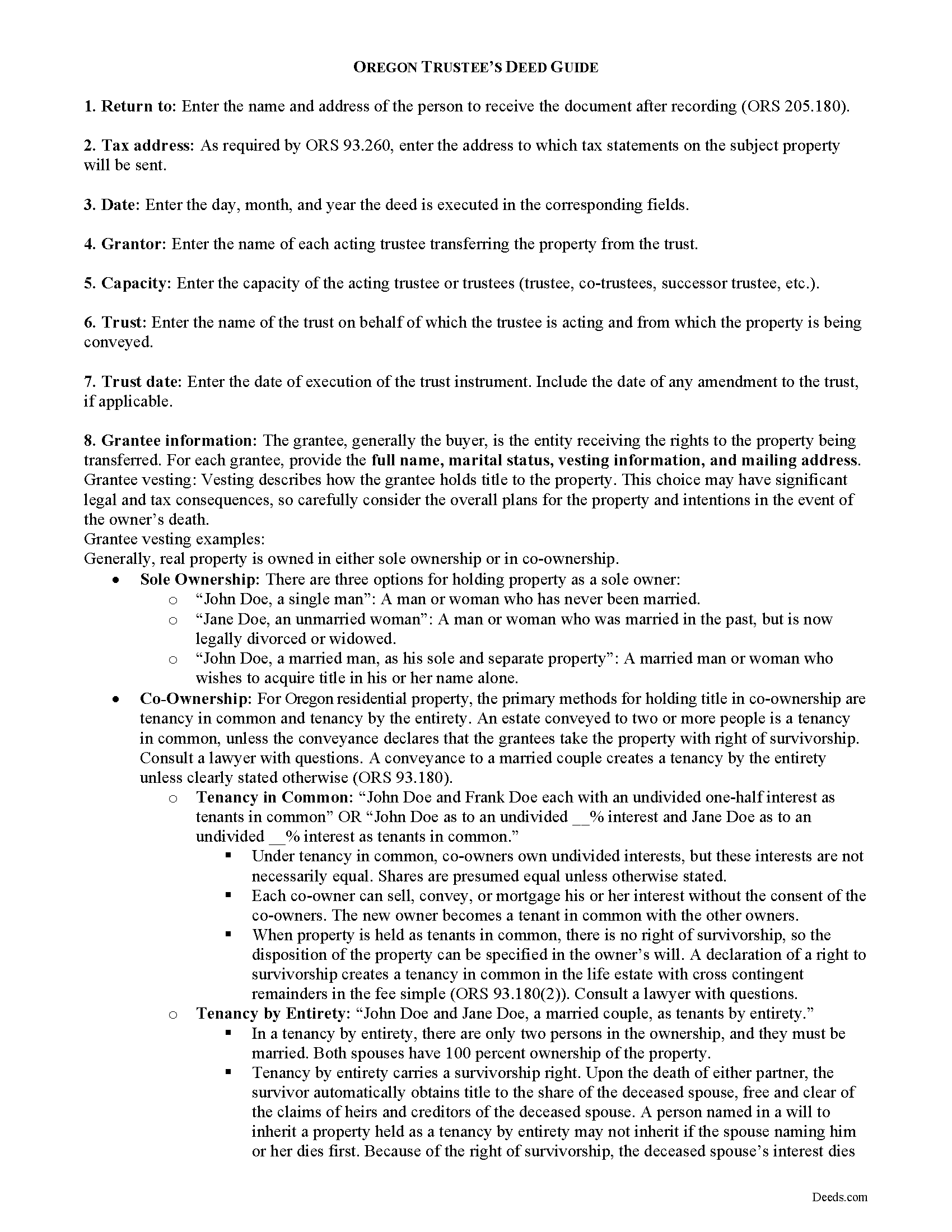
Yamhill County Trustee Deed Guide
Line by line guide explaining every blank on the form.
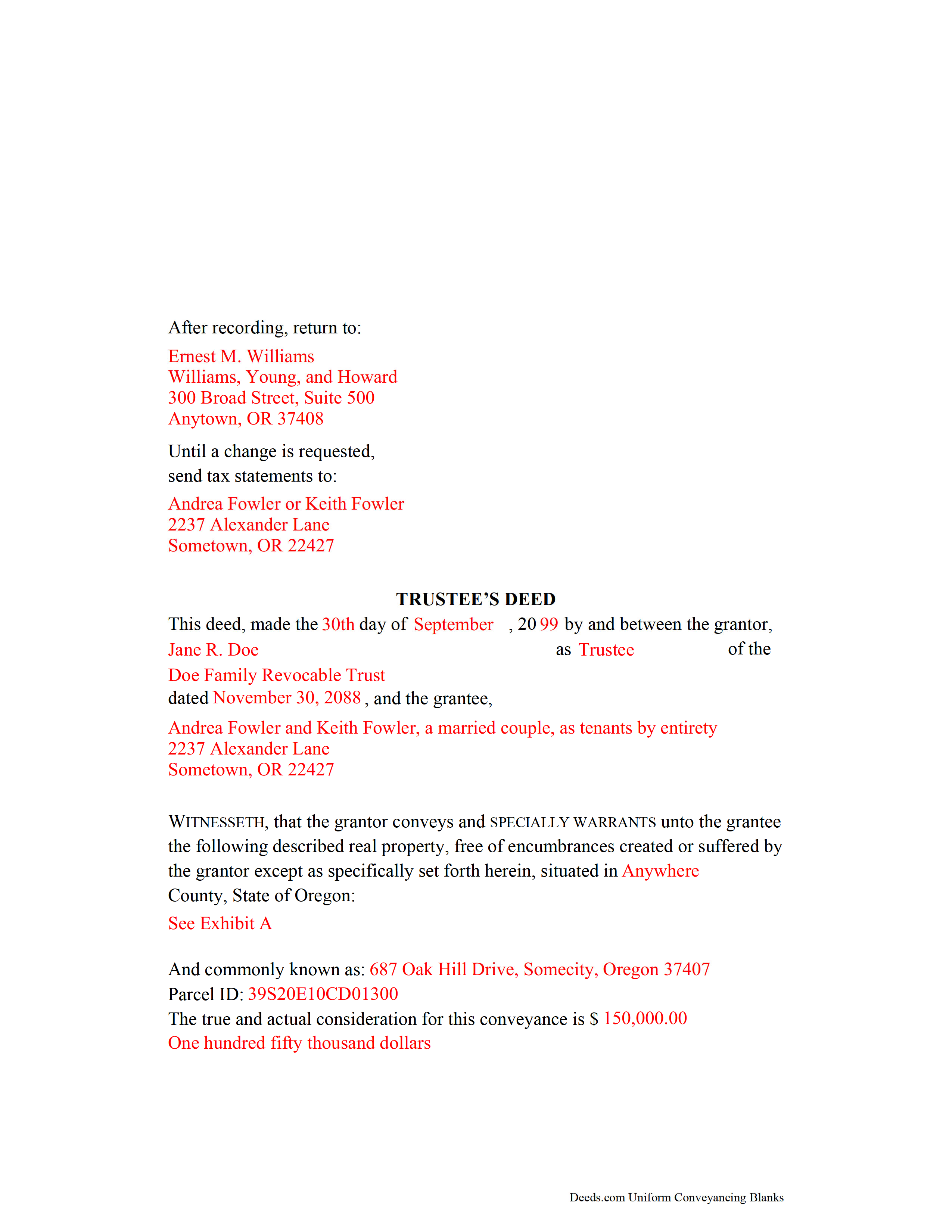
Yamhill County Completed Example of the Trustee Deed Document
Example of a properly completed form for reference.
All 3 documents above included • One-time purchase • No recurring fees
Immediate Download • Secure Checkout
Additional Oregon and Yamhill County documents included at no extra charge:
Where to Record Your Documents
Yamhill County Clerk
McMinnville, Oregon 97128-4607
Hours: 9:00 to 5:00 M-F / Recording until 4:30
Phone: (503) 434-7518
Recording Tips for Yamhill County:
- Bring your driver's license or state-issued photo ID
- Ensure all signatures are in blue or black ink
- Both spouses typically need to sign if property is jointly owned
- Bring extra funds - fees can vary by document type and page count
- Check margin requirements - usually 1-2 inches at top
Cities and Jurisdictions in Yamhill County
Properties in any of these areas use Yamhill County forms:
- Amity
- Carlton
- Dayton
- Dundee
- Lafayette
- Mcminnville
- Newberg
- Sheridan
- Willamina
- Yamhill
Hours, fees, requirements, and more for Yamhill County
How do I get my forms?
Forms are available for immediate download after payment. The Yamhill County forms will be in your account ready to download to your computer. An account is created for you during checkout if you don't have one. Forms are NOT emailed.
Are these forms guaranteed to be recordable in Yamhill County?
Yes. Our form blanks are guaranteed to meet or exceed the applicable formatting requirements used for recording in Yamhill County, including margin requirements, font requirements, and other layout standards. This guarantee applies to formatting, not to the legal sufficiency of information entered by the user or the suitability of a form for a particular transaction.
Can I reuse these forms?
Yes. You can reuse the forms for your personal use. For example, if you have multiple properties in Yamhill County you only need to order once.
What do I need to use these forms?
The forms are PDFs that you fill out on your computer. The free Adobe Acrobat Reader is recommended, and most PDF apps also work. You do NOT enter your property information online - you download the blank forms and complete them privately on your own computer.
Are there any recurring fees?
No. This is a one-time purchase. Nothing to cancel, no memberships, no recurring fees.
How much does it cost to record in Yamhill County?
Recording fees in Yamhill County vary. Contact the recorder's office at (503) 434-7518 for current fees.
Questions answered? Let's get started!
Oregon Trustee's Deeds & Transfers from Living Trusts
NOTE: This article pertains to living trusts, a type of express trust as set forth in the Oregon Uniform Trust Code (ORS 130.005). Deeds titled "trustee's deed," which transfer real property by an express trust, should not be confused with deeds titled "trustee's deed upon sale," which are used to convey real property after foreclosure under a deed of trust (see ORS 86.775 for trustee's deeds upon sale).
Oregon is among the majority of states that has adopted or introduced for adoption some form of the Uniform Trust Code, "a set of basic default rules that fairly, consistently and clearly govern voluntary trusts," providing a more consistent and uniform (as the name would suggest) framework of rules to govern voluntary trusts across states. States generally adopt parts of the Uniform Trust Code to work alongside existing legislation. In Oregon, the Uniform Trust Code is codified at Chapter 130 of the Revised Statutes.
A trust is an arrangement whereby a settlor transfers property to another person, a trustee, who manages the assets for the benefit of another (the beneficiary). The Uniform Trust Code requires that the settlor has the capacity and expresses the intention to create a trust; that the trust has a clear beneficiary; that the trustee has duties to perform; and that the same individual is not both sole trustee and sole beneficiary (ORS 130.155). Trusts must be made for purposes that are both lawful and attainable, and for the benefit of the trust's beneficiary (ORS 130.165).
In Oregon, a settlor may create a living trust through a transfer of property to another person or to himself as trustee. The settlor conveys real property into trust by executing a deed that titles property in the name of the trustee as trustee of the trust. As with any transfer, it is important to understand the legal rights and responsibilities of vesting title in the name of a trust. For example, spouses holding property as tenants by the entirety who transfer the property into trust change their rights in the property. Consult an attorney with questions about titling trust assets.
The settlor determines how his assets will be managed and establishes plans for the distribution of the trust's contents after death by executing a trust instrument. This unrecorded document also designates the trustee and the trust beneficiaries. In a living trust, "Appointing a successor trustee is essential" when the settlor also serves as the original trustee; this ensures that the trust will continue to be managed pursuant to the settlor's intentions upon his death or incapacitation.
The Uniform Trust Code gives the trustee all the general powers over trust property "that an unmarried financially capable owner has over individually owned property" unless otherwise limited by the terms set forth in the trust instrument, and the specific power to sell trust property (ORS 130.720, 130.725(2)). In order to transfer real property held in a living trust, the trustee executes a trustee's deed.
The trustee's deed is one in a class of instruments named descriptively after the granting party, rather than the warranty of title conveyed (think administrator's deed, executor's deed, sheriff's deed). A trustee may use any statutory deed to convey interest; a lawyer can help determine the appropriate document for the situation.
In Oregon, there are four statutory short forms for deeds: warranty deed, special warranty deed, bargain and sale deed, and quitclaim deed. A warranty deed (ORS 93.850) conveys the grantor's interest and any and all after-acquired title, along with the covenants that the grantor is seized of the property and has good right to convey; that the property is free from any encumbrances apart from those indicated on the deed; and that he warrants and defends the title against the claims of all persons. A bargain and sale deed (ORS 93.860) conveys interest and any and all after-acquired title, but contains no covenants. A quitclaim deed (93.865) conveys only the interest a grantor may have at the time of the deed (and not any interest the grantor obtains after).
In Oregon, trustees most frequently use a special warranty deed to convey property. A special warranty deed (ORS 93.855) has the same effect as a warranty deed, except that the covenant of freedom from encumbrances is limited to "those created or suffered by the grantor." With a special warranty, the grantor warrants and defends the title more narrowly -- solely against persons claiming "by, through or under the grantor."
In addition to titling property in the name of the grantee, the granting clause of a trustee's deed names all executing trustees (as grantors), along with the trust and the trust date. All instruments pertaining to real property in Oregon also need a statement of the true consideration paid for the transfer, an adequate legal description of the property being conveyed, and the requisite mailing addresses to meet first-page requirements. All trustees involved in the transaction must sign the deed in the presence of a notary public before recording in the appropriate county. Grantees may request that the trustee provide a certification of trust (ORS 130.860) to confirm the trust's existence and the trustee's authority to enter the transaction.
Each case is unique, so consult a lawyer with specific questions or for complex situations relating to express trusts in Oregon and for guidance in preparing a trustee's deed.
(Oregon TD Package includes form, guidelines, and completed example)
Important: Your property must be located in Yamhill County to use these forms. Documents should be recorded at the county recording office listed above.
This Trustee Deed meets all recording requirements specific to Yamhill County.
Our Promise
The documents you receive here are guaranteed to meet or exceed the applicable Yamhill County recording format requirements. If there is a rejection caused by our formatting, we will correct the issue or refund your payment. This guarantee applies to document formatting only and does not extend to information entered by the user, the selection of the form, or the legal effect of the completed document.
Save Time and Money
Get your Yamhill County Trustee Deed form done right the first time with Deeds.com Uniform Conveyancing Blanks. At Deeds.com, we understand that your time and money are valuable resources, and we don't want you to face a penalty fee or rejection imposed by a county recorder for submitting nonstandard documents. We constantly review and update our forms to meet rapidly changing state and county recording requirements for roughly 3,500 counties and local jurisdictions.
4.8 out of 5 - ( 4,815 Reviews )
Betty S. 5 out of 5 stars
Thank you for the excellent and complete layout of all forms needed to complete the Affidavit of Death and Heirship, including the notarial officer and an example of how these forms should be completed. This method definitely saves time and money and an answer to my family's Prayers.
Thank you for your feedback. We really appreciate it. Have a great day!
John B. 5 out of 5 stars
Forms are as advertised and easy to access.
Thank you for your feedback. We really appreciate it. Have a great day!
Brenda D. 5 out of 5 stars
Very easy to use once I found it.
Thank you!
Remon W. 5 out of 5 stars
Excellent and fast service. I will be using this site as needed in the future.
Thank you Remon, we appreciate you.
Shanna B. 5 out of 5 stars
So quick and easy
We’re glad you had a positive experience. Thank you.
JACQUELINE R. 5 out of 5 stars
We have been waiting for a Title Company to put a release of Lien together for the past 3 months. I figured it was taking way to long and decided to use template here instead. In less than hour I was able to add all the information on the template and provide forms to our Seller to use. We were buying and he didnt think they were necessary. But I refused to pay him in full until he agreed to sign papers at the bank, and of course in front of a notary. We turned around and filed the Release of lien paperwork at County Clerks office, we officially own our house. Thank you!
Thank you for your feedback. We really appreciate it. Have a great day!
Linda D. 5 out of 5 stars
This is a very nice service. Easy to use and reasonable. I especially appreciated the helpful explanations of each of the fields on the form. I will positively use this service again.
Thank you for your feedback. We really appreciate it. Have a great day!
janice l. 5 out of 5 stars
Exact form needed with perfect instructions. Easy Peazy! Just got my fully recorded document back today. Saved hundreds. Just make sure and read all the instructions .
Thank you for your feedback. We really appreciate it. Have a great day!
Howard K. 5 out of 5 stars
Great products, quick downloads, the "guides" are extremely helpful. Overall 5 stars!
Thank you!
Jamie F. 4 out of 5 stars
I purchased he Alabama Correction Warranty Deed Form to correct a mistake in the legal description. However, this form says it must be signed by all who previously signed the deed. One of these people is now deceased. Can I use this form? How would it be different? I would give you 5 stars but wish this issue had been addressed. Thanks.
Thank you for your feedback. From the product description: All parties who signed the prior deed must sign the correction deed in the presence of a notary.
Barbara M. 5 out of 5 stars
Easy to do.
We appreciate your business and value your feedback. Thank you. Have a wonderful day!
Edwina L. 5 out of 5 stars
Awesomeness a true life saver I'm very appreciative.
Thank you!
Gail D. 5 out of 5 stars
Very concise and thorough website. Easily navigated and easily affordable.
Knowing our customers are happy is our top priority. Thank you for the wonderful feedback!
Susan A. 5 out of 5 stars
Very convenient. Instructions and samples are a plus because I often see documents incorrectly completed. Take the time to do it right.
We appreciate your business and value your feedback. Thank you. Have a wonderful day!
Giuseppina M. 5 out of 5 stars
Fast, reliable excellent service
Your feedback is greatly appreciated. Thank you for taking the time to share your experience!