Pennsylvania Quitclaim Deed (Married Grantor with Non-Owner Spouse Joinder)
County Specific Legal Forms Validated as recently as October 15, 2026 by our Forms Development Team
About the Pennsylvania Quitclaim Deed (Married Grantor with Non-Owner Spouse Joinder)
How to Use This Form
- Select your county from the list
- Download the county-specific form
- Fill in the required information
- Have the document notarized if required
- Record with your county recorder's office
What Others Like You Are Saying
"This process was so easy. I am pleased with efficiency and ease of it all."
"So far this has been a great experience. Very easy to use the deeds.com website and download the for…"
"Extremely easy site to use. We had our document e-recorded the same day and we didn't have to make a…"
"The process was easy going. The process is one thing, the results another. I have attempting to reso…"
"great DIY site."
4.8/5 from 4,829 reviews. Read all
Two signatures appear on this Pennsylvania quitclaim deed, and they do different work. The grantor is a married owner who holds record title alone and releases whatever interest that owner has. The second signer is the grantor's spouse, who owns nothing of record and signs only to consent. That consenting signature is what this configuration exists to capture: under 20 Pa.C.S. Section 2203(b)(1), property subject to a surviving spouse's elective share does not include a conveyance made with the express consent or joinder of the surviving spouse.
The signature that consents rather than conveys
The joinder section states the facts the consent rests on and then performs it. The signer named as the joining spouse is married to the grantor, is not a record owner, joins in the deed, and expressly consents to the conveyance the deed makes. Three limits sit in the same section: the joining spouse passes no separate record interest, so the consent itself moves no title; the joining spouse assumes no obligation of the grantor; and the joinder reaches this conveyance and nothing else, so it is not a general release of the one-third elective share that 20 Pa.C.S. Section 2203(a) describes.
What the release words carry, and what they leave out
The conveyance section performs the release in the words 21 P.S. Section 6 supplies, remising, releasing, and quitclaiming everything the grantor holds in the property: right, title, interest, claim, and demand, with the appurtenances. It then states what a Pennsylvania quit claim deed leaves out. The deed does not use the words grant and convey, so the covenants 21 P.S. Section 3 attaches to those words are absent, and it carries no general warranty under Section 4 and no special warranty under Section 5. The grantee takes the interest as the record holds it.
Why the recorder does not ask for the spouse's signature
Pennsylvania's recording prerequisites do not include a spousal signature on solely titled land: acknowledgment before recording (21 P.S. Section 351), the grantee's precise residence and complete post-office address certified inside the deed (16 P.S. Section 9781), a parcel identifier where a county ordinance calls for one, and transfer tax paid or an exclusion documented. Dower and curtesy are not current Pennsylvania interests, because 20 Pa.C.S. Section 2105 makes a surviving spouse's statutory share in lieu and full satisfaction of both, and no statewide homestead joinder statute reaches a deed of a residence titled in one spouse's name alone. The joinder answers probate law and title underwriting rather than the intake counter.
One owner, one consenting spouse, two certificates
The architecture follows those two roles. A party block names the married record owner, a second names the spouse and states the non-owner status, each signer has a signature line with a printed name and date, and each has an acknowledgment certificate carrying the short-form sentence of 57 Pa.C.S. Section 316, so the two may appear on separate dates or before officers in different states. Ownership patterns that present this arrangement recur in Pennsylvania title work: an owner who took title before the marriage releasing that parcel to a relative, an owner who received land by inheritance during the marriage passing it along for nominal consideration, and a solely titled parcel where a title examiner wants the spouse's consent inside the recorded instrument. Where both spouses hold record title, Pennsylvania reads the title as one entireties estate and both of them sign as grantors, a different arrangement from the owner plus consenting spouse this deed recites.
Tax and the county counter
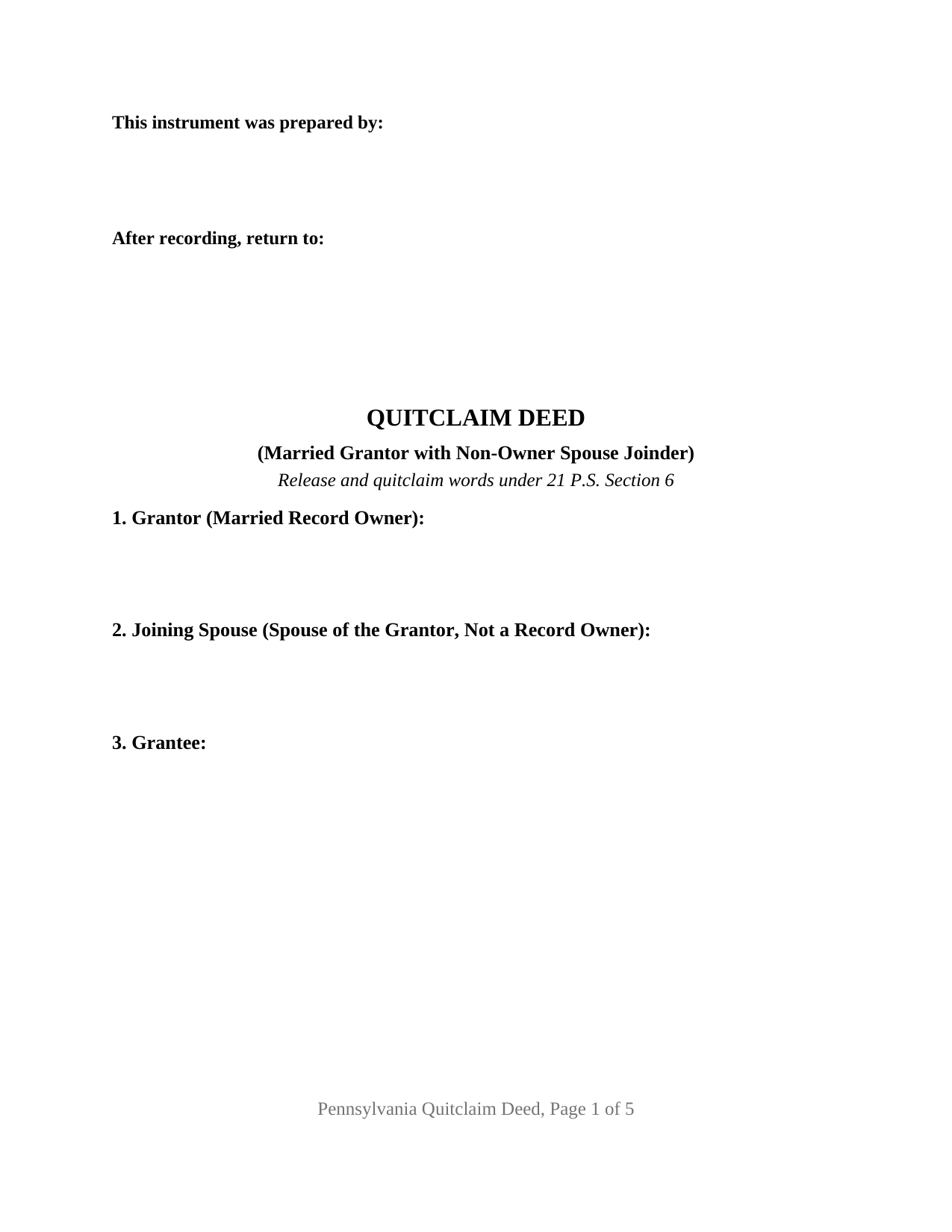
A quitclaim deed is taxable on the same basis as another deed where there is an actual conveyance of real estate (61 Pa. Code Section 91.164), at the 1 percent state rate plus the local rate. A transfer between the family members listed in 61 Pa. Code Section 91.193(b)(6) is an excluded transaction, and on a familial claim the REV-183 Statement of Value may be limited to an explanation of why the document is not taxable (61 Pa. Code Section 91.191). The first page keeps the prepared-by and return-to blocks at the top left, with the stamp area at the right left clear.
The download includes the deed as a blank fillable PDF, a completed example following a Chester County release to a sibling with the spouse joining, and a guide covering every section, the joinder, notarization, transfer tax documentation, and county recording. It describes Pennsylvania law in general terms and is not legal advice.
Important: County-Specific Forms
Our quitclaim deed (married grantor with non-owner spouse joinder) forms are specifically formatted for each of the 67 counties in Pennsylvania.
After selecting your county, you'll receive forms that meet all local recording requirements, ensuring your documents will be accepted without delays or rejection fees.