Pennsylvania Quitclaim Deed (Interspousal)
County Specific Legal Forms Validated as recently as October 12, 2026 by our Forms Development Team
About the Pennsylvania Quitclaim Deed (Interspousal)
How to Use This Form
- Select your county from the list
- Download the county-specific form
- Fill in the required information
- Have the document notarized if required
- Record with your county recorder's office
What Others Like You Are Saying
"your site was a godsend for us, really appreciate the sample and instructions you provide, was very …"
"cost effective and quick!"
"Very easy to do. Will use them in the future."
"Easy to create an account! Awesome!"
"Very useful service! This was easy and quick. It guides you through each step and emails update you …"
4.8/5 from 4,836 reviews. Read all
An interspousal quitclaim deed carries a sentence most Pennsylvania deeds never need: a statement, on the face of the instrument, that the grantor and the grantee are married to each other. This form is built around that sentence and the single release it introduces, one spouse passing an interest in Pennsylvania real estate to the other spouse, with no warranty of title attached to it.
Why the marriage sits on the face of the deed
The recital does tax work as well as title work. A transfer between husband and wife is an excluded transaction for Pennsylvania realty transfer tax purposes under 61 Pa. Code Section 91.193(b)(6)(i)(A), so an interspousal deed ordinarily records with no state or local tax collected. How that exclusion is documented depends on what the deed itself says. Under 61 Pa. Code Section 91.112(d)(1), a Statement of Value need not be filed, and the document need not set forth its value, where the parties are outside the tax by reason of familial relationship and the document clearly indicates that relationship. Subsection (d)(2) calls for a Statement of Value where the deed fails to indicate the specific familial relationship claimed. Counties keep their own intake habits within that framework, and Montgomery County's published requirements call for a current REV-183.
A release measured by the record, not by the words
Pennsylvania supplies the operative words by statute. Under 21 P.S. Section 6, release and quit claim language passes the grantor's whole right, title, interest, claim, and demand and bars the grantor and the grantor's heirs from later claiming it. What travels is whatever the grantor holds at delivery. The form says plainly that it does not use the words grant and convey, so the covenants 21 P.S. Section 3 attaches to those words are absent, and that it carries neither the general warranty of Section 4 nor the special warranty of Section 5. Liens, easements, restrictions, and any severance of coal, oil, gas, or other minerals stay exactly where the record leaves them.
One grantor spouse, one grantee spouse
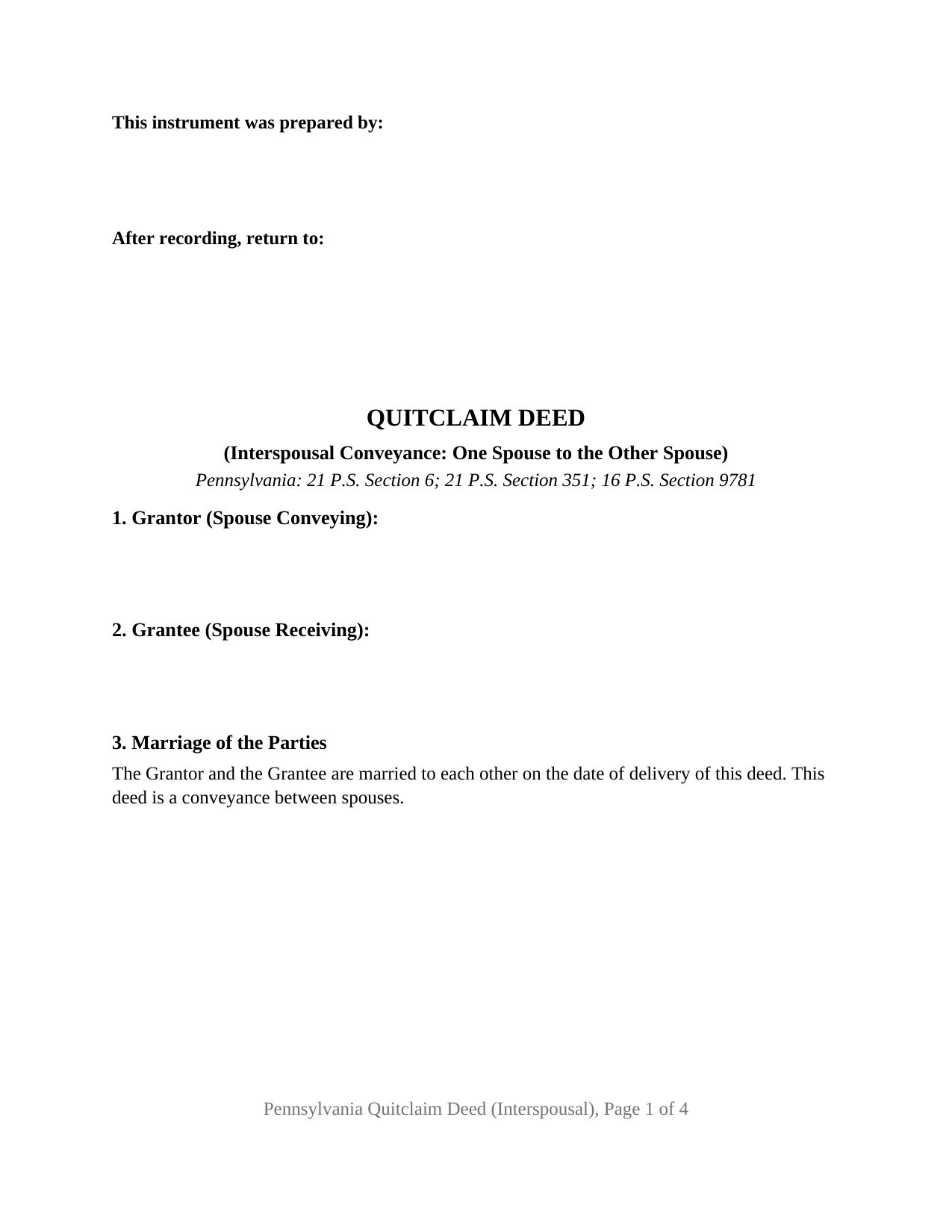
The architecture is deliberately narrow. A single grantor block names the married owner, a single grantee block names that owner's spouse, one signature line carries a printed name and date, and one acknowledgment certificate prints the statutory short-form sentence of 57 Pa.C.S. Section 316, so the deed acknowledges before any notarial officer, in Pennsylvania or elsewhere, and remotely under 57 Pa.C.S. Section 306.1. Configurations of this kind turn up wherever Pennsylvania title stands in one spouse's name: a parcel bought before the wedding and released afterward to the other spouse, land that came to one spouse by family gift during the marriage and is passed along to the other, and a spouse releasing an interest so that the other spouse's sole record title reads clean ahead of a refinance. Because one grantee is named, the interest lands in that spouse individually as sole ownership in fee simple; a deed naming both spouses as grantees is what raises the entireties presumption, and this quit claim deed is not arranged to name two.
What the grantee spouse holds afterward
Sole ownership carries no survivorship. The interest passes at the grantee spouse's death by will, by intestacy under 20 Pa.C.S. Section 2102, or through another arrangement, since Pennsylvania has enacted no transfer on death deed. The deed leaves debt alone: a grantor obligated on a mortgage stays obligated after releasing title.
At the Pennsylvania recorder of deeds
Recording protects the grantee rather than completing the transfer: 21 P.S. Section 351 makes an unrecorded conveyance void as against a later bona fide purchaser, mortgagee, or judgment creditor without notice. The deed closes with the certificate of the grantee's residence and post-office address that 16 P.S. Section 9781 makes a condition of recording, signed by the grantee, and it carries a parcel identifier entry for the counties whose ordinances demand one. Page one keeps its prepared-by and return-to blocks at the upper left with the stamp area open to the right.
The download holds three things: the blank interspousal quitclaim deed as a fillable PDF, a completed example worked through a Dauphin County release between spouses, and a step-by-step guide to the twelve sections, the marriage recital, the notarial rules, the transfer tax paperwork, and what a Pennsylvania recording desk expects. It explains this law in general terms and is not legal advice.
Important: County-Specific Forms
Our quitclaim deed (interspousal) forms are specifically formatted for each of the 67 counties in Pennsylvania.
After selecting your county, you'll receive forms that meet all local recording requirements, ensuring your documents will be accepted without delays or rejection fees.