Pennsylvania Quitclaim Deed (Trustee Grantor)
County Specific Legal Forms Validated as recently as September 21, 2026 by our Forms Development Team
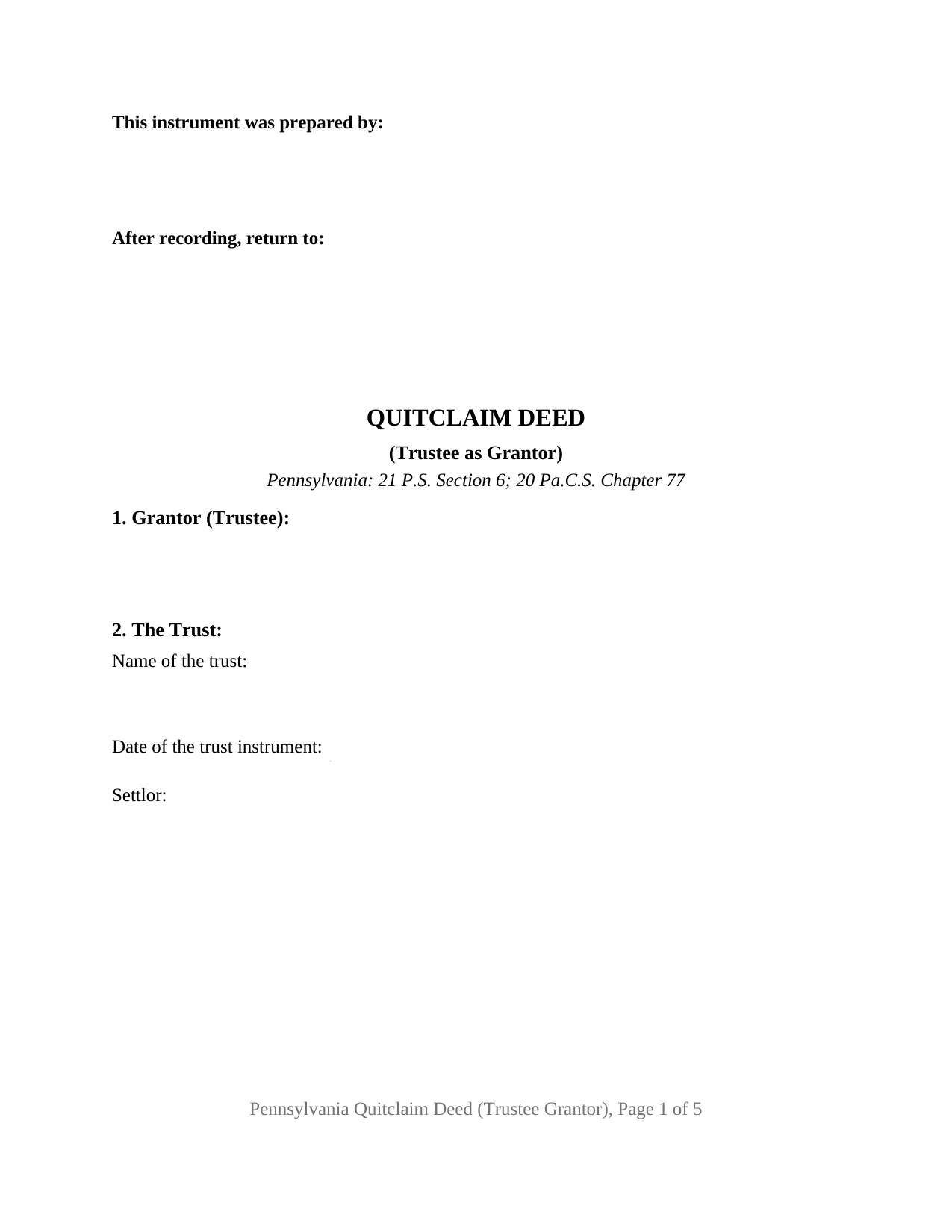
About the Pennsylvania Quitclaim Deed (Trustee Grantor)
How to Use This Form
- Select your county from the list
- Download the county-specific form
- Fill in the required information
- Have the document notarized if required
- Record with your county recorder's office
What Others Like You Are Saying
"This was a very easy and organized system to use."
"Helpful, but some of the blanks aren't large enough, particularly when the grantor is an affiant und…"
"Exceptional service. Thank you for your assistance."
"Downloaded perfect. Can hardly wait to get them done."
"amazing customer service. thank you deeds.com. I just wish I knew about this company earlier. Kevin"
4.8/5 from 4,829 reviews. Read all
The party releasing title on this Pennsylvania quitclaim deed signs an office rather than a personal holding. The grantor is a trustee, the interest released belongs to a trust, and the instrument says so three times over: in the grantor block, in the operative sentence, and above the signature line. That disclosure does work. Under 20 Pa.C.S. Section 7790(a), a trustee who discloses the fiduciary capacity is not personally liable on a contract properly entered into in that capacity in the course of administering the trust.
A grantor named by office, trust, and date
The form collects its identifying facts before it releases anything. The grantor block takes the trustee's name, capacity, and address, and a numbered section beneath it takes the trust's name, the date its instrument was executed, and the settlor. What the deed does not do is prove any of it: a recital states the status asserted, and authority to release trust property comes from the trust instrument together with the trustee powers of 20 Pa.C.S. Sections 7780.5 and 7780.6, which include selling or exchanging real property and executing the instruments that carry those powers into effect.
What protects the party on the other side
Pennsylvania answers the authority question outside the deed. Under 20 Pa.C.S. Section 7790.2, a person dealing with a trustee, absent actual knowledge of a breach of trust or of facts amounting to bad faith, may assume without inquiry that the trust powers exist and are properly exercised, and is fully protected as if they were. Subsection (c.1) adds that a trustee's act is not set aside merely for going beyond the listed powers, while a court stays free to act on fraud, accident, mistake, or self dealing. What the release carries is fixed by 21 P.S. Section 6: remising, releasing, and quitclaiming the whole of the grantor's right, title, interest, claim, and demand, with no covenant under 21 P.S. Section 3 and neither warranty of Sections 4 and 5.
Transfer tax turns on where the property is headed
A conveyance out of a trust is measured by its destination, not by its label (61 Pa. Code Section 91.164). Under 61 Pa. Code Section 91.156(e)(1), a transfer from the trustee of a living trust during the settlor's lifetime to a grantee other than the settlor is treated as if the settlor had made it directly, so the exclusions tested are the ones that would reach the settlor's own deed. Subsection (e)(2) excludes a transfer from the trustee of a living trust back to its settlor. Subsection (f) reaches a distribution after the settlor's death, exempting it only for no or nominal consideration and only to the person entitled under the governing instrument to the real estate or its sale proceeds; subsection (d) states the parallel rule for an ordinary trust. Subsection (g) sets the condition all of them share: the recorder of deeds is presented with a copy of the trust agreement.
One acting trustee, one certificate
The architecture matches a single fiduciary title. The grantor block names the acting trustee together with the capacity; a signature line beneath the release takes that trustee's printed name and the date; and the notarial certificate that follows carries the short form wording supplied by 57 Pa.C.S. Section 316, which lets a trustee appear before a notarial officer of any state, or remotely under 57 Pa.C.S. Section 306.1. Releases on this configuration recur in Pennsylvania record rooms: a trustee distributing a parcel to the beneficiary entitled to it after the settlor has died, a trustee handing record title back to the settlor of a revocable trust, and and a successor trustee releasing a stray claim held in a former trustee's name so a sale can close. One acting trustee is what the form recites; where cotrustees hold title and the trust calls for more than one to act, each of them executes the release, a multiple-signer grantor arrangement this deed does not print. Section 12 closes the form with the residence certificate that 16 P.S. Section 9781 conditions recording on, stating where the grantee resides and the grantee's full post-office address, and the grantee signs it.
The download holds the blank deed as a fillable PDF, a completed example following a Berks County distribution out of a family trust, and a plain-language guide to the twelve sections, the capacity rules, notarization, the trust tax subsections, and county recording. The materials describe Pennsylvania law in general terms and are not legal advice.
Important: County-Specific Forms
Our quitclaim deed (trustee grantor) forms are specifically formatted for each of the 67 counties in Pennsylvania.
After selecting your county, you'll receive forms that meet all local recording requirements, ensuring your documents will be accepted without delays or rejection fees.