Pennsylvania Quitclaim Deed (Divorce)
County Specific Legal Forms Validated as recently as September 29, 2026 by our Forms Development Team
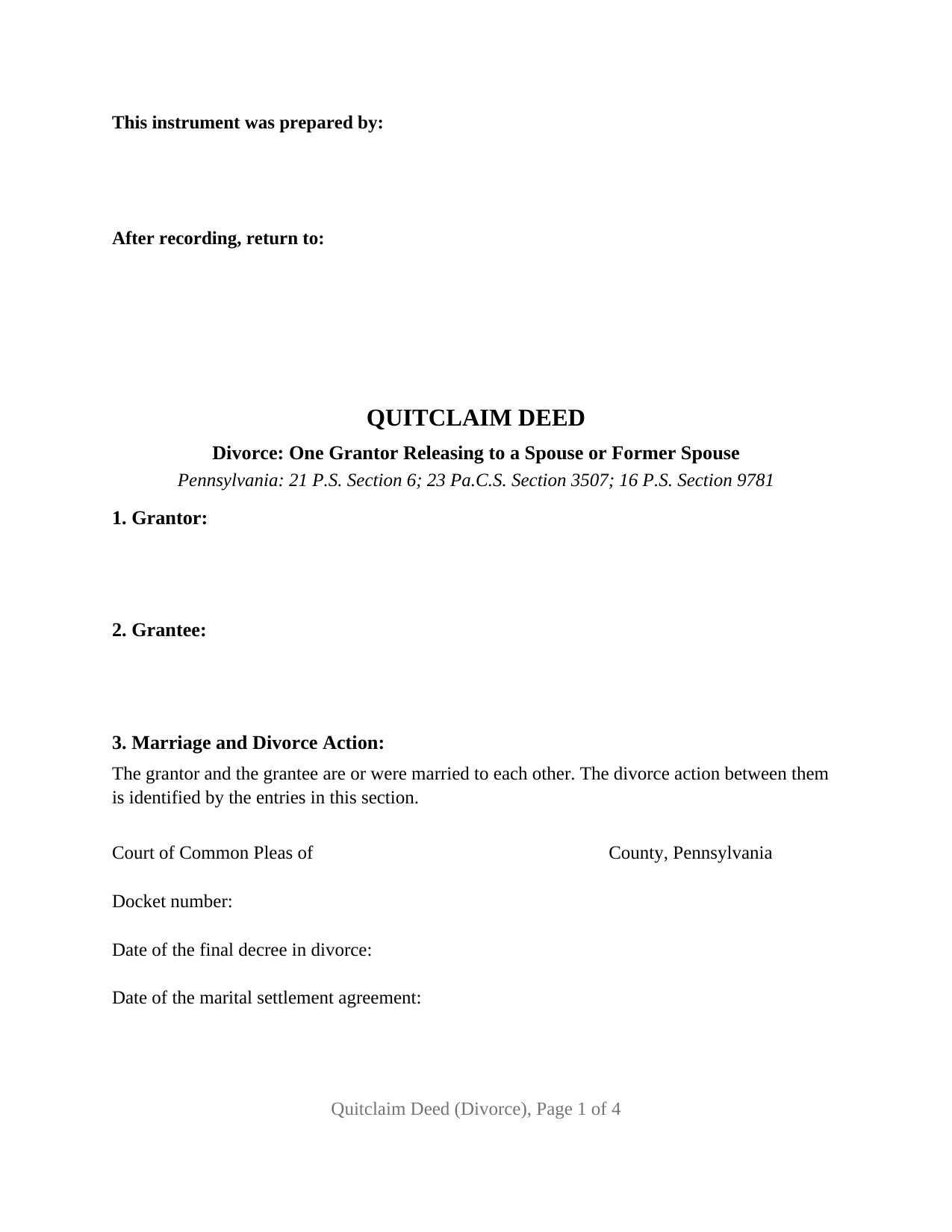
About the Pennsylvania Quitclaim Deed (Divorce)
How to Use This Form
- Select your county from the list
- Download the county-specific form
- Fill in the required information
- Have the document notarized if required
- Record with your county recorder's office
What Others Like You Are Saying
"I was glad that I paid to get a copy of the gift deed it help me out a lot and the copy of the examp…"
"got the forms needed plus all the information needed to fill them out."
"easy to use"
"Very helpful.Thank you"
"Awesome same-day service!"
4.8/5 from 4,833 reviews. Read all
Most Pennsylvania deeds identify a property and two parties. This one identifies a lawsuit as well. Section 3 takes the county whose Court of Common Pleas holds the divorce action between the two people named on the deed, the docket number, the date of the final decree, and the date of any marital settlement agreement, so the release and the proceeding it belongs to reach the recorder in one instrument. Under that recital sits an ordinary Pennsylvania quit claim deed: one spouse, or one former spouse, passing whatever interest that party holds to the other, with no warranty of title.
What a divorce decree has already done to the title
The entry in the decree blank changes what the releasing party actually owns. While the action is pending, spouses who took title together still hold an entireties estate, a single indivisible ownership rather than two shares. Once the decree is entered, 23 Pa.C.S. Section 3507 turns that estate into a tenancy in common of equal one-half shares unless the court order provides otherwise, and 23 Pa.C.S. Section 3503 ends the property rights that depend on the marital relation, vested rights aside. The conveyance section is written for the record in either condition: it releases the grantor's entire interest, naming an interest held as a tenant by the entirety and an undivided interest held as a tenant in common alike.
The part of a divorce that never happens on the deed
Equitable distribution belongs to the divorce action. Under 23 Pa.C.S. Section 3502(a) a court divides, distributes, or assigns marital property, and under Section 3502(e)(4) it may order and direct the transfer or sale of property where a party has not complied with an order or an agreement. A signed deed is the ordinary route by which record title follows that decision, and it records the outcome rather than reaching it. Debt stays where the deed found it: the conveyance section states that the release moves an interest in the property without releasing, assuming, or modifying any obligation secured by it.
One releasing party, one grantee, one certificate
The architecture is deliberately narrow: a single grantor block, a single grantee block, one dated signature line carrying the signer's printed name, and a single acknowledgment certificate printing the Section 316 short form, which a notarial officer of Pennsylvania or of another state completes and which 57 Pa.C.S. Section 306.1 also allows by communication technology. Section 12 is the one part the grantee signs, and it conveys nothing: it is the certificate of residence, and 16 P.S. Section 9781 tells the recorder to refuse a deed that arrives without a signed statement giving where the grantee lives and the full mailing address. Both timings this configuration presents, a release delivered while the action is pending and a release delivered after the decree, run through that same single-signer arrangement; a release in which two spouses stand together on the grantor side, or in which a spouse signs only to consent, follows a signing pattern this deed does not print.
An exclusion written for people who are no longer married
Realty transfer tax is collected when the deed records, one percent to the Commonwealth plus the local municipal and school rate, and 61 Pa. Code Section 91.164 measures a quitclaim deed by whether real estate actually changes hands rather than by the caption on it. The exclusion this configuration reaches for is 61 Pa. Code Section 91.193(b)(6)(i)(F), covering persons who were previously married but who have since been divorced, on the condition that the realty was acquired by both spouses, or by either spouse, before or during the marriage. That acquisition timing is the working test, which is why the form collects the recorded instrument the parties took title under, and the claim is documented on the REV-183 Statement of Value handed across the counter with the deed.
Three files arrive in the download: the deed as a blank fillable PDF, a completed example worked through a Montgomery County release made a month after the decree, and a plain-language guide to the twelve sections, the divorce recital, the notarial rules, the transfer tax exclusions, and the county recording desk. These materials explain Pennsylvania law in general terms; they are not legal advice.
Important: County-Specific Forms
Our quitclaim deed (divorce) forms are specifically formatted for each of the 67 counties in Pennsylvania.
After selecting your county, you'll receive forms that meet all local recording requirements, ensuring your documents will be accepted without delays or rejection fees.