Pennsylvania Quitclaim Deed (Reserving Life Estate)
County Specific Legal Forms Validated as recently as October 19, 2026 by our Forms Development Team
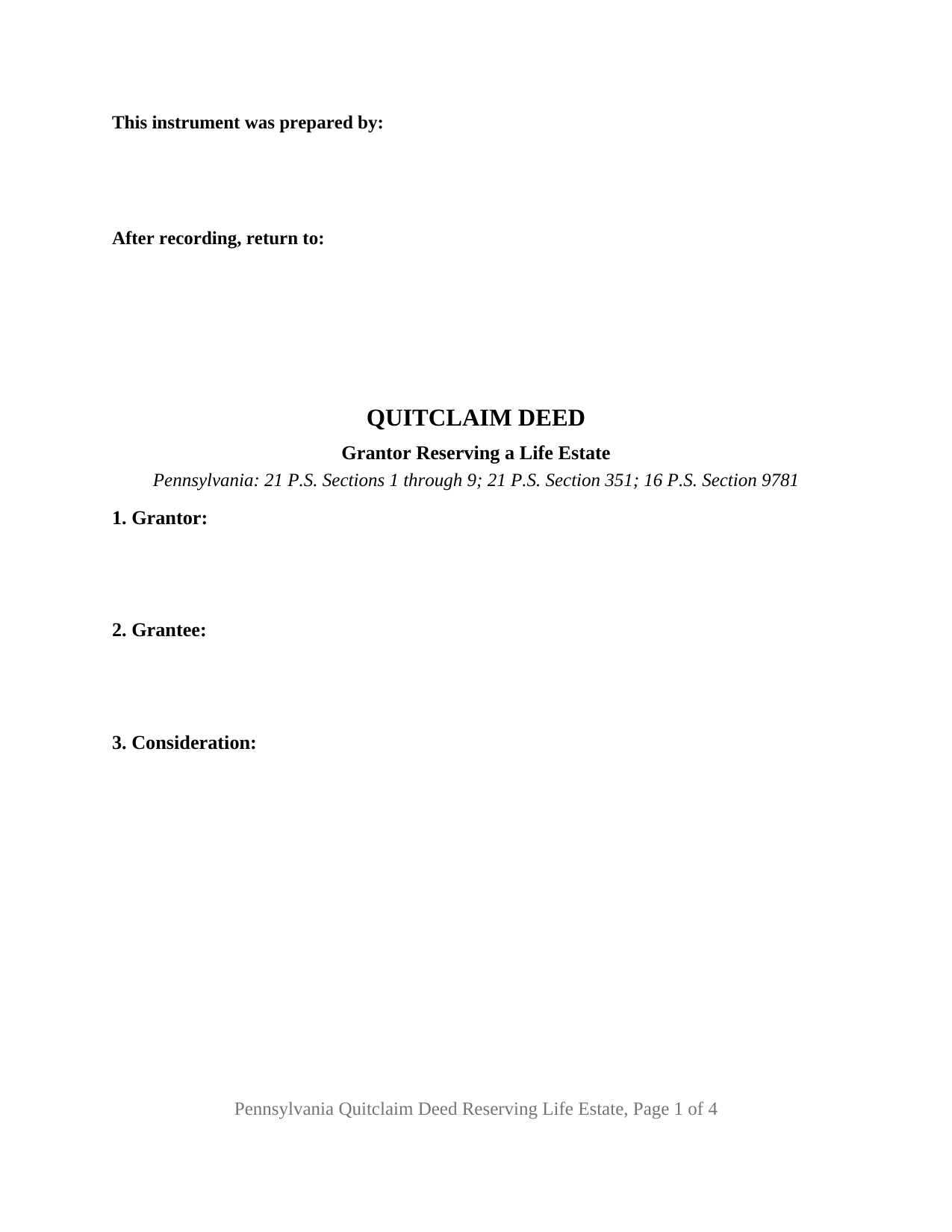
About the Pennsylvania Quitclaim Deed (Reserving Life Estate)
How to Use This Form
- Select your county from the list
- Download the county-specific form
- Fill in the required information
- Have the document notarized if required
- Record with your county recorder's office
What Others Like You Are Saying
"The form was very easy to fill out. The instructions were clear. Overall, a very user friendly produ…"
"Great and quick service!"
"Very easy. Worked well. Will be glad to use the service again."
"Deeds.com support is very quick and responsive. Would use again and recommend to others in need of e…"
"so far getting what i needed was easy the site is well done thank you"
4.8/5 from 4,833 reviews. Read all
One Pennsylvania deed, two estates. On this quitclaim deed the grantor releases the remainder in the described property and reserves a life estate, so the right to occupy the parcel and take its rents stays with the grantor while the grantee holds a present interest that becomes possessory at the grantor's death. One grantor keeps that estate, one grantee takes the remainder in fee simple, and no warranty travels with it.
The life estate the grantor keeps
Section 9 is where the deed does its distinctive work. The grantor excepts and reserves, for the term of the grantor's natural life, a life estate in the property with its possession, use, and occupancy and its rents, issues, and profits, ending at the grantor's death. A blank in the same section takes any further terms the parties agree on, an allocation of real estate taxes, insurance premiums, and ordinary repairs among them, which matters because Pennsylvania has no statute assigning those charges between a life tenant and a remainder holder on a deed created life estate. The reservation carries no power to undo the deed: the remainder is a present interest from delivery, and a later sale or mortgage of the whole fee takes both of them signing together.
Where the deed act leaves room for a reservation
The 1909 deed act supplies both halves. Its release words come from 21 P.S. Section 6, and 21 P.S. Section 2 carries a grantor's entire estate to the grantee unless the deed contains an exception or reservation, which is what this one contains; Section 7 confirms that the short form deed may include reservations. No covenant rides along, because the deed prints no grant and convey language and states that it makes no general warranty under Section 4 and no special warranty under Section 5. The life estate is a common law estate: no Pennsylvania statute prescribes its wording, and the Commonwealth has enacted no transfer on death deed.
A remainder valued by factor rather than by price
Realty transfer tax here reaches the remainder, not the retained estate, and one regulation says how to measure it. Under 61 Pa. Code Section 91.165 the value of a life estate or remainder interest is the consideration paid for it; where that consideration is absent, nominal, or below actual monetary worth, the taxable value becomes the computed value of the whole parcel multiplied by the remainder factor for the measuring life, taken from factors the Department of Revenue publishes in the Pennsylvania Bulletin. Example 3 of that regulation walks the identical pattern: a grantor conveying a remainder for less than monetary worth and retaining the life estate. Where grantor and grantee are family members listed in 61 Pa. Code Section 91.193(b)(6), the transaction is excluded, and the REV-183 Statement of Value carries the explanation.
One grantor, one grantee, one measuring life
The architecture is narrow. One grantor block names the record owner, one grantee block names the party taking the remainder, one signature line with a printed name and date carries the execution, and one acknowledgment certificate prints the wording of 57 Pa.C.S. Section 316, so the deed acknowledges before a notarial officer in any state, or remotely under 57 Pa.C.S. Section 306.1. Patterns of this shape recur in Pennsylvania record rooms: an owner releasing the remainder in a long held home to an adult child while keeping occupancy for life, and an owner of farmland passing the remainder to the next generation while keeping the farm income. The measuring life the form prints is the grantor's own; an estate measured by another person's life, and a life estate reserved to two people, follow arrangements this quit claim deed does not print.
What the Pennsylvania recording counter looks for
Recording protects the grantee's remainder against later purchasers, mortgagees, and judgment creditors (21 P.S. Section 351). The deed closes with the certificate of the grantee's precise residence and complete post office address, which 16 P.S. Section 9781 makes a condition of recording, and it carries a parcel identifier entry for the ordinance counties. Its prepared by and return to blocks sit at the top left of page one, leaving the stamp area clear.
The download holds the blank deed as a fillable PDF, a completed example following a Bucks County owner who reserves a life estate, and a plain language guide to the twelve sections, notarization, the transfer tax factors, and county recording. The materials describe Pennsylvania law in general terms and are not legal advice.
Important: County-Specific Forms
Our quitclaim deed (reserving life estate) forms are specifically formatted for each of the 67 counties in Pennsylvania.
After selecting your county, you'll receive forms that meet all local recording requirements, ensuring your documents will be accepted without delays or rejection fees.