Pennsylvania Quitclaim Deed (Trustee Grantee)
County Specific Legal Forms Validated as recently as October 2, 2026 by our Forms Development Team
About the Pennsylvania Quitclaim Deed (Trustee Grantee)
How to Use This Form
- Select your county from the list
- Download the county-specific form
- Fill in the required information
- Have the document notarized if required
- Record with your county recorder's office
What Others Like You Are Saying
"Just as promised My quitclaim deed went through the county recorders office with no problem."
"No review provided."
"Amazing! Great forms - created the quitclaim fairly easy, recorded with no issues. Thanks!"
"I found that it was easy-to-use and complete."
"This was a complete set of the necessary forms, with instructions. It will be very useful. Instant d…"
4.8/5 from 4,828 reviews. Read all
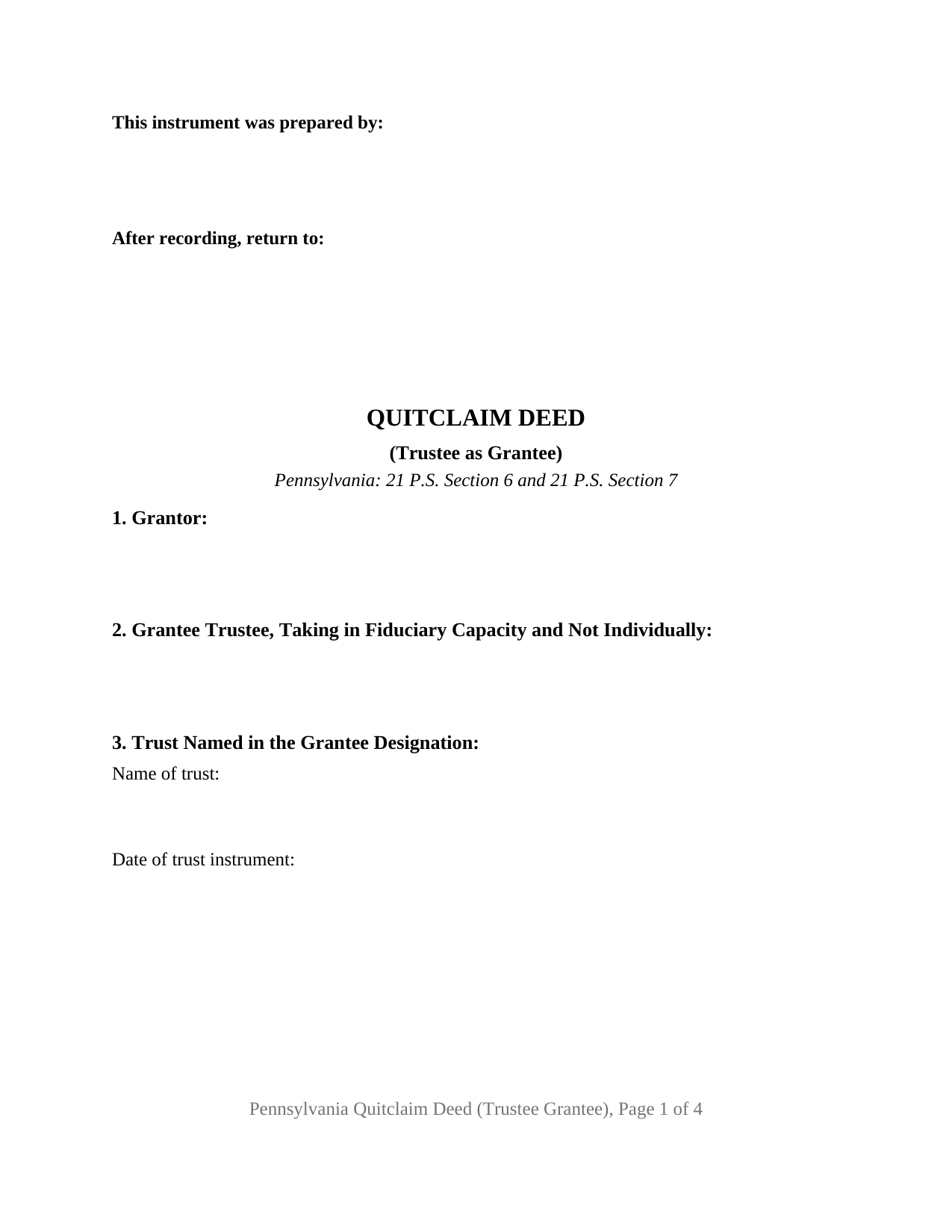
The grantee line is what makes this Pennsylvania quitclaim deed its own instrument. It names a person, the fiduciary office that person occupies, and the trust that office answers to, and the section beneath it pins the trust down by name and by the date of its instrument. One record owner releases whatever interest that owner holds, it lands in a trustee rather than in an individual, and no warranty of title travels with it.
A grantee with an office, a trust, and a date
Three facts identify a trustee grantee, and the deed collects them before it conveys anything: the trustee's name and address, the name of the trust, and the date the trust instrument was executed. The last two are the facts a certification of trust under 20 Pa.C.S. Section 7790.3 opens with, which is what a title examiner usually asks for. The deed then adds what a bare grantee name cannot: title vests in the capacity stated on its face and not individually, and runs to each successor trustee in office, so a change of trustee later does not leave the record naming someone who has left the job. The beneficial side stays out of the county index by design: 21 P.S. Section 358 provides that a trust beneficiary does not have to be indexed for constructive notice.
The transfer tax rule turns on who the grantor is
Pennsylvania taxes a transfer to a trust by looking through it rather than at the deed. Under 61 Pa. Code Section 91.156(c)(1), a transfer for no or nominal actual consideration to a trustee of a living trust from its settlor is excluded from realty transfer tax. Where the grantor is not the settlor, subsection (c)(2) taxes the transfer in full unless it would have been wholly excluded moving directly from that grantor to the settlor, and a trust outside the regulation's living trust definition runs through the beneficiary look-through of subsection (a). Subsection (g) adds the practical condition: no exemption is granted under that section unless the recorder of deeds is presented with a copy of the trust agreement. A REV-183 Statement of Value ordinarily rides along on a no-consideration transfer, and the deed's label settles nothing: a quitclaim deed is taxable on the same basis as another deed where an actual conveyance occurs (61 Pa. Code Section 91.164).
One releasing owner, one trustee grantee
The architecture is narrow. A single grantor block names the releasing owner, a single grantee block names the trustee and states the capacity, one signature line and one acknowledgment certificate carry the execution under the short form of 57 Pa.C.S. Section 316, and the closing certificate of residence is signed by the trustee. Ownership patterns that present this configuration recur in Pennsylvania record rooms: an owner moving a parcel to the trustee of a trust created under an estate plan, a co-owner releasing an undivided share to the trustee of a trust that already holds the rest of the parcel, and an owner clearing up land a trust was meant to hold on a funding deed that never reached the counter. The form recites one releasing owner and one trustee taking a single fiduciary title; a trust whose cotrustees take title together follows a grantee arrangement this quit claim deed does not print.
Words that release, covenants that stay behind
The conveyance section releases in the words 21 P.S. Section 6 supplies, then states its limits: no grant and convey, so none of the covenants of 21 P.S. Section 3, and neither the general warranty of Section 4 nor the special warranty of Section 5. The trustee takes the parcel as the record holds it, liens, easements, and any severance of coal or minerals included.
What the county counter looks for
The final section carries the grantee residence certificate that 16 P.S. Section 9781 makes a condition of recording, signed here by the trustee, and a parcel identifier entry serves the ordinance counties. Trust paperwork draws county-specific handling: Delaware County treats trust documents as non-recordable while allowing copies as Statement of Value attachments, and Montgomery County publishes that deeds involving trusts go by mail or in person.
The download holds the blank quitclaim deed as a fillable PDF, a completed example following a Northampton County owner placing a home in the trust she settled, and a plain-language guide to the twelve sections, notarization, the trust tax rules, and county recording. The materials describe Pennsylvania law in general terms and are not legal advice.
Important: County-Specific Forms
Our quitclaim deed (trustee grantee) forms are specifically formatted for each of the 67 counties in Pennsylvania.
After selecting your county, you'll receive forms that meet all local recording requirements, ensuring your documents will be accepted without delays or rejection fees.