Pennsylvania Quitclaim Deed (Partnership or Limited Partnership Grantor)
County Specific Legal Forms Validated as recently as October 22, 2026 by our Forms Development Team
About the Pennsylvania Quitclaim Deed (Partnership or Limited Partnership Grantor)
How to Use This Form
- Select your county from the list
- Download the county-specific form
- Fill in the required information
- Have the document notarized if required
- Record with your county recorder's office
What Others Like You Are Saying
"This service is fantastic! Took a few tries to scan the document correctly, but their patience and q…"
"This was so easy and seemless. I wish I had found deeds.com for eRecording sooner! I submitted my do…"
"I was very impressed on what I needed to get the Deed I requested. Everything was there and I got it…"
"They didn't have what I was looking for so they refunded my money immediately. Very easy to work wit…"
"Exactly what I was looking for and easy to fill out."
4.8/5 from 4,836 reviews. Read all
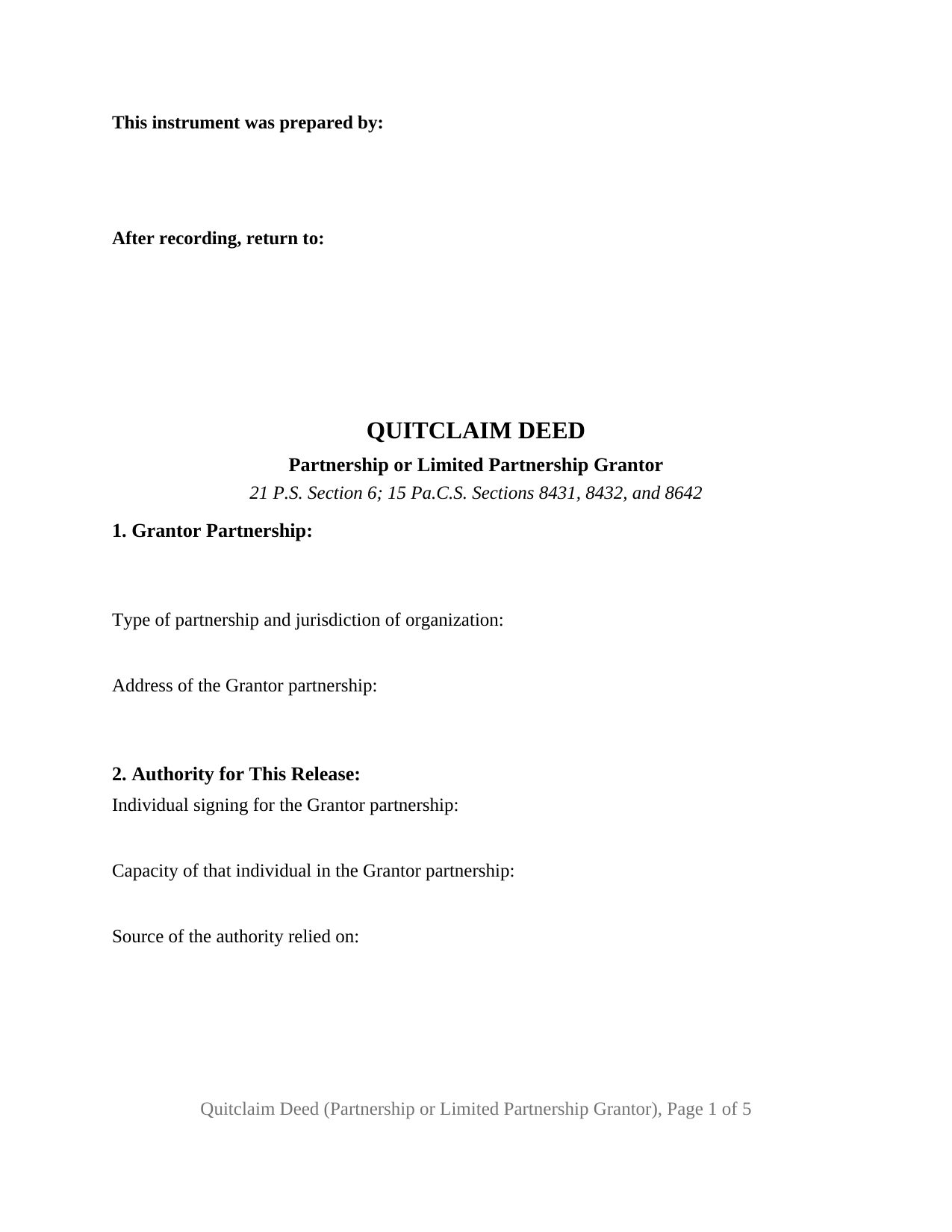
Partnership real estate is the one kind of Pennsylvania title that lawfully reads two ways: the record may carry the firm's own name, or the partners' names with a note of the capacity in which they took. This quitclaim deed is written for the first reading: a partnership holding record title in its own name, releasing whatever interest it holds to one grantee, with no warranty of title.
Which name the record carries
Pennsylvania answers that question by reading the instrument that put title where it sits. Under 15 Pa.C.S. Section 8424(a), property belongs to the partnership and not to the partners individually when acquired in the partnership name, or in the names of partners acting as partners with the firm named in that instrument. Subsection (c) runs the other way, presuming property taken in a partner's name alone, silent as to capacity or any firm, to be separate property. Section 7 of the form asks for the deed by which the partnership took title, the first instrument a title examiner reads.
The partner the statute lets sign
A firm signs through a person, and Pennsylvania names a different one for each kind of partnership. Under the Pennsylvania Uniform Partnership Act of 2016, 15 Pa.C.S. Section 8431(1) makes each partner an agent of the partnership, so a partner's signature in the partnership name binds the firm where the act apparently carries on its ordinary business, unless that partner lacked authority and the other party knew of it. Section 8441(j) adds the internal counterpart: an act outside the ordinary course takes the consent of all the partners. Under the Pennsylvania Uniform Limited Partnership Act of 2016, agency belongs instead to the general partners (15 Pa.C.S. Section 8642), Section 8632 addresses the absence of agency power in a limited partner acting as such, and Section 8646(a) leaves a partnership matter to a majority of the general partners.
An authority one chapter records
Here the two chapters part company. A general partnership may file a certificate of partnership authority naming who may sign an instrument transferring real property held in the partnership name, and under 15 Pa.C.S. Section 8433(f) a certified copy recorded where the property lies makes that grant conclusive for a person who gives value relying on it. Section 8433(g) charges everyone with knowledge of a recorded limitation. The limited partnership chapter offers no counterpart: its filing sections, 15 Pa.C.S. Sections 8621 through 8625, stop at the registered office. That certified copy is its own instrument, not part of this package.
One partnership, one signer, one certificate
The architecture is narrow. A grantor block takes the partnership name, its type and jurisdiction of organization, and its address; a numbered authority section takes the signer, that individual's class of partner, and the authority relied on; one signature line follows, captioned for the partnership signing by its authorized partner; and one acknowledgment certificate carries the short form sentence of 57 Pa.C.S. Section 316, its blank taking the signer's name and representative capacity. Releases on this configuration recur in Pennsylvania record rooms: a firm releasing its interest where an older deed named the partners trading as the firm, a limited partnership winding up through its general partner, and a partnership handing a parcel to the limited liability company that took over its business. One partnership acting through one signing partner is what the form recites; a release that a partnership agreement requires two partners to execute follows an arrangement this quit claim deed does not print.
The two year test on a release to a partner
At the tax window a firm and its partners are strangers. Under 61 Pa. Code Section 91.154(a), entities are separate from their partners, and title moving between them is fully taxable unless excluded. A release to the firm's own owner reaches for 61 Pa. Code Section 91.193(b)(13), which asks three things: that the realty stand of record in the association's name, that the grantee's interest in the association match the interest conveyed, and that it have been held more than two years.
The caption settles nothing: under 61 Pa. Code Section 91.164 a quitclaim deed is taxed like any other deed where real estate actually changes hands. The download holds the blank partnership quit claim deed as a fillable PDF, a completed example following a Cumberland County release by a limited partnership, and a guide to the twelve sections, the authority rules, notarization, and recording. It explains Pennsylvania law in general terms and is not legal advice.
Important: County-Specific Forms
Our quitclaim deed (partnership or limited partnership grantor) forms are specifically formatted for each of the 67 counties in Pennsylvania.
After selecting your county, you'll receive forms that meet all local recording requirements, ensuring your documents will be accepted without delays or rejection fees.