Pennsylvania Quitclaim Deed (Two Grantors)
County Specific Legal Forms Validated as recently as October 12, 2026 by our Forms Development Team
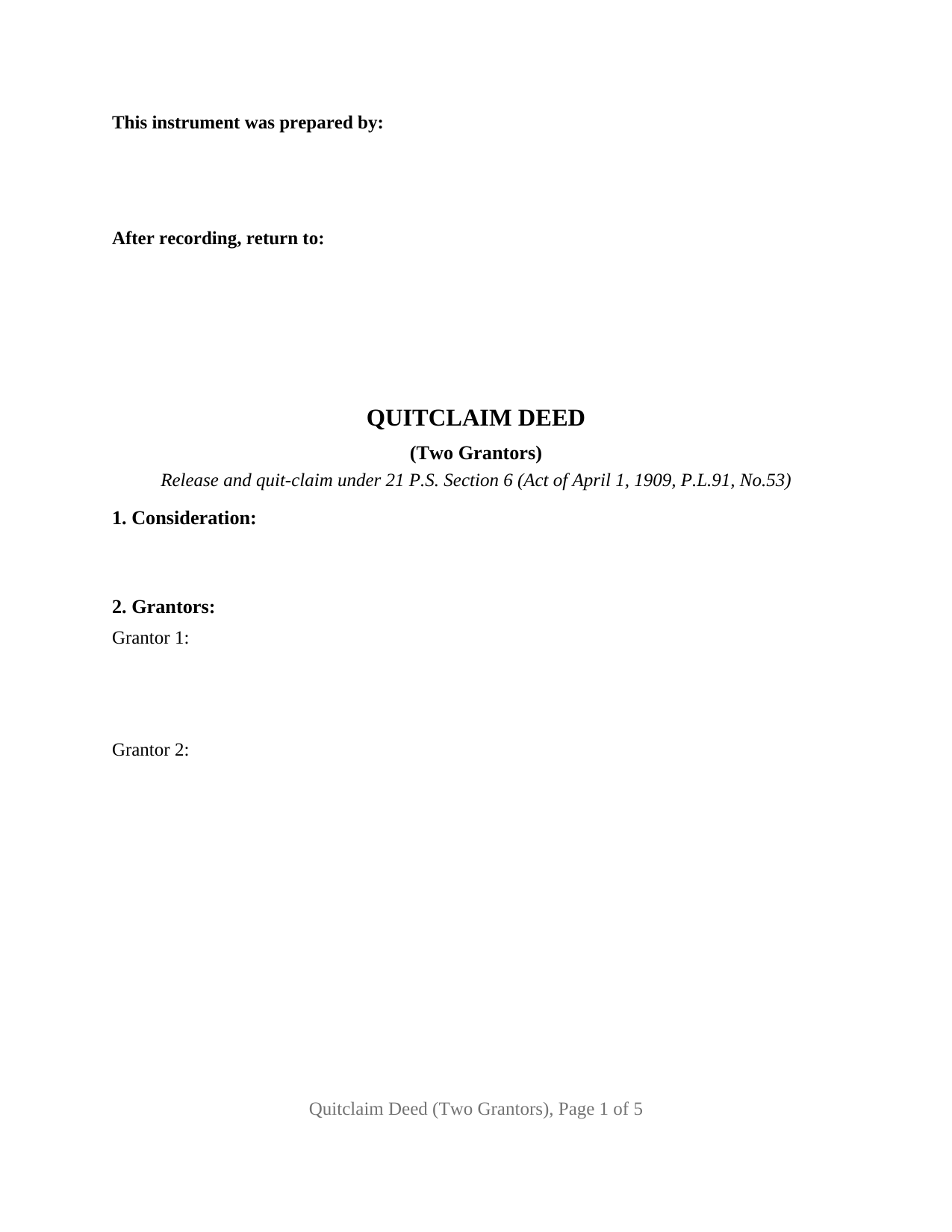
About the Pennsylvania Quitclaim Deed (Two Grantors)
How to Use This Form
- Select your county from the list
- Download the county-specific form
- Fill in the required information
- Have the document notarized if required
- Record with your county recorder's office
What Others Like You Are Saying
"This website is very user friendly. I easily found the form I needed and was given an example for fi…"
"Easy to use and they are very responsive."
"Super easy and efficient. One time charge for the form with no commitment to a recurring charge for …"
"THIS IS MY FIRST EXPERIENCE WITH DEEDS.COM. I DLED THE ESTATE DEED FORM THAT I HOPE WILL GO THROUGH …"
"good format, helpful instructions"
4.8/5 from 4,828 reviews. Read all
A Pennsylvania quitclaim deed built for two grantors carries the release of two record owners in a single instrument: two party blocks, two signature lines with printed names and dates, and an acknowledgment certificate for each signer. Spouses conveying a home they own together, and co-owners joining to pass their combined interests to one grantee, present the two-grantor pattern this quit claim deed form recites, and it releases whatever right, title, and interest both owners hold, without any warranty.
Two releasing owners, one instrument
The grantor section recites two individuals, and the execution architecture follows: each grantor signs and dates the deed, and the form carries its own acknowledgment certificate for each grantor, so the two owners are free to acknowledge on different dates, before different notarial officers, in Pennsylvania or in another state. The patterns that arrive on this configuration run through Pennsylvania county record rooms: a married couple moving a family property to an adult child, two siblings who took inherited title together releasing both undivided shares to a single buyer, and former spouses whose divorce left them tenants in common of equal halves under 23 Pa.C.S. Section 3507, joining in one deed so a third party takes the whole record title. The form recites exactly two releasing owners; a release by one owner alone follows a one-grantor configuration this form is not arranged to carry.
Why entireties title takes both signatures
Pennsylvania treats a conveyance to spouses as creating a tenancy by the entirety, and the Pennsylvania Supreme Court has long described that estate as one and indivisible: during the marriage, neither spouse alone can convey or mortgage the whole (Beihl v. Martin, 1912; Madden v. Gosztonyi Savings and Trust Co., 1938). A deed moving entireties real estate therefore carries both spouses as grantors, which is precisely the structure this two-grantor quitclaim deed supplies. Unmarried co-owners stand differently: Pennsylvania has presumed a tenancy in common since its 1812 act (68 P.S. Section 110), a presumption the court reaffirmed in Grant v. Grant (2025), so each co-owner holds an undivided share, and two co-owners joining in one deed pass the entire record interest at once instead of through two separate instruments.
A release without covenants
The operative section performs the release with the statutory words of 21 P.S. Section 6, remising, releasing, and quitclaiming all of the grantors' right, title, interest, claim, and demand, and then says plainly that the deed makes no covenant and no warranty of title. The grantee takes exactly what the two grantors hold at delivery, subject to matters of record, which is why the quitclaim form suits transfers between people who already know the title: family conveyances, consolidations between co-owners, and record cleanup before a sale.
Built for the Pennsylvania recording counter
The deed arrives at the recorder of deeds ready for Pennsylvania intake conventions: prepared-by and return-to blocks in the first-page top-left area with the right side left open for the recorder's stamp, a parcel identifier entry for the counties whose ordinances call for it, and the certificate of the grantee's precise residence and complete post-office address that 16 P.S. Section 9781 makes part of every recorded Pennsylvania deed. Each acknowledgment certificate prints the statutory short-form sentence of 57 Pa.C.S. Section 316. State and local realty transfer tax are collected when the deed records, and a REV-183 Statement of Value documents nominal-consideration, gift, and excluded family transfers.
The package delivers the blank two-grantor quitclaim deed as a fillable PDF, a completed example showing spouses in Montgomery County conveying to their daughter, and a plain-language guide covering every section, the co-ownership rules, notarization, and county recording. The materials describe Pennsylvania law in general terms and are not legal advice.
Important: County-Specific Forms
Our quitclaim deed (two grantors) forms are specifically formatted for each of the 67 counties in Pennsylvania.
After selecting your county, you'll receive forms that meet all local recording requirements, ensuring your documents will be accepted without delays or rejection fees.