Tennessee Quitclaim Deed (Corrective)
County Specific Legal Forms Validated as recently as October 15, 2026 by our Forms Development Team
About the Tennessee Quitclaim Deed (Corrective)
How to Use This Form
- Select your county from the list
- Download the county-specific form
- Fill in the required information
- Have the document notarized if required
- Record with your county recorder's office
What Others Like You Are Saying
"Deeds.com was so simple and easy to use! My local recorders office is closed due to COVID-19 and the…"
"I found what I needed easily."
"Straightforward, no issues."
"Thank you for this service, saved me from driving down town. It was quick and very easy to navigate.…"
"So far very good. I will know more when I complete the forms and submit them."
4.8/5 from 4,832 reviews. Read all
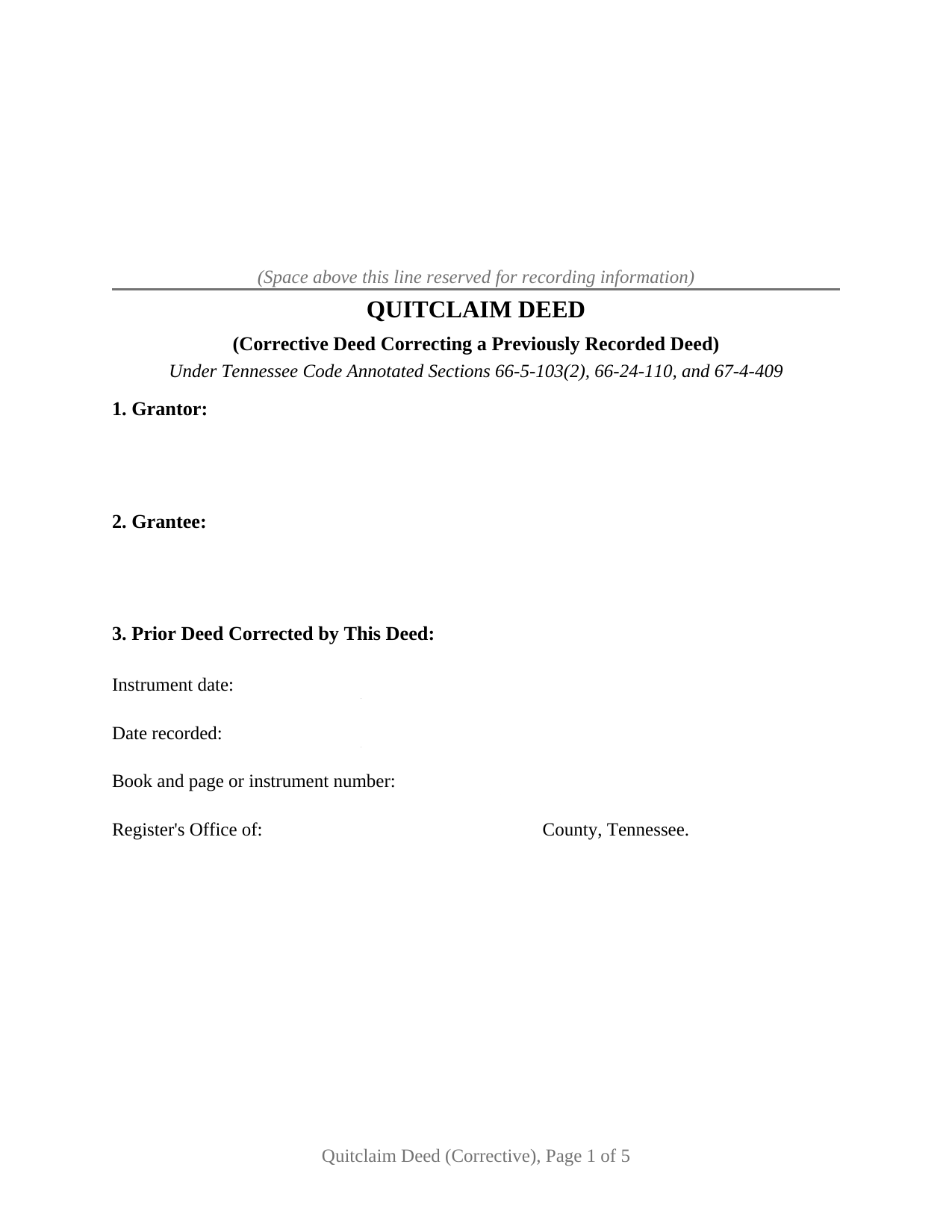
This Tennessee quitclaim deed is written about another deed. It names an instrument already sitting in the register's books, states the matter as that instrument records it, states the matter as corrected, and releases the same interest a second time, so the fix reaches the records as a conveyance rather than a comment on one.
Tennessee answers a deed error twice, and neither answer is a form
The code's first answer is a courthouse. T.C.A. Section 66-5-107, carried forward from an 1813 act, lets a person liable to injury by an error in a deed of conveyance, or in its registration, in courses, distances, or names, petition the circuit court of the county where the land sits. On evident proof the court orders the instrument rectified so as to comport with the intention of the parties, and directs the register to register the conveyance agreeably to the correction. The second answer is an affidavit: Section 66-24-101(a)(27) makes affidavits of scrivener's error registrable, and since 2007 the affiant may attach a document, including a previously recorded one carrying corrections, although guidance published for registers gives that attachment the weight of an exhibit to an affidavit, not of a recorded deed. This form prepares the instrument between those two, the one the original grantor signs.
Three sections that no ordinary release carries
Section 3 pins the earlier instrument down by date, recording date, book and page or instrument number, and the office holding it. Section 4 states the matter as that deed reads, and Section 5 states it as corrected. Section 13 then quitclaims the grantor's right, title, and interest in the land described in Section 7, states that the two instruments cover one conveyance of the same land between the same parties, and leaves the earlier deed otherwise as recorded.
One grantor, one certificate, one sworn figure
The deed recites exactly one grantor, the individual who signed the instrument being corrected, and one grantee, the person that instrument named. A single signature block and a single acknowledgment certificate follow, in the substance of the individual certificate at T.C.A. Section 66-22-107. Below Section 15 the statement of consideration or value carries its own signature line and jurat, since swearing to a figure and acknowledging a signature are separate notarial acts. A lot number contradicted by the recorded plat, a middle initial that never matched the vesting deed, and a street address misstated in a stamped deed present the corrections this instrument recites. It is not drawn for a grantor who has died or cannot be found, for a company, a partnership, or a trustee signing in a representative capacity, or for a change that would hand the grantee more land than the first deed conveyed, which is a fresh conveyance whatever the caption says.
What a correction meets at the tax counter
Tennessee taxes the privilege of recording, at thirty seven cents per one hundred dollars of the statutory base. Keeping the statutory quitclaim substance of T.C.A. Section 66-5-103(2) sets that base at the actual consideration given, under Section 67-4-409(a)(4), which on a correction between the original parties is commonly nothing. None of the exemptions listed in Section 67-4-409(a) is written for a deed of correction, so Section 15 carries a line for the sworn amount and a separate line for an exemption claimed.
What a second deed cannot reach backward and undo
A corrective deed takes its own place in the order of registration. A purchaser, lender, or creditor whose interest was noted for registration between the two recordings keeps the position T.C.A. Sections 66-26-102, 66-26-103, and 66-26-105 give it. The first deed also stays in the books under its own parties, which is why the Section 3 reference matters to a later examiner. Where the parties do not agree on what the first deed was meant to say, the road is reformation, and Sikora v. Vanderploeg, 212 S.W.3d 277 (Tenn. Ct. App. 2006), sets a clear and convincing evidence standard for it. Searchers reach it as a correction deed, a corrective quitclaim deed, a deed of correction, or a quit claim deed correcting a prior deed.
Three files come with the purchase: the deed as a blank fillable PDF, a completed Madison County example carried from the prior deed reference to the jurat under the oath, and a plain language guide covering the fifteen numbered sections, the two notarial acts, and the register's intake. All of it describes Tennessee law generally, for information; none of it is legal advice.
Important: County-Specific Forms
Our quitclaim deed (corrective) forms are specifically formatted for each of the 95 counties in Tennessee.
After selecting your county, you'll receive forms that meet all local recording requirements, ensuring your documents will be accepted without delays or rejection fees.