Tennessee Quitclaim Deed (Trustee Grantee)
County Specific Legal Forms Validated as recently as October 2, 2026 by our Forms Development Team
About the Tennessee Quitclaim Deed (Trustee Grantee)
How to Use This Form
- Select your county from the list
- Download the county-specific form
- Fill in the required information
- Have the document notarized if required
- Record with your county recorder's office
What Others Like You Are Saying
"Easy to use Website. Quick accurate data reporting. I will use the service in the future."
"I was truly impress with the customer service. The young lady that assisted me was AWESOME. She was …"
"Excellent service! Easy to use interface and quick response post-recording."
"was good choice for me but did not realize notary had to witness all 3 signatures at the same luckil…"
"So simple. Thank you."
4.8/5 from 4,818 reviews. Read all
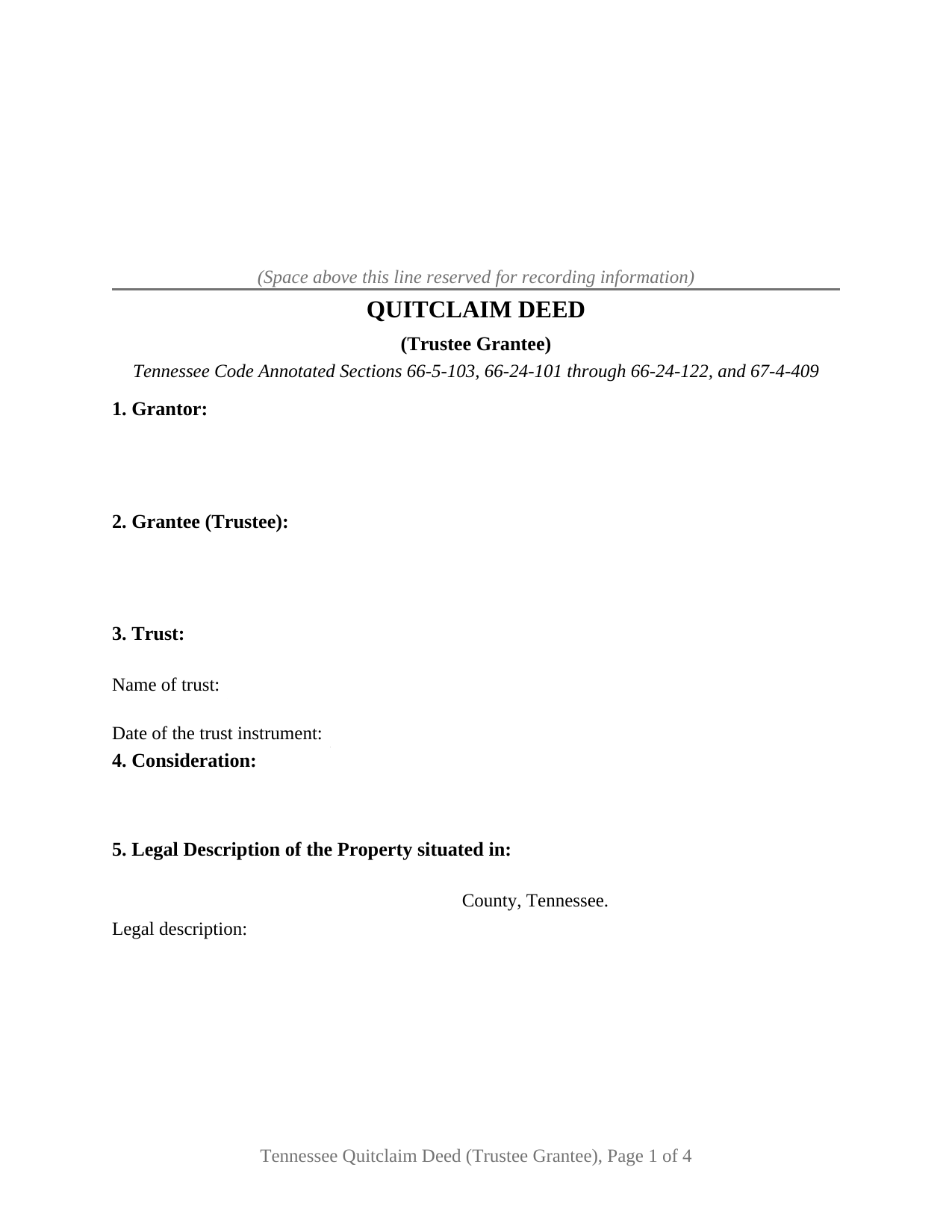
The grantee line on this Tennessee quitclaim deed carries a name and a capacity. Title goes to a trustee, identified with the trust that trustee serves and the date of the trust instrument, and one individual grantor signs the release that puts it there.
Title lands in the trustee, not in the trust
A trust is not a company. It files no charter, and under the Tennessee Uniform Trust Code at Title 35, Chapter 15, it holds nothing in its own name; the trustee holds legal title and administers the property under the trust instrument. That is why the grantee section of this deed asks for a person and an office rather than an entity, and why Section 3 collects the trust name and the date of the trust instrument beside it. The operative language follows the same logic: title vests in the grantee in the capacity of trustee and in the successor trustees serving under that trust, so a later change in who holds the office moves the administration without moving the title out of it. A title company or lender asking what the trust says looks to the certification of trust of Section 35-15-1013, a notarized statement of the trust's existence, date, trustees, and trustee powers, prepared separately and not included here.
One grantor, one trustee grantee
The form is drawn for exactly two parties: one individual grantor conveying personally, and one grantee taking as trustee. It carries a single grantor signature block with one acknowledgment certificate in the substance of the statutory form at Section 66-22-107. The trustee appears twice more: at Section 10, where the owner and tax responsible party entries name the trustee in that capacity at the address where the tax notice arrives, and below Section 13, where the grantee, the grantee's agent, or a trustee acting for the grantee swears the consideration or value figure. A sole owner moving a residence into that owner's own revocable living trust, and an owner deeding a parcel to the trustee of a family trust that already holds other property, present the title movement this deed describes. The form is not set up for a grantor signing in a fiduciary or representative capacity, for two record owners releasing together, or for a grantee taking individually rather than as trustee.
Where the transfer tax lands on a deed into a trust
Every Tennessee deed passes a tax counter before it reaches the records, at thirty seven cents per one hundred dollars of consideration or value, whichever is greater, collected by the register from the grantee. Two provisions matter here. A deed keeping the statutory quitclaim substance is taxed on the actual consideration given rather than on value, under Section 67-4-409(a)(4). And Section 67-4-409(a)(1)(C)(vi) exempts a transfer by a transferor of real estate to a revocable living trust created by the same transferor or by that transferor's spouse, along with a transfer by the trustee of such a trust back to the transferor or the transferor's spouse; where the exemption reaches the transaction, no oath of value is called for at all. Section 13 collects the sworn amount on one line and the exemption claimed on another. A deed to a trustee who is not the settlor sits on different ground.
What the trustee actually receives
Buyers reach this instrument as a quitclaim deed, a quit claim deed, or a deed transferring property into a trust. Whatever the label, Section 66-5-103(2) of the Tennessee Code prints the operative substance in one sentence, and this form keeps it: the grantor quitclaims all of the grantor's interest in the described land. Deeds of trust, judgment liens, easements, and unpaid taxes travel with the parcel into the trustee's hands, and no covenant of title stands behind the transfer. Section 66-24-110 asks the deed itself to state where the grantor's interest came from, and the numbered sections gather the parcel identification number, the source of the legal description, the improved property notation, and the preparer statement that Tennessee registers read at intake.
Three files arrive with the purchase: the deed as a blank fillable PDF; a Williamson County example worked through from the grantor line to the jurat beneath the oath; and a plain language guide that walks the numbered sections, the trustee vesting language, the swearing of the oath, and the counter at the register's office. All of it is informational, a description of Tennessee law rather than legal advice about a particular title or trust.
Important: County-Specific Forms
Our quitclaim deed (trustee grantee) forms are specifically formatted for each of the 95 counties in Tennessee.
After selecting your county, you'll receive forms that meet all local recording requirements, ensuring your documents will be accepted without delays or rejection fees.