Tennessee Quitclaim Deed (Interspousal)
County Specific Legal Forms Validated as recently as October 16, 2026 by our Forms Development Team
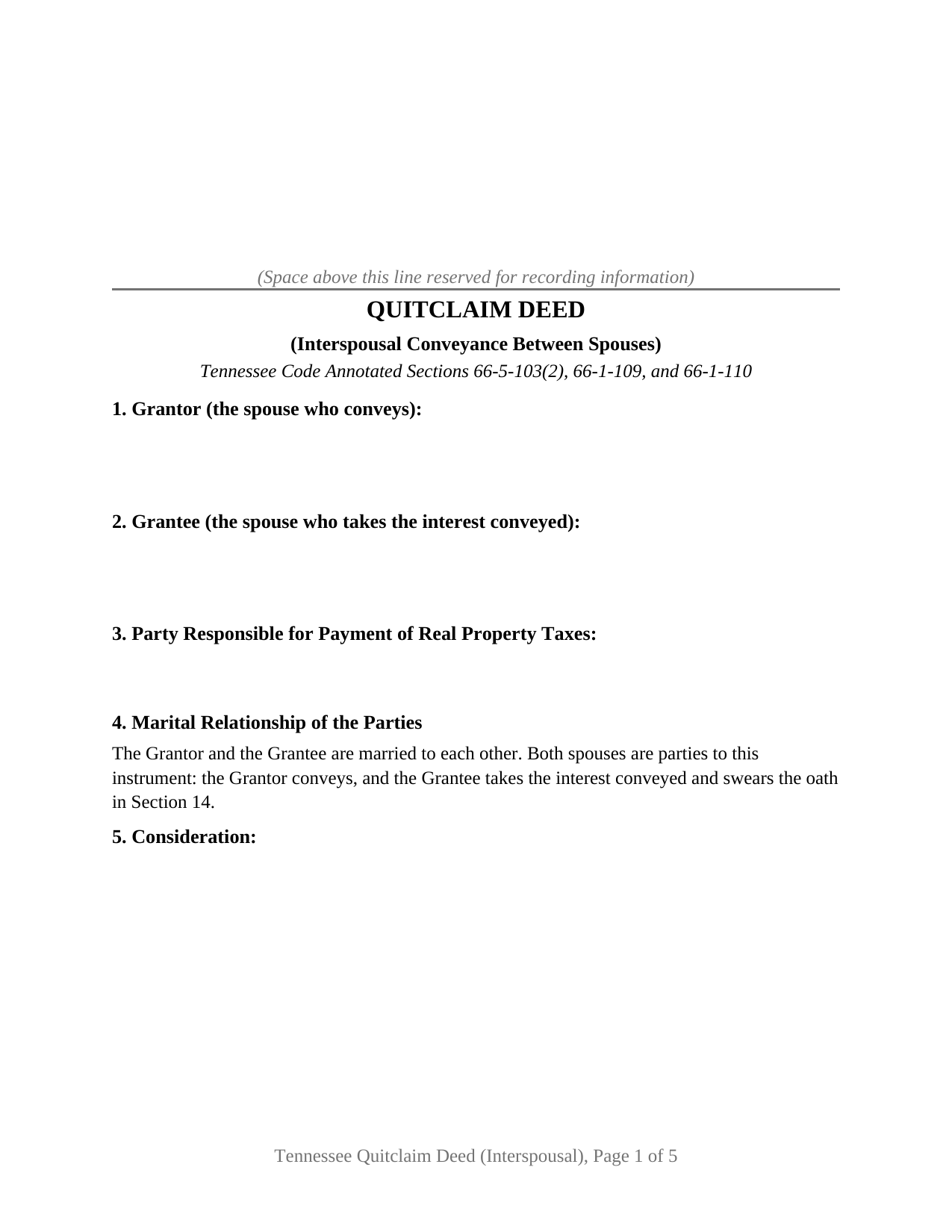
About the Tennessee Quitclaim Deed (Interspousal)
How to Use This Form
- Select your county from the list
- Download the county-specific form
- Fill in the required information
- Have the document notarized if required
- Record with your county recorder's office
What Others Like You Are Saying
"Looks like a very professional site. I just don’t know what it would cost using this site."
"Received everything that was promised."
"Thank you for making this easy!"
"I was skeptical after experiencing other websites. However not only did we get the form we needed fo…"
"We were very pleased at how quickly the forms showed up and the guide and copy of a sample filled in…"
4.8/5 from 4,829 reviews. Read all
Grantor and Grantee on this Tennessee quitclaim deed are married to each other. The form is built for a conveyance that stays inside a marriage: one spouse releases whatever interest that spouse holds in Tennessee real property, and the other spouse takes it, on the single signature line the conveying spouse signs.
Two statutes written for a deed running spouse to spouse
Tennessee legislated this transfer in both directions, and the deed names each provision on its face. Where the spouses already hold as tenants by the entirety, T.C.A. Section 66-1-110 provides that either spouse may, by direct conveyance of that spouse's interest, vest the other spouse with title to the property in fee simple. Running the other way, T.C.A. Section 66-1-109 lets a married person who owns property in that person's own name convert the interest into an estate by the entireties with that person's spouse by direct conveyance to the spouse, in an instrument providing that it is the grantor's intention to create an estate by the entireties in and to the entire interest previously held by the grantor. That intention language is statutory, and Section 11 of the form is where it goes.
One conveying spouse, one receiving spouse
The form recites exactly two parties, natural persons married to each other, with one conveying and one taking. It carries a single grantor signature block and a single acknowledgment certificate under T.C.A. Section 66-22-107, because the conveyance takes one signature. The receiving spouse appears twice more: in the grantee section, which collects the name and address T.C.A. Section 66-24-114 makes recording data, and at the sworn statement below Section 14, where the grantee swears the consideration or value figure. Section 4 states the marriage on the face of the instrument, and Section 12 addresses the homestead consent sentence of T.C.A. Section 26-2-301 directly, since a marital relationship is what brings that section into a lifetime conveyance. A spouse whose separately owned house becomes an entireties parcel, and a spouse whose entireties interest passes to the other spouse so that spouse holds alone in fee simple, present the two title movements this deed recites. The form is not set up as a conveyance to someone other than the grantor's spouse, as a release by two record owners acting together, or as a signing in a representative capacity for a trust, an estate, or an entity.
The tax line a deed between spouses opens
Recording a Tennessee deed is a tax event, and the register collects the realty transfer tax before the instrument goes into the records, computed at $0.37 for each $100 of the consideration or the property's value, whichever is greater. A conveyance between spouses meets an express exemption: T.C.A. Section 67-4-409(a) exempts the creation or dissolution of a tenancy by the entirety by the conveyance from one spouse to the other, which reaches both of the movements above, and an exempt transaction calls for no oath of value at all. Where tax is owed instead, a deed keeping the statutory quitclaim substance of T.C.A. Section 66-5-103(2) is taxed on the actual consideration rather than on value under Section 67-4-409(a)(4). Section 14 collects the sworn figure and carries a separate line for the exemption claimed, so the deed arrives at the counter with the register's arithmetic already stated.
A release, with a release's honest limits
Buyers reach this instrument as an interspousal quitclaim deed, a quit claim deed between spouses, or a deed adding a spouse to title. Whatever the label, what passes is the grantor spouse's interest exactly as it stands, with no covenant of title behind it: deeds of trust, judgment liens, easements, restrictions, and unpaid taxes ride along, and a spouse who signed a note stays liable on that debt after the deed records. The numbered sections also collect what a Tennessee register reads before recording: the derivation of title recital of T.C.A. Section 66-24-110, the assessor's parcel identification number, the source of the legal description, and the preparer statement.
The download holds the blank deed as a fillable PDF, a completed example set in Shelby County that shows every numbered section, the certificate, and the sworn oath filled in, and a plain language guide covering each section, the notarization and oath mechanics, the transfer tax exemptions, and filing with the register of deeds. The materials describe Tennessee law in general terms for information, and none of it is legal advice.
Important: County-Specific Forms
Our quitclaim deed (interspousal) forms are specifically formatted for each of the 95 counties in Tennessee.
After selecting your county, you'll receive forms that meet all local recording requirements, ensuring your documents will be accepted without delays or rejection fees.