Tennessee Quitclaim Deed (Trustee Grantor)
County Specific Legal Forms Validated as recently as September 22, 2026 by our Forms Development Team
About the Tennessee Quitclaim Deed (Trustee Grantor)
How to Use This Form
- Select your county from the list
- Download the county-specific form
- Fill in the required information
- Have the document notarized if required
- Record with your county recorder's office
What Others Like You Are Saying
"Easy to use service. Thank you."
"I was very happy with this site. It included all the papers I needed, instructions, and even an exam…"
"Great service! The example completed form and instructions provided by Deeds.com were extremely help…"
"My questions were answered promptly. I was not able to locate the deed I was searching for because m…"
"Very easy to use. Had my Transfer of Death Designation Affidavit done in no time and filed with the …"
4.8/5 from 4,833 reviews. Read all
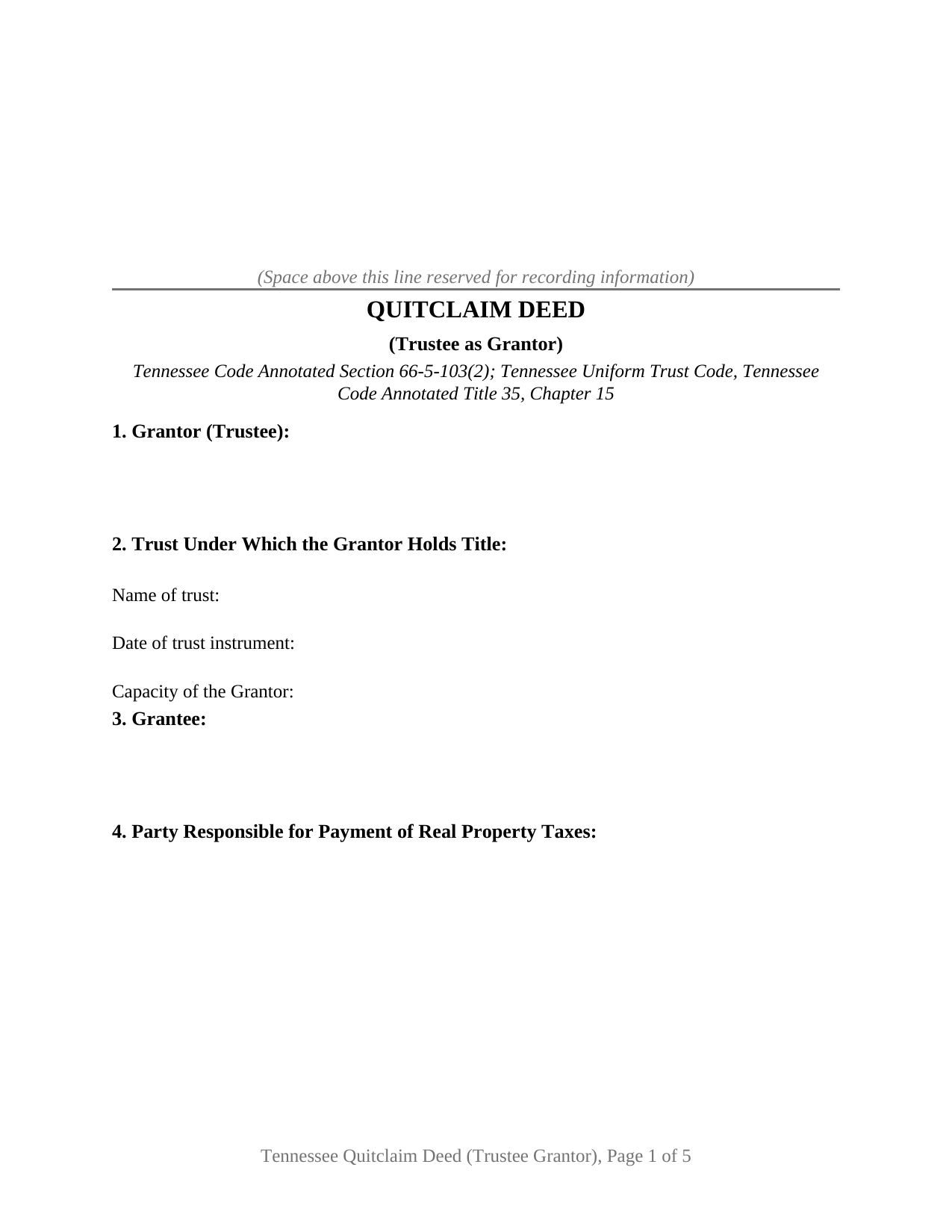
Title stands in a trustee, and the trustee is the one who signs. This Tennessee quitclaim deed is built for that configuration: a trustee holding legal title under a trust releases the trust's interest in Tennessee real property, signing in the capacity the deed recites and not individually.
The office signs, and the deed says which office
Under the Tennessee Uniform Trust Code at Title 35, Chapter 15, trust land stands in the name of whoever occupies the office of trustee. The grantor block therefore asks for a person and an office, and Section 2 pins the office down: the trust name, the date of the trust instrument, and whether the signer acts as trustee, successor trustee, or cotrustee. Section 13 carries that capacity onto the signature line, and the acknowledgment blank takes it as well.
Powers the trust code supplies, proof it does not
Section 35-15-815 provides that a trustee may exercise the powers conferred by the terms of the trust and, except as those terms limit them, all powers over the trust property that an unmarried competent owner has over individually owned property. Section 35-15-816(b) adds specific powers, unless the trust instrument expressly provides otherwise, among them the power to acquire or sell property at public or private sale. Section 12 recites both. Section 35-15-1012 protects a person other than a beneficiary who deals with a trustee in good faith and for value, and relieves that person of any duty to inquire into the extent of a trustee's powers. What the deed cannot do is prove the office: the certification of trust of Section 35-15-1013 is prepared separately and is not included with this form.
The exemption menu Tennessee wrote for deeds leaving a trust
Every deed passes the register's tax counter at thirty seven cents per one hundred dollars of consideration or value, whichever is greater. Three subdivisions of Section 67-4-409(a)(1)(C) name deeds a trustee signs: a transfer by the trustee of a revocable living trust back to the same transferor or that transferor's spouse, under (vi); a deed by such a trustee implementing a testamentary devise by the trustor, under (vii); and a deed by the trustee of a testamentary or revocable living trust implementing distribution of the property to trust beneficiaries, under (viii). An exempt transaction calls for no oath of value at all. Not every trust appears on that list, and a taxable trustee's deed still takes the quitclaim measure, tax on actual consideration rather than appraised value, so Section 14 holds a line for the sworn amount and another for an exemption claimed instead.
One trustee, one certificate, one sworn figure
The form recites exactly one grantor, a trustee acting for one identified trust, and one grantee. It carries one signature block, one acknowledgment certificate in the substance of the statutory certificate at Section 66-22-107, and, below the oath section, a signature line and jurat for the person who swears the value. A successor trustee deeding a residence to the beneficiaries after the settlor's death, a trustee returning a parcel to the person who created the trust, and a trustee releasing trust land in a family settlement present the movements this deed recites. It is not set up for two cotrustees signing together, the pattern Section 35-15-703 addresses, for an individual conveying personally, or for a grantee taking in a fiduciary capacity.
Recitals a Tennessee register expects on a fiduciary deed
Buyers reach it as a trustee's quitclaim deed, a quit claim deed from a trust, or a deed transferring property out of a trust. Its numbered sections gather what the register reads at intake: the derivation of title recital of Section 66-24-110, which on a fiduciary deed points to the instrument that put title in the trustee's hands, plus the owner and tax party entries of Section 66-24-114, the parcel number of Section 66-24-122, the description source of Section 66-24-121, the improved property notation of Section 66-24-113, and the preparer statement of Section 66-24-115. What it does not carry is a promise: liens, easements, and unpaid taxes stay with the parcel, and no covenant of title stands behind the release.
The download holds the blank deed as a fillable PDF, a completed Sumner County example running from the trust identification through the jurat beneath the oath, and a plain language guide covering every numbered section, the capacity language, and recording with the register of deeds. It describes Tennessee law in general terms for information and is not legal advice.
Important: County-Specific Forms
Our quitclaim deed (trustee grantor) forms are specifically formatted for each of the 95 counties in Tennessee.
After selecting your county, you'll receive forms that meet all local recording requirements, ensuring your documents will be accepted without delays or rejection fees.