Tennessee Quitclaim Deed (Individual Grantor by Attorney-in-Fact under Power of Attorney)
County Specific Legal Forms Validated as recently as October 22, 2026 by our Forms Development Team
About the Tennessee Quitclaim Deed (Individual Grantor by Attorney-in-Fact under Power of Attorney)
How to Use This Form
- Select your county from the list
- Download the county-specific form
- Fill in the required information
- Have the document notarized if required
- Record with your county recorder's office
What Others Like You Are Saying
"Nice, clear, well formatted documents. Good information provided."
"Great fillable form! And the separate instruction sheet was detailed and very clear. I particularly …"
"very quick and easy"
"The website is easy to navigate. Unfortunately, you were not able to record the deed. However, I app…"
"Documents were easy to complete!"
4.8/5 from 4,832 reviews. Read all
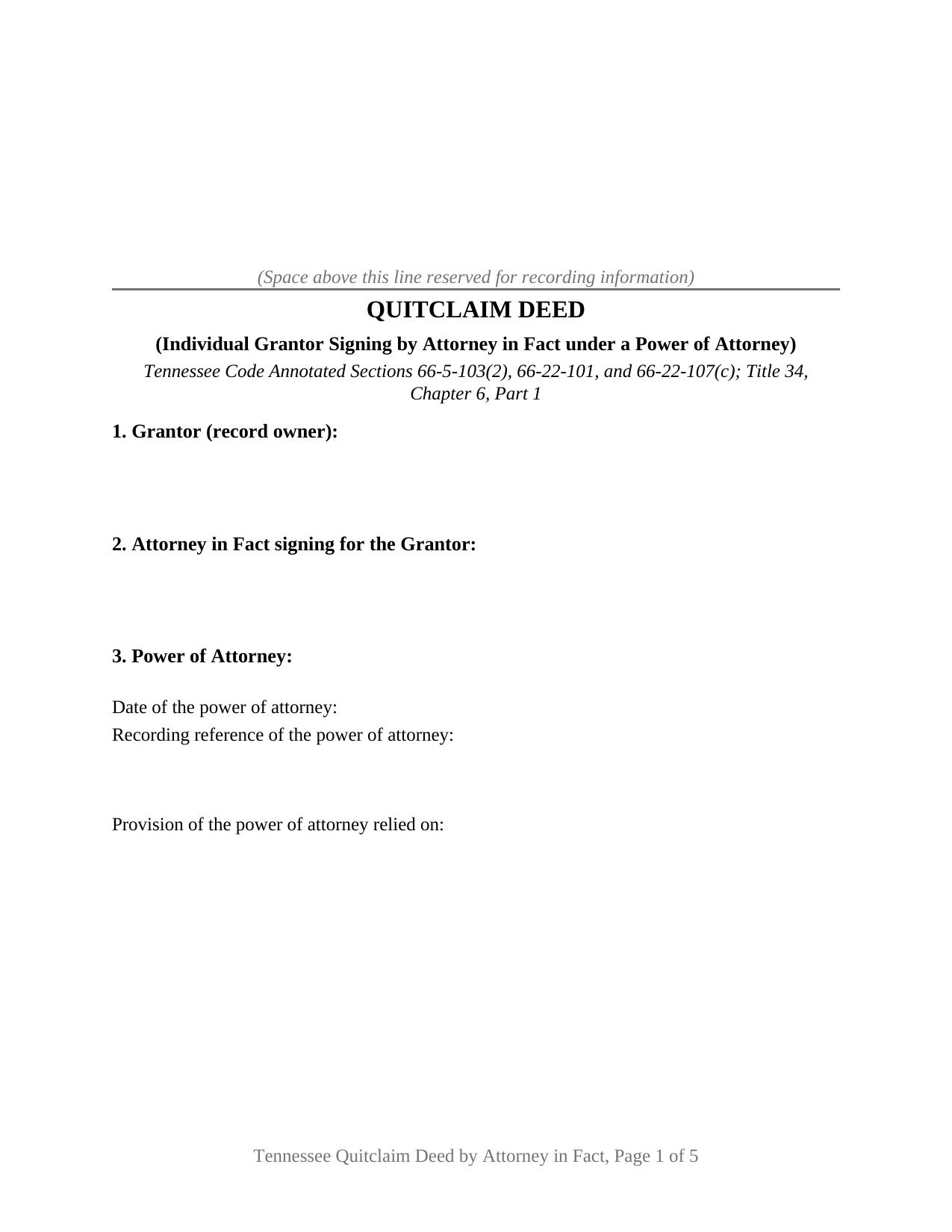
Someone who owns no part of the land signs this Tennessee quitclaim deed. Record title stays with the Grantor the deed names, while an attorney in fact writes that owner's name under a power of attorney signed earlier. The form is drawn for that movement: one individual record owner releasing whatever interest the owner holds in Tennessee real property, over an agent's single signature.
Where the signature gets its authority
Section 66-22-101 asks for an original signature from the maker, or from the natural person signing for the maker, so Tennessee registration law already reaches a signer who is not the owner. The authority comes from the Uniform Durable Power of Attorney Act, Title 34, Chapter 6, Part 1. Section 34-6-102 makes a power durable when its writing says the authority survives the principal's incapacity. Section 34-6-109 enumerates the agent's powers, opening with the power to generally do, sign or perform in the principal's name, place and stead any act, deed, matter or thing whatsoever.
A certificate for a signer acting by attorney
Section 66-22-107(c) prints a certificate for natural persons acting by attorney, and Section 14 carries its substance: a named person appeared, known or proved to be the person who executed the instrument in behalf of another, and acknowledged executing it as that other person's free act and deed. The blank takes the signer's name and capacity as attorney in fact.
Nominal consideration, and the question it opens
A quitclaim recited at ten dollars is ordinary between relatives, but signed by an agent it meets provisions no other configuration reaches. Section 34-6-108(c) provides that powers incorporated by reference do not authorize gifts, grants, or other transfers without consideration, apart from charitable pledges made while the principal was competent. Section 34-6-110(a) runs the other way: where the writing lets the agent do any act the principal might do, or shows intent to give full power over the principal's property, gift authority follows, measured against the principal's history of lifetime giving. Section 34-6-107 keeps the agent a fiduciary.
One owner, one agent, one signature
The form recites exactly one Grantor holding record title, one attorney in fact, and one Grantee, with a single signature block and a single acknowledgment certificate, since one person signs the conveyance. Section 12 states what that signer asserts: signing in the owner's name and not individually, under a power of attorney that authorizes the conveyance, with no actual knowledge of its revocation or termination. The sworn statement below Section 15 takes its own signature line and jurat, signed on the Grantee side under Section 67-4-409(a)(1)(F). An owner in a care facility whose agent releases a fractional interest to the co-owner buying it, and an owner abroad whose agent finishes a family land sale, present the movements this deed recites. It is not drawn for an owner signing personally, for two owners releasing together, for a spouse joining to give homestead consent under Section 26-2-301(b), or for a signer whose authority runs from a trust instrument or an operating agreement.
The record standing behind the deed
Tennessee treats the authority document as recordable in its own right: Section 66-24-101(a)(2) makes powers of attorney authorizing the conveyance of real estate eligible for registration, which is how the agent's authority reaches a later examiner. Section 34-6-105(c) adds a companion paper: an affidavit by the attorney in fact stating no actual knowledge that the power has been revoked or terminated, which the statute makes conclusive proof of nonrevocation as to acts taken in good faith reliance, and recordable when authenticated for record. Both are prepared separately. Tennessee even wrote a curative rule for these deeds: under Section 66-26-108, such a deed registered twenty years or more in the county where the land lies is presumed properly made.
What passes is the owner's interest as it stands, with deeds of trust, liens, easements, and unpaid taxes riding along and no covenant of title behind it. Keeping the statutory quitclaim wording of Section 66-5-103(2) keeps the Section 67-4-409(a)(4) measure, tax figured on actual consideration rather than appraised value. Buyers search this one as a quitclaim deed signed by an attorney in fact, a quit claim deed under a power of attorney, or a POA deed. The purchase delivers the blank deed as a fillable PDF, a completed Sevier County example, and a plain language guide covering the fifteen sections, the notarial acts, and the register's counter. It describes Tennessee law in general terms for information and is not legal advice.
Important: County-Specific Forms
Our quitclaim deed (individual grantor by attorney-in-fact under power of attorney) forms are specifically formatted for each of the 95 counties in Tennessee.
After selecting your county, you'll receive forms that meet all local recording requirements, ensuring your documents will be accepted without delays or rejection fees.