Tennessee Quitclaim Deed (Married Grantor with Non-Owner Spouse Joinder)
County Specific Legal Forms Validated as recently as October 1, 2026 by our Forms Development Team
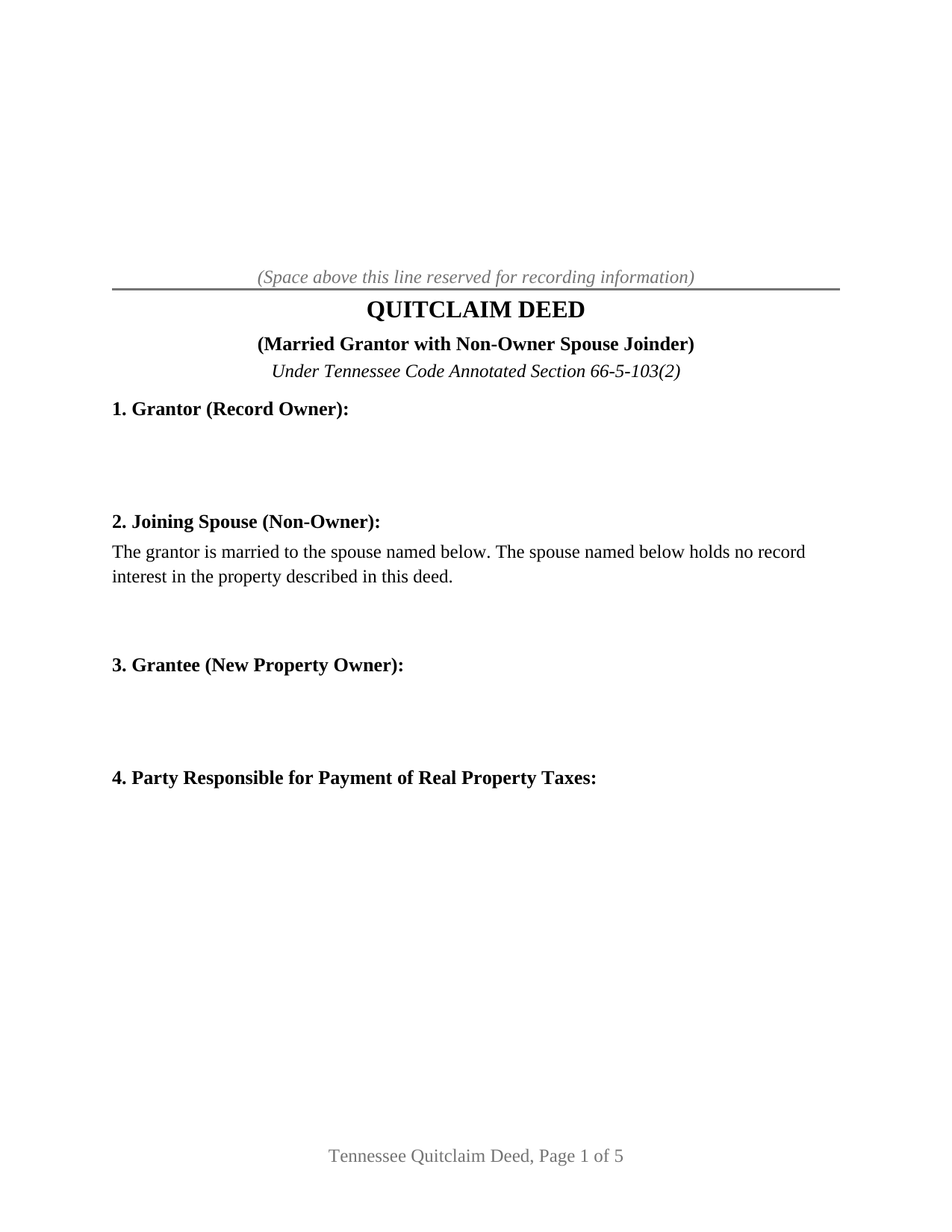
About the Tennessee Quitclaim Deed (Married Grantor with Non-Owner Spouse Joinder)
How to Use This Form
- Select your county from the list
- Download the county-specific form
- Fill in the required information
- Have the document notarized if required
- Record with your county recorder's office
What Others Like You Are Saying
"Really liked the quick access to documents. Great service, thanks."
"This is my fourth try, and I hope my form is complete and acceptable."
"Great service and easy use"
"Overall positive experience; especially liked immediate access to downloaded documents and instructi…"
"Great bargain! Thanks. Easy to download forms. -Keith M"
4.8/5 from 4,830 reviews. Read all
The second signature line on this Tennessee quitclaim deed belongs to a person who owns nothing. Record title stands in one spouse's name, and the other spouse signs to consent. That is the configuration this form is built for: one married record owner releasing whatever interest that owner holds in Tennessee real property, with the nonowner spouse joining to supply the joint consent Tennessee's homestead statute describes.
The spouse who is not on the deed
Tennessee abolished dower and curtesy in 1977 and is not a community property state, so a spouse whose name never reached the deed records ordinarily holds no interest to convey. What that spouse does hold is homestead. T.C.A. Section 26-2-301(a) attaches a homestead exemption to property used by the owner, the owner's spouse, or a dependent as a principal place of residence, and subsection (b) provides that while a marital relationship exists, a homestead exemption is not alienated or waived without the joint consent of the spouses. Subsection (d) completes the mechanism: an instrument conveying property in which there may be a homestead exemption, duly executed, conveys the property free of the exemption. The joining signature is what makes the consent joint, and this deed records it on the instrument's face.
One grantor, one consenting spouse
The form recites exactly one grantor, an individual who holds record title and is married, and one joining spouse who holds no record interest. Section 2 names that spouse and states the marriage and the absence of a record interest. Section 11 does the legal work in three sentences: the grantor quitclaims all of the grantor's interest in the described land; the joining spouse consents to the conveyance and to the alienation of any homestead exemption under Section 26-2-301(b), while conveying no interest and making no covenant of title. Each signer has a signature block and an acknowledgment certificate of its own, so the two signatures can be taken on different days or before different notaries. Land that came to one spouse before the marriage, land that arrived by inheritance or gift, and land deeded to one spouse alone are the title patterns this configuration recites. The form is not set up for two record owners conveying together, or for a trustee, executor, or entity signing in a representative capacity.
A release, not a promise
What passes is the grantor's interest exactly as it stands. T.C.A. Section 66-5-103(2), Tennessee's statute of sufficient deed forms, prints the quitclaim in a single sentence, and a deed carrying that substance conveys the grantor's right, title, and interest with no covenant to sue on. Deeds of trust, judgment liens, easements, restrictions, and unpaid property taxes travel with the land. Searchers reach the instrument as a quitclaim deed, a quit claim deed, or a quick claim deed.
The sworn figure, not the appraisal
Recording a Tennessee deed collects the state transfer tax, thirty seven cents per one hundred dollars of consideration or value, stated on county schedules as $3.70 per $1,000 and collected from the grantee before the instrument records. A deed in the statutory quitclaim form conveying only the grantor's interest is taxed under Section 67-4-409(a)(4) on the actual consideration rather than on value, a materially different figure on a transfer recited at ten dollars. Section 13 carries the oath that figure rests on, sworn by the grantee or the grantee's agent before an officer authorized to administer oaths.
What the register reads at the counter
Tennessee writes several recording requirements into the deed itself, and the numbered sections collect each one: the derivation of title recital of Section 66-24-110; the name and address of the new owner and of the party responsible for the property taxes under Section 66-24-114; the assessor's parcel identification number under Section 66-24-122; the source of the legal description under Section 66-24-121; the property identification map number and improved property notation Section 66-24-113 calls for in metropolitan Nashville and Davidson County; and the preparer statement of Section 66-24-115. Where an instrument leaves no room for the register's certificate, Section 8-13-108(a)(6) lets the register add a page at the page fee, so the form reserves the top of the first page for the stamp.
The download holds the blank deed as a fillable PDF, a completed example set in Rutherford County, and a plain language guide walking each section, the two certificates, the sworn oath, and the filing itself. All of it describes Tennessee law generally, for information, and none of it is legal advice.
Important: County-Specific Forms
Our quitclaim deed (married grantor with non-owner spouse joinder) forms are specifically formatted for each of the 95 counties in Tennessee.
After selecting your county, you'll receive forms that meet all local recording requirements, ensuring your documents will be accepted without delays or rejection fees.