Texas Deed Without Warranty (Grantor to Own Revocable Trust)
County Specific Legal Forms Validated as recently as October 5, 2026 by our Forms Development Team
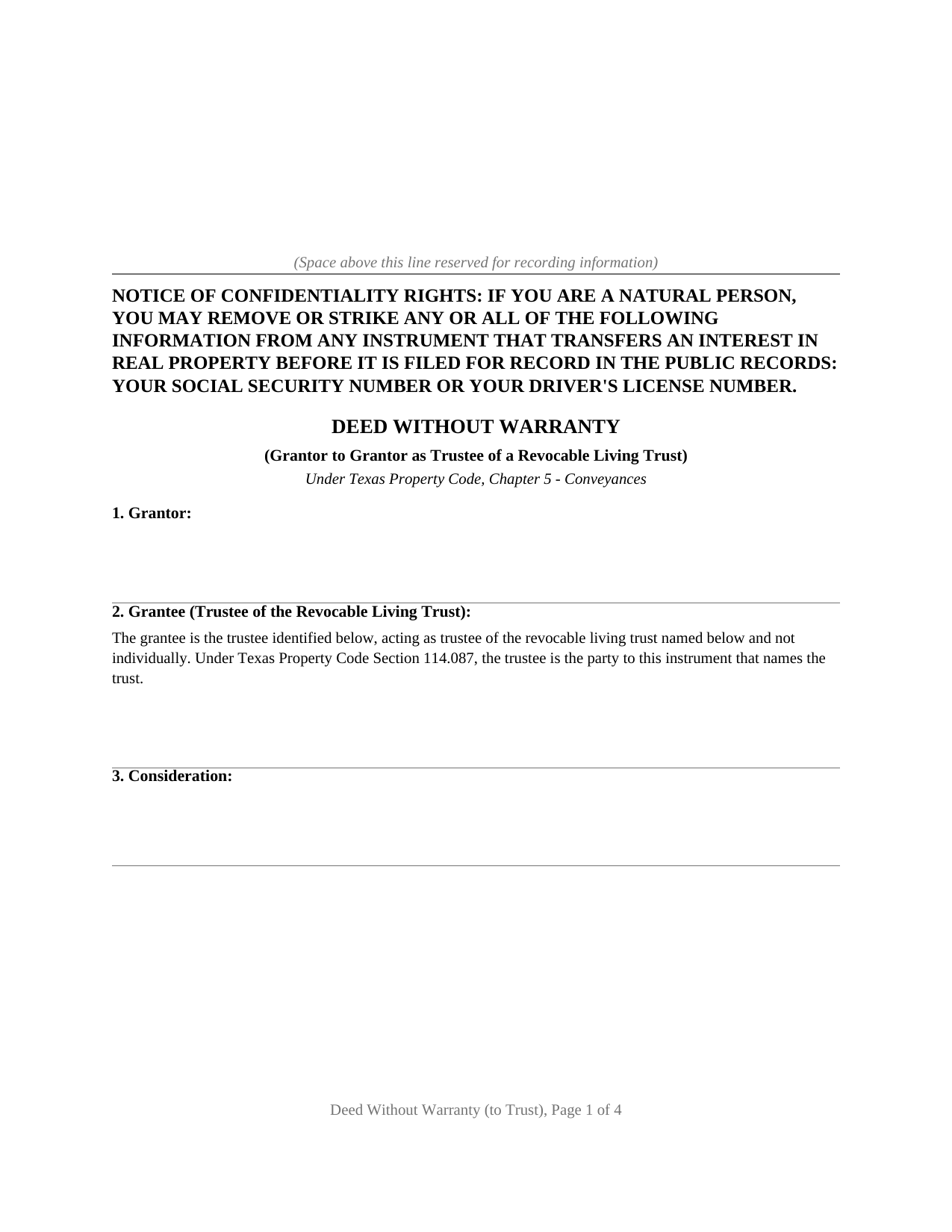
About the Texas Deed Without Warranty (Grantor to Own Revocable Trust)
How to Use This Form
- Select your county from the list
- Download the county-specific form
- Fill in the required information
- Have the document notarized if required
- Record with your county recorder's office
What Others Like You Are Saying
"Download worked exactly as portrayed - will definitely use service again when needed."
"This process is outstanding, and it saved the hassle of going downtown and dealing with traffic."
"I'm still working on it. I'm surprised that it appears so much information has to be included about …"
"Easy site to use. Well worth the time spent to complete the form."
"Super efficient, extremely responsive , and above all quick turnaround. Thank you! Will definitely u…"
4.8/5 from 4,828 reviews. Read all
Moving real property into a revocable living trust is how an estate plan takes effect for real estate. The owner transfers title to herself as trustee, and from that moment the property is a trust asset. When grantor and trustee are the same person, there is nothing to warrant about the title. This form prepares a Texas deed without warranty for that transfer: from an individual owner to that same individual acting as trustee of the owner's own revocable living trust, under Chapter 5 of the Texas Property Code.
A transfer deed, not a quitclaim
A deed without warranty occupies a precise legal position. It conveys the property itself, using the operative word CONVEYS, which places it among true conveyance deeds rather than quitclaims. A quitclaim passes only whatever right, title, and interest the grantor holds, a posture courts read as doubt about the title; a deed without warranty passes the property and simply makes no promise about it. Texas courts look at the whole instrument to decide which a deed is, not just the caption, and this form is drafted to come down on the conveyance side.
Why the warranty exclusion must be spelled out
Texas Property Code Section 5.023 hides a trap in ordinary conveyance language. The words grant or convey imply two covenants unless the deed expressly provides otherwise: that the grantor has not already conveyed the estate to someone else, and that the property is free from encumbrances. A deed labeled without warranty that simply grants and conveys can still carry those statutory covenants. This form closes the gap: its conveyance section expressly excludes the Section 5.023 covenants and all other title warranties, so the operative words import no promise the grantor never intended to make.
Naming the trustee as grantee
Texas Property Code Section 114.087 establishes that the trustee, not the trust itself, is the party to an instrument that names the trust. Title vests in the trustee in a fiduciary capacity; the trust entity holds no title. This form names the grantee in full: the individual's name, the word Trustee, the exact name of the trust as stated in the trust instrument, and the date the trust was created. A shorthand description, or a description that mismatches the trust instrument's language, can leave a gap in the chain of title that surfaces at the next conveyance or refinance.
Homestead and the joining-spouse block
A deed without warranty is a present conveyance, and a present conveyance of the homestead requires both spouses to sign under Texas Family Code Section 5.001. The form carries a joining-spouse signature block and a separate acknowledgment certificate for a spouse who is not the record owner, so the homestead joinder requirement can be satisfied where the property qualifies. Where the property is not homestead or the grantor has no spouse, the block is left blank; a joining spouse conveys no separate ownership interest by signing.
What the package includes
The package includes the blank deed as a fillable PDF, a completed example filled in for a realistic Travis County fact pattern, and a plain-language guide that walks through every numbered section, explains the governing statutes, and describes signing, notarization, and recording. The materials are informational and are not legal advice.
Important: County-Specific Forms
Our deed without warranty (grantor to own revocable trust) forms are specifically formatted for each of the 254 counties in Texas.
After selecting your county, you'll receive forms that meet all local recording requirements, ensuring your documents will be accepted without delays or rejection fees.