Texas Deed Without Warranty (Individual)
County Specific Legal Forms Validated as recently as September 18, 2026 by our Forms Development Team
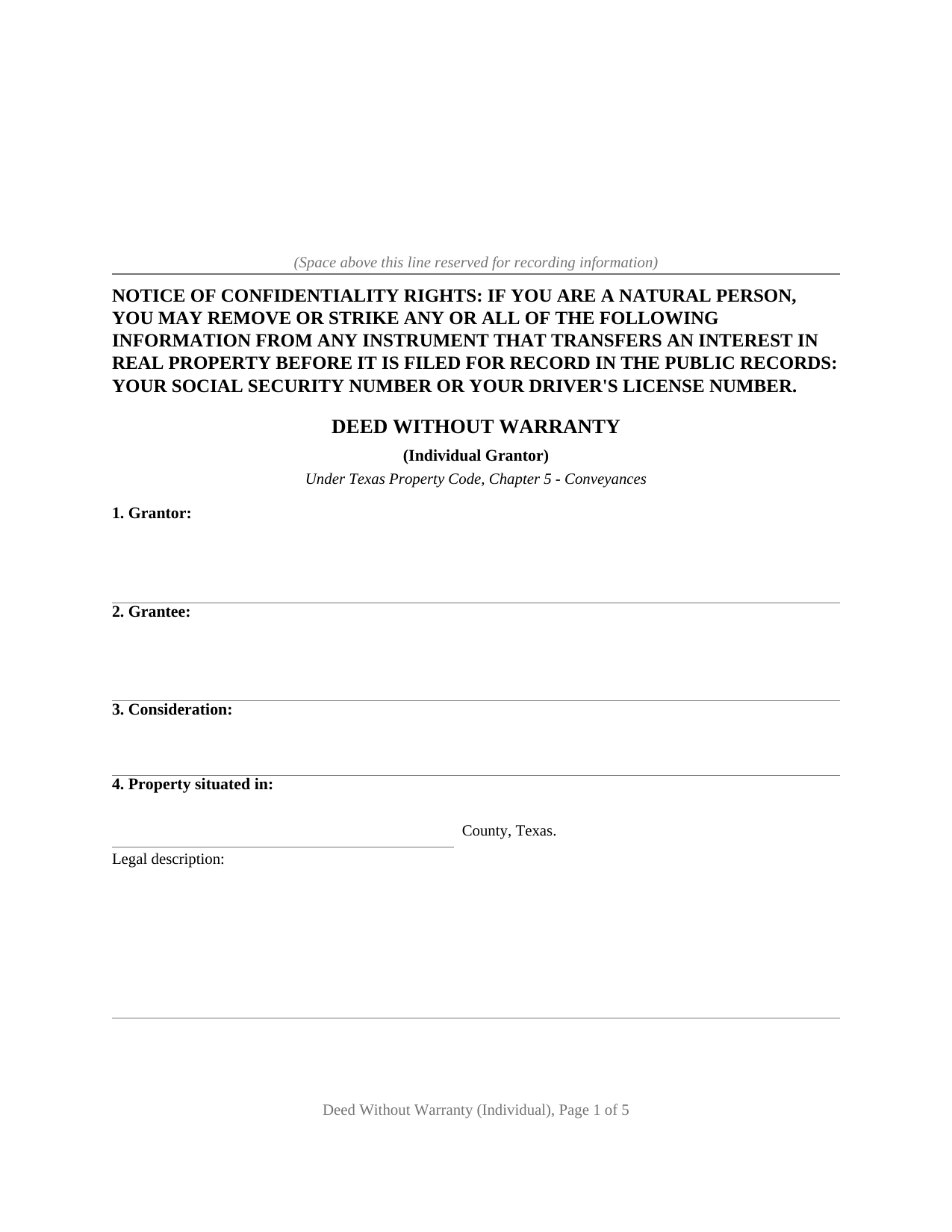
About the Texas Deed Without Warranty (Individual)
How to Use This Form
- Select your county from the list
- Download the county-specific form
- Fill in the required information
- Have the document notarized if required
- Record with your county recorder's office
What Others Like You Are Saying
"I have not yet used the site however, I feel that this site could be a big asset to the genealogical…"
"Quick and easy! Had my document submitted to the county and back in one day. Good rates as well!"
"It was easy and I will use it again."
"Your PDF form Personal Representative's Deed was exceedingly helpful."
"The website works just as described. I couldn't ask for anything more helpful in drafting an easemen…"
4.8/5 from 4,824 reviews. Read all
A Texas deed without warranty does something a quitclaim deed does not: it conveys the property itself, using the traditional words of grant, while the grantor still makes no warranty of title. That single distinction is why Texas title professionals treat a deed without warranty as a real deed and a quitclaim as something less. This form prepares a deed without warranty for one grantor under Chapter 5 of the Texas Property Code.
Conveys the Property, Warrants Nothing
The operative language grants, sells, and conveys the property to the grantee, to have and to hold, but adds that the conveyance is without express or implied warranty. The grantee receives whatever title the grantor holds and takes the property subject to every lien, easement, and other matter affecting title. If a title problem surfaces later, the grantor is not on the hook, because the grantor promised nothing about the state of the title. What the grantor does convey is the property, and the deed says so in words, which is what keeps it on the deed side of the line rather than the quitclaim side.
The Section 5.023 Trap a Careful Deed Closes
Texas builds two covenants into the very words a deed uses to convey. Under Property Code Section 5.023, the words grant and convey imply that the grantor has not already conveyed the estate to someone else and that the property is free of encumbrances, unless the deed expressly provides otherwise. A document labeled without warranty that simply grants and conveys can still carry those implied covenants by operation of the statute. This form closes that gap: it states that it conveys without express or implied warranty and expressly excludes both the common law warranties and the Section 5.023 implied covenants, so the deed carries no warranty at all rather than a hidden one.
Deed Without Warranty or Quitclaim
Both instruments leave the grantee without warranty protection, so people often treat them as the same. Texas law does not. A quitclaim conveys only the grantor's right, title, and interest, if any, and signals doubt about the grantor's title, which can cloud the chain and delay a later good faith purchaser. A deed without warranty conveys the property itself, and Texas courts decide which an instrument is by reading the whole document, not the caption at the top. This form conveys the property in express terms and states that it does so. Where the intent is only to release a possible claim, a quitclaim deed recites that narrower conveyance instead.
Homestead, Marriage, and Signing
Because a deed without warranty is a present conveyance, the homestead joinder rule reaches it. Texas Family Code Section 5.001 requires both spouses to join in a conveyance of the homestead, whether the homestead is community property or one spouse's separate property, so the form provides a separate joinder line for a spouse who is not a grantor. The grantor signs before a notary, a joining spouse acknowledges on a separate certificate, and the deed is recorded with the county clerk of the county where the property is located. The package includes the fillable deed, a completed example for a realistic Travis County transfer, and a plain language guide covering every section, signing, and recording. The materials are informational and are not legal advice.
Important: County-Specific Forms
Our deed without warranty (individual) forms are specifically formatted for each of the 254 counties in Texas.
After selecting your county, you'll receive forms that meet all local recording requirements, ensuring your documents will be accepted without delays or rejection fees.