Texas Deed Without Warranty (Trustee Grantor)
County Specific Legal Forms Validated as recently as October 13, 2026 by our Forms Development Team
About the Texas Deed Without Warranty (Trustee Grantor)
How to Use This Form
- Select your county from the list
- Download the county-specific form
- Fill in the required information
- Have the document notarized if required
- Record with your county recorder's office
What Others Like You Are Saying
"Easy and fast"
"The website was very easy to navigate and I found it easy to get the documents I needed. I also foun…"
"Real value. Excellent forms, guidance & samples. Included Homestead Exemption form & info ar…"
"Glad to find the Easement Forms for Halifax County, NC online. Thanks"
"I liked it, very much."
4.8/5 from 4,828 reviews. Read all
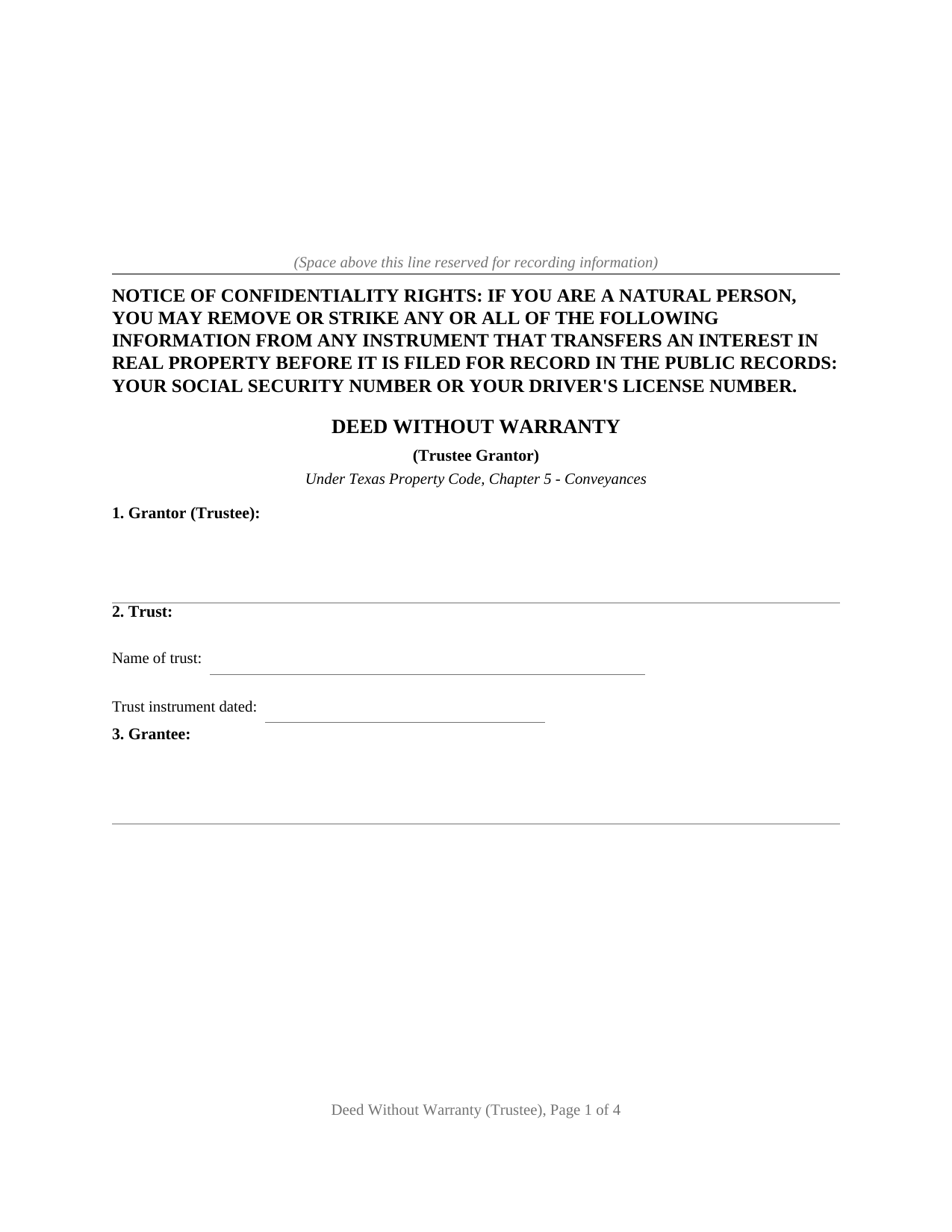
When a trust sells or distributes Texas real property, the trustee who signs the deed often has no basis for warranting the title. A deed without warranty fits that position: the trustee grants, sells, and conveys the property in fiduciary capacity, with words that pass the property itself, while the deed expressly states that no warranty of title is given. This form prepares that deed for a trustee grantor under Chapter 5 of the Texas Property Code and the Texas Trust Code.
The Trustee as Grantor, Not the Trust
A Texas trust is not a legal entity and cannot be a party to a deed. Texas Property Code Section 114.087 provides that the trustee is the party to an instrument when the trust is named. The trustee signs in fiduciary capacity, identified by name and the exact name and date of the trust, in the style of the example: Margaret E. Halloran, Trustee of the Halloran Family Living Trust dated June 3, 2015. The deed recites the trustee's authority under Trust Code Sections 113.002, 113.009, and 113.010, and notes that a court order under Section 113.001 may limit that authority. Because the grantor is a trustee conveying trust property, no homestead joinder line appears; the homestead rules that apply to an individual's personal conveyance do not govern a trustee acting in fiduciary capacity.
Conveying the Property, Disclaiming the Warranty
Texas Property Code Section 5.022 permits a conveyance without a warranty covenant. Section 5.023 is the reason the disclaimer is written out rather than assumed: unless the deed expressly provides otherwise, the words grant and convey imply a covenant that the grantor has not already conveyed the estate and a covenant that the estate is free from encumbrances. Both implied covenants are actionable as if written into the deed. A trustee that conveys with words of grant and says nothing further can inadvertently bind the trust estate to those covenants. This form uses words of grant to carry the conveyance and then expressly excludes both Section 5.023 implied covenants, so the deed performs its act without importing promises the trust never intended to make.
A Conveyance, Not a Quitclaim
Texas courts draw a line between a deed that conveys the property and an instrument that merely releases whatever claim the grantor holds. An instrument that transfers only the grantor's right, title, and interest, without more, falls on the quitclaim side of that line, which can affect how later purchasers and title examiners treat the chain of title. This form conveys the Property with operative words of grant and separately excludes the warranties, so it operates as a true conveyance that passes the trustee's interest while declining to warrant it.
Trust Sales, Distributions, and Successor Trustees
The trustee-grantor pattern recurs in several trust administration situations. A trustee selling trust property to a third-party buyer may lack knowledge of the property's full title history and declines to warrant beyond what the trust received. A trustee making a distribution of specific property to a beneficiary uses a deed, and the deed without warranty fits that in-trust transfer. A successor trustee retitling property after a prior trustee held it in trust may convey with a deed that identifies the transfer without warranting the title the predecessor held. In each case the form's fiduciary-capacity recital and its express warranty exclusion track the trustee's actual position.
What the Package Includes
The package includes the blank deed as a fillable PDF, a completed example built on a realistic Travis County fact pattern showing a trustee conveying to an LLC grantee, and a plain-language guide that walks through every section, the trust-code authority provisions, the Section 5.023 covenants and their express exclusion, signing and notarization, and recording. The materials are informational and are not legal advice.
Important: County-Specific Forms
Our deed without warranty (trustee grantor) forms are specifically formatted for each of the 254 counties in Texas.
After selecting your county, you'll receive forms that meet all local recording requirements, ensuring your documents will be accepted without delays or rejection fees.