Texas Deed Without Warranty (Two Grantors)
County Specific Legal Forms Validated as recently as October 7, 2026 by our Forms Development Team
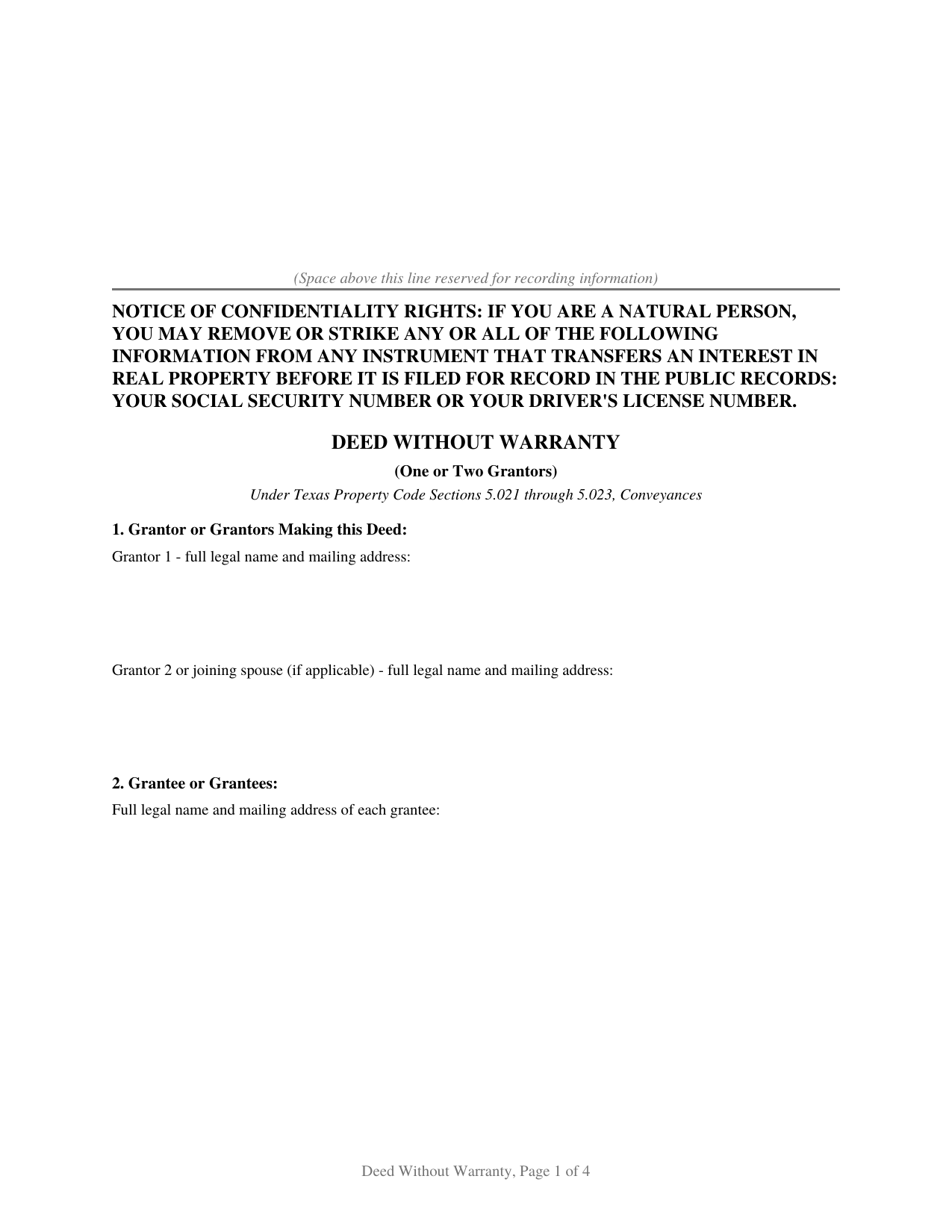
About the Texas Deed Without Warranty (Two Grantors)
How to Use This Form
- Select your county from the list
- Download the county-specific form
- Fill in the required information
- Have the document notarized if required
- Record with your county recorder's office
What Others Like You Are Saying
"Spent several weeks searching the net for warranty deeds. For the money and correctness, IMHO, Deeds…"
"Worked Great! First time go at the courthouse"
"You should list the address of where to mail the forms, so we don't have to look it up. It would mak…"
"good service but pricey."
"form was east to use...instructions came in handy."
4.8/5 from 4,825 reviews. Read all
A Texas deed without warranty transfers real property while drawing a clear line on title risk: the grantor conveys the property itself, and the deed states that no title warranty is given. This form prepares a deed without warranty under Chapter 5 of the Texas Property Code, where title covenants may be limited or excluded by express deed language.
A Conveyance Form, Distinguished from a Quitclaim
Texas decisions distinguish deeds that convey property from instruments that merely release a claim. An instrument that transfers only the grantor's right, title, and interest, if any, is commonly treated as a quitclaim, and title professionals often treat a quitclaim in the chain of title as a complication. This form is drafted as a conveyance of the property itself, using words of grant, while also stating that no covenant or warranty of title, express or implied, is made.
Property Code Section 5.023 implies title covenants into a deed that uses words such as grant or convey unless the deed expressly provides otherwise. This form includes express no-warranty language so the deed remains a conveyance of the property itself without adding warranty covenants.
Common Contexts Described in the Guide
The form includes space for one or two grantors. Deeds without warranty are commonly associated with family transfers, trust and entity transfers, divorce and settlement transfers, and other conveyances where the deed transfers the property without title warranty covenants. The guide explains how this instrument differs from warranty deeds and quitclaim deeds in general terms.
Texas Marital Property and Homestead Features
The second grantor block is included for situations involving two record owners, including spouses conveying community property. Because Texas Family Code Section 5.001 addresses spousal joinder for a conveyance of homestead property, the form also includes a second signature area that can be used for a joining spouse who is not a record owner. The guide explains both signing arrangements in general terms, with citations.
Signing and Recording
The form includes a separate notary acknowledgment certificate for each signer. A delivered deed is effective between the parties, while recording places the deed in the public land records. Property Code Section 13.001 addresses the effect of an unrecorded deed as to creditors and later good faith purchasers. The guide describes county recording practice, including the photo identification rule effective January 1, 2026.
What Is Included
- The blank form as a fillable PDF, completed on screen or printed and completed by hand
- A plain language guide covering every numbered section: what each blank asks, where the information typically comes from, and how a sample entry may look
- A completed example showing the entire document filled in for a realistic Texas fact pattern
The document is formatted for Texas recording standards: letter size pages within Local Government Code Section 191.007, every line of type at 10 point or larger, the Property Code Section 11.008 notice of confidentiality rights in 12 point boldfaced capitals on page one, and reserved space for the county clerk's recording stamp. A non-recorded instructions page at the front of the form covers completion basics, including how an entry that outgrows its space continues on a recorded exhibit page.
Related Texas Forms
The Texas General Warranty Deed includes general warranty covenants. The Texas Special Warranty Deed includes a limited warranty tied to claims arising by, through, or under the grantor. The Texas Quitclaim Deed is structured as a release of whatever interest, if any, the signer may have in the property. The Texas Transfer on Death Deed (Individual) is designed for a transfer that occurs at the owner's death rather than as a present lifetime conveyance.
Important: County-Specific Forms
Our deed without warranty (two grantors) forms are specifically formatted for each of the 254 counties in Texas.
After selecting your county, you'll receive forms that meet all local recording requirements, ensuring your documents will be accepted without delays or rejection fees.