Texas Deed Without Warranty (Signed by Attorney-in-Fact)
County Specific Legal Forms Validated as recently as September 23, 2026 by our Forms Development Team
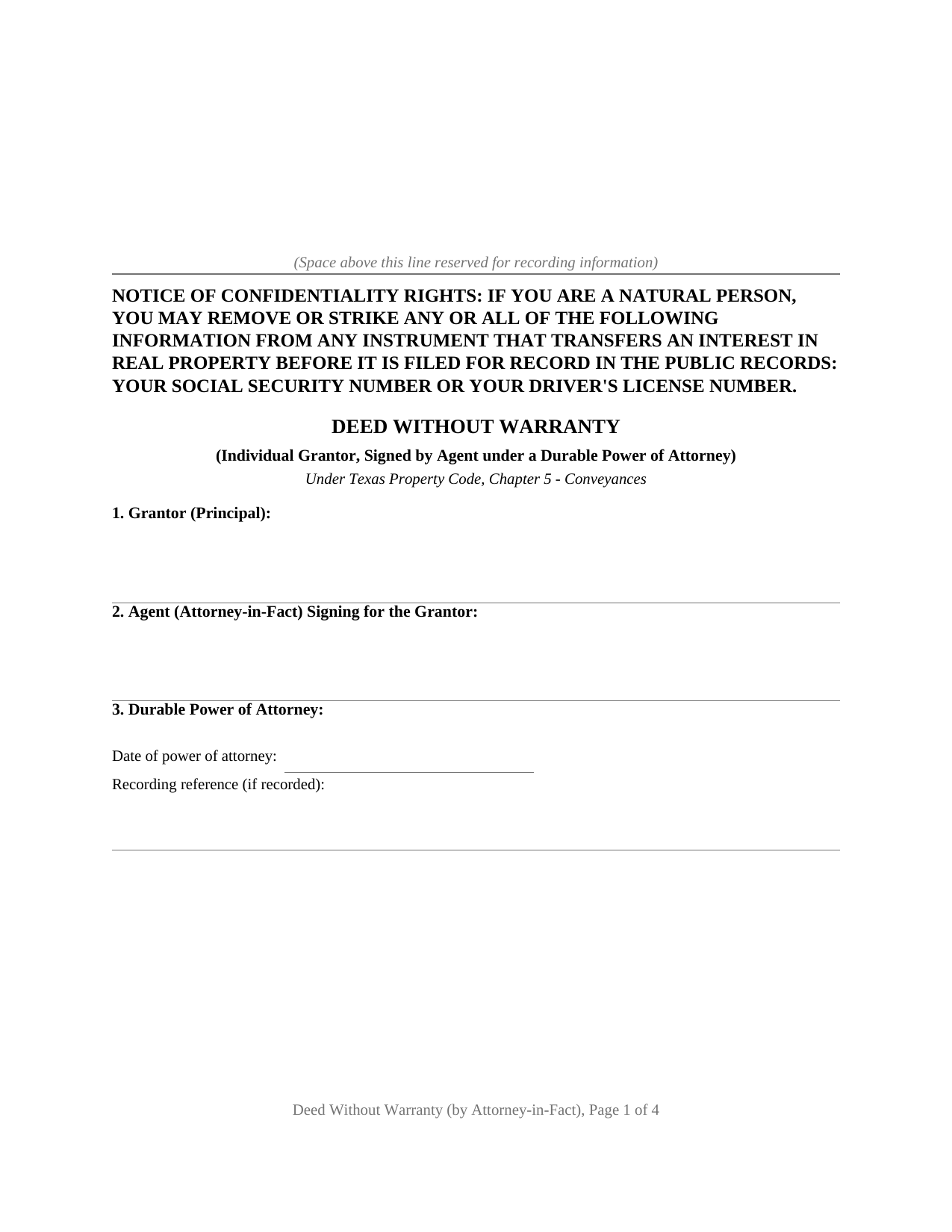
About the Texas Deed Without Warranty (Signed by Attorney-in-Fact)
How to Use This Form
- Select your county from the list
- Download the county-specific form
- Fill in the required information
- Have the document notarized if required
- Record with your county recorder's office
What Others Like You Are Saying
"These forms were very easy to both download and print, as well as fill out on the site and then prin…"
"Very easy to use and I appreciate the fees being charged after the submission."
"Great way to get the forms you need. Quick, easy and affordable"
"Easy to use! The forms were perfect and everything was explained well! Will use again!"
"GREAT! site, had everything we needed to complete our estate planning for our children"
4.8/5 from 4,825 reviews. Read all
When a Texas property owner cannot sign a deed in person, a durable power of attorney lets an agent handle the transaction. This form prepares a deed without warranty for exactly that situation: the grantor's agent, called the attorney-in-fact, signs the deed on the owner's behalf, and the deed itself conveys the property while making no warranty of title.
What the Agent's Signature Means for the Deed
A deed without warranty conveys the property itself, using words of grant, while telling the grantee plainly that no title warranty accompanies the transfer. That combination places this form between a warranty deed, which stands behind the title, and a quitclaim, which releases only whatever the grantor holds. The agent's signature does not change the legal character of the conveyance; it changes only who physically signs. The operative clause grants, sells, and conveys the property through the agent and under the authority of the durable power of attorney, and the without-warranty character of the deed is stated in express terms in the same section.
The Section 5.023 Exclusion
Texas Property Code Section 5.023 provides that the words grant or convey imply two covenants unless the deed expressly provides otherwise: a covenant that the grantor has not already conveyed the estate and a covenant that the estate is free from encumbrances. A deed that says nothing about those covenants can carry them into the transaction regardless of its caption. This form provides otherwise in plain language, excluding both the Section 5.023 implied covenants and any common-law warranty of title, so the words of grant convey the property without importing promises the grantor did not intend to make.
The Power of Attorney in the Chain of Records
Texas Estates Code Section 751.151 requires that a durable power of attorney used for a real property transaction requiring a recorded instrument be recorded in the county where the property sits, not later than the 30th day after the deed is filed. In practice, the power of attorney and the deed go to the county clerk together, so the records show both the conveyance and the authority behind it. The form carries the agent's name and the power of attorney's date and recording reference in its own numbered section, making that connection visible on the face of the deed.
How the Agent Signs
The agent signs in a representative capacity, not as a principal. The conventional signature form is the grantor's name followed by the agent's name and the designation attorney-in-fact. The acknowledgment certificate names the agent as attorney-in-fact on behalf of the principal, which is the form Texas Civil Practice and Remedies Code Section 121.008 supports for a person signing in a representative capacity. The grantor does not sign. The form carries one acknowledgment certificate for the agent, reflecting that the agent is this deed's sole signer.
Included in This Package
The download contains the fillable deed as a blank PDF, a completed example built on a Denton County fact pattern showing an agent conveying an individual's property, and a plain-language guide that covers every section, the power-of-attorney recitals, and the dual-recording requirement at the clerk's office. The materials are informational and are not legal advice.
Important: County-Specific Forms
Our deed without warranty (signed by attorney-in-fact) forms are specifically formatted for each of the 254 counties in Texas.
After selecting your county, you'll receive forms that meet all local recording requirements, ensuring your documents will be accepted without delays or rejection fees.