Texas Special Warranty Deed
County Specific Legal Forms Validated as recently as September 3, 2026 by our Forms Development Team
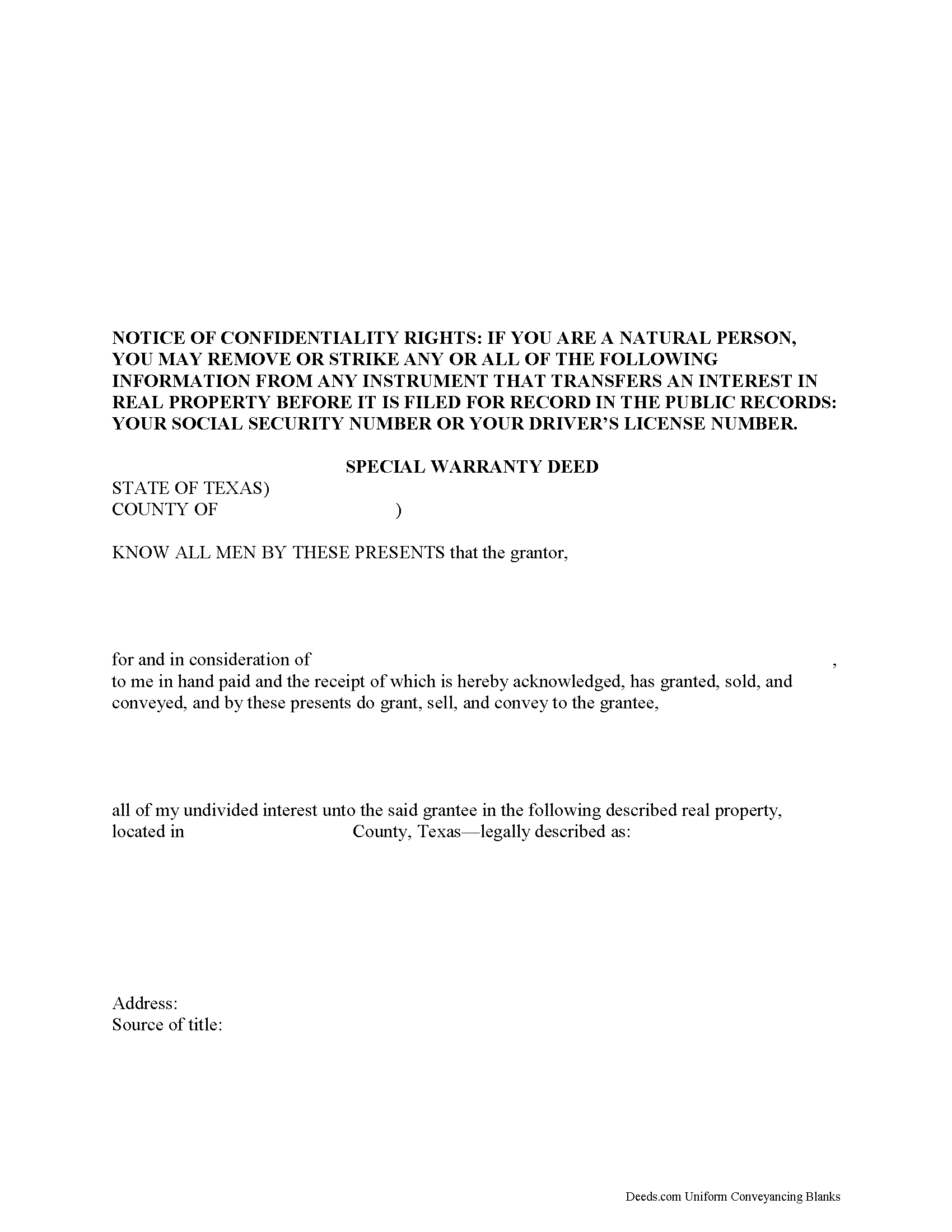
About the Texas Special Warranty Deed
How to Use This Form
- Select your county from the list
- Download the county-specific form
- Fill in the required information
- Have the document notarized if required
- Record with your county recorder's office
What Others Like You Are Saying
"Really nice deed form and guide the whole process was super easy."
"Excellent. Timely. Efficient. Smooth. Thank you!"
"Forms & Guide easy to use. It would have been helpful if the counties with identical form packag…"
"I was very pleased to find ONLINE, Deed Revision Document(s) and their explanation. I ordered these …"
"It was very easy to get the forms I needed which makes its so much easier than running back and fort…"
4.8/5 from 4,828 reviews. Read all
Texas prints exactly one statutory deed form, and it is a general warranty form. Property Code Section 5.022 sets that form out and then adds two sentences that do more work than the form itself: a covenant of warranty is not required in a conveyance, and the parties may insert any clause or use any form not in contravention of law. The Texas special warranty deed, also called a limited warranty deed, lives in the room those two sentences leave open. It keeps the statutory words of grant and the statutory habendum, and narrows one thing only, the covenant of title. This package prepares that deed in its base configuration, for natural persons signing in their own names.
What the Supreme Court of Texas settled about the limit
The phrase that defines the instrument is short: by, through, or under Grantor, but not otherwise. The Supreme Court of Texas read it in Chicago Title Insurance Co. v. Cochran Investments, Inc., 602 S.W.3d 895 (Tex. 2020), where a grantor who had bought at a foreclosure sale conveyed by special warranty deed and the foreclosure was afterward challenged in bankruptcy. The holding: the deed's plain language limits the grantor's liability for failures or defects of title to those resulting from persons claiming the property by, through, and under the grantor. The court declined to decide whether a special warranty deed implies the statutory covenant of seisin, since the limitation governed either way, and it turned aside the argument that reading the clause this way collapses the instrument into a quitclaim.
Where the narrowing happens, and where it does not
Not in the granting clause. This deed grants, sells, and conveys the Property itself, with the traditional habendum, because Texas sorts a true conveyance from a quitclaim by asking whether the words pass the property or only whatever right and interest the maker happens to hold, the test applied in Geodyne Energy Income Production Partnership v. Newton Corp., 161 S.W.3d 482 (Tex. 2005). The narrowing happens twice, both times inside the warranty. The express covenant to warrant and forever defend carries the by, through, or under qualifier. Then Section 5.023, which implies a prior non-conveyance covenant and a covenant against encumbrances whenever a deed uses the word grant or the word convey, is answered on its own terms: that section governs unless the conveyance expressly provides otherwise, and Section 8 of this form expressly provides otherwise, holding the implied covenants to the written covenant's scope.
One or two names on each side, nothing preprinted
The face of this form carries no marital status, no capacity, and no form of co-ownership. Section 1 takes one or two grantor names on open lines with whatever status wording the transaction carries. Section 2 takes one or two grantee names followed by the co-ownership designation the grantees take under, written in rather than picked from printed options, because Texas makes survivorship a matter of written agreement under Estates Code Section 111.001 and leaves two unqualified grantees as tenants in common. Execution follows the same shape: a block headed GRANTOR, a block headed SECOND GRANTOR (if applicable), and one acknowledgment certificate for each, so two signers may appear before different notaries on different days. A sole owner conveying alone leaves the second block and its certificate empty. Spouses conveying jointly managed community property, and a married owner conveying a homestead with the other spouse joining under Family Code Section 5.001, both present the two-signature pattern this deed accommodates.
At the recording counter
The deed is recorded with the county clerk of the county where the property is located, which Property Code Section 11.001 makes the condition of an effective record. The confidentiality notice required by Property Code Section 11.008 appears at the top of the first page. A mailing address for each grantee belongs in the instrument under Section 11.003, backed by a penalty filing fee rather than by refusal. Senate Bill 16 added a photo identification requirement at the recording counter for instruments filed in person on or after December 4, 2025. Texas collects no real estate transfer tax, so the deed and any exhibit page are the entire filing.
The download includes the blank deed as a fillable PDF, a completed example filled in on a Travis County fact pattern, and a plain language guide covering every numbered section, the co-ownership forms two grantees may take, the signing formalities, and recording. The materials are informational and are not legal advice.
Important: County-Specific Forms
Our special warranty deed forms are specifically formatted for each of the 254 counties in Texas.
After selecting your county, you'll receive forms that meet all local recording requirements, ensuring your documents will be accepted without delays or rejection fees.