Texas Special Warranty Deed (Joint Grantors)
County Specific Legal Forms Validated as recently as October 15, 2026 by our Forms Development Team
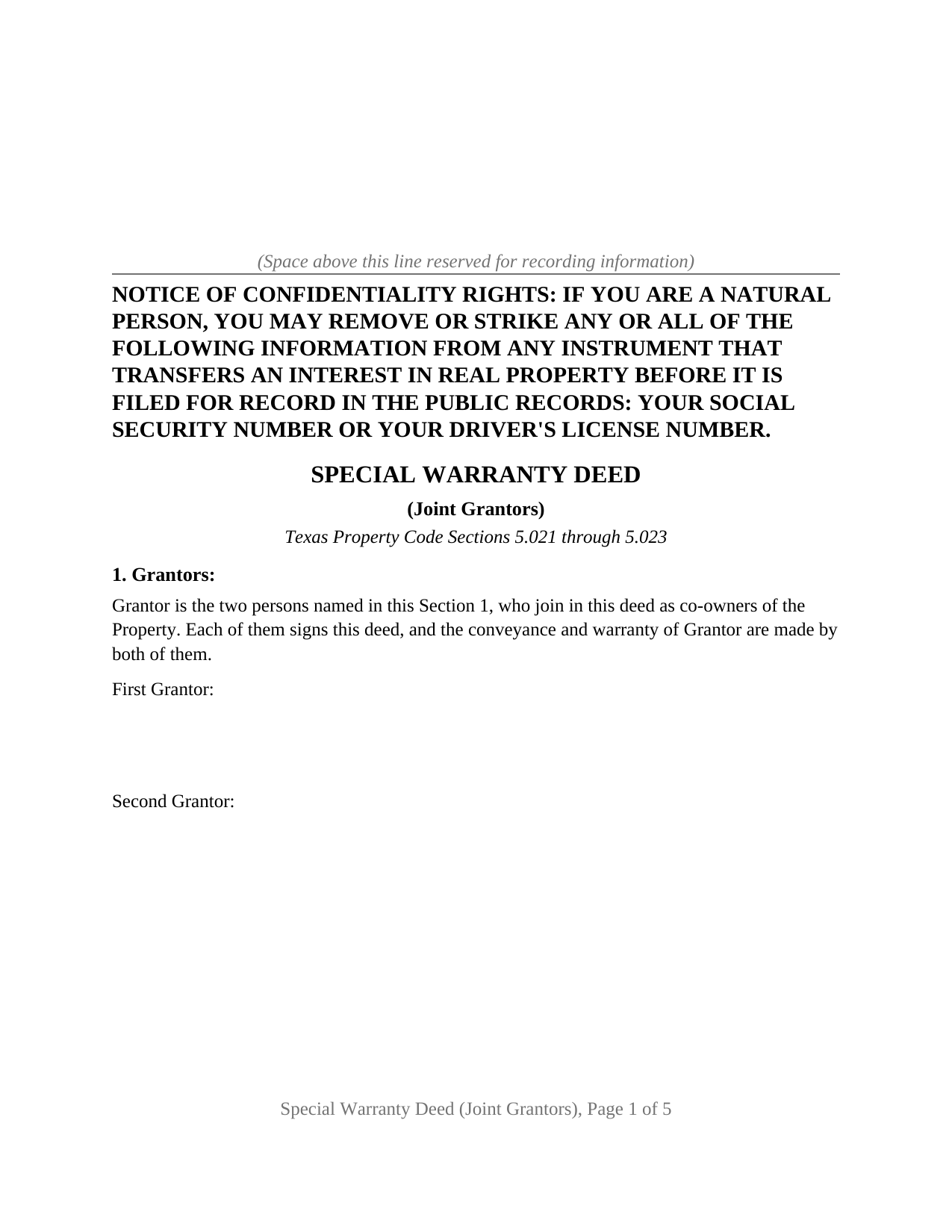
About the Texas Special Warranty Deed (Joint Grantors)
How to Use This Form
- Select your county from the list
- Download the county-specific form
- Fill in the required information
- Have the document notarized if required
- Record with your county recorder's office
What Others Like You Are Saying
"Great service"
"Super easy, fast recording time. 100% recommend."
"Excellent service, communication and done in a timely fashion. Worth the cost for the convenience an…"
"Very satisfied. Highly recommend!"
"Awesome forms, easy to complete and print."
4.8/5 from 4,828 reviews. Read all
Two co-owners who sell Texas real estate together put one deed into the record, not two, and that deed has to carry both of them from the first recital to the last notary certificate. The Texas Special Warranty Deed (Joint Grantors) is built for exactly that: two natural persons named as grantors in a single instrument, each signing under a heading of their own, each acknowledging before a notary, and both standing behind one covenant of title that reaches only claims arising by, through, or under them.
One deed carried by two grantors
Section 1 of the deed names both grantors on open lines and recites, in fixed text, that Grantor is the two persons named there, that they join in the deed as co-owners of the Property, and that the conveyance and the warranty are made by both of them. Nothing about marital status is preprinted; whatever status wording the transaction carries follows each name, the way the completed example names each grantor as a single person. From that point forward the deed speaks of Grantor as one party, and a construction clause near the end ties the word back to both persons, so the granting clause, the habendum, and the warranty each operate as the act of two owners at once rather than as two half conveyances stapled together.
A limited warranty measured against two periods of ownership
Texas Property Code Section 5.022 prints a general warranty form and then permits the parties to use any clause or form not in contravention of law, and the special warranty deed, also searched for as a limited warranty deed, uses that permission to keep the statutory words of grant while narrowing the covenant to claims by, through, or under Grantor, but not otherwise. With two grantors the covenant answers for what either of them did while on title: a lien one of them granted, a contract one of them signed, an earlier conveyance by either. Defects older than their ownership stay outside it and belong to the title examination and the title policy in the transaction. The deed's second warranty paragraph takes the express provision route that Section 5.023 opens, holding the covenants implied from the words grant and convey to that same scope, so neither grantor carries a broader implied promise than the written one.
Who the two grantor pattern describes
The form recites exactly two grantors and carries exactly two signature blocks, headed FIRST GRANTOR and SECOND GRANTOR, with an acknowledgment certificate for each, so the two owners may acknowledge on different dates, before different notaries, or in different states; the example's grantors acknowledge two days apart in two counties. Two siblings who took a parent's house by inheritance and now sell it, two investors parting with a rental they bought together, and an unmarried couple selling the home they purchased jointly present the pattern this deed recites. The form is not set up as a sole owner deed, as an entity, trustee, or attorney-in-fact conveyance, or as a deed for three or more owners; each of those carries a different signature and certificate structure. The grantee side takes one or two names with the co-ownership designation written in after them, and the guide describes the four forms Texas recognizes between two grantees and the written agreement each survivorship form rests on.
At the clerk's counter
Local Government Code Section 191.007(e) asks for the name of each person who signs a recorded legal paper to be typed or printed immediately under the signature, and both signature blocks carry a printed name entry for that reason. The confidentiality notice required by Property Code Section 11.008 appears at the top of the first page. Senate Bill 16 added a photo identification requirement at the recording counter for instruments filed in person on or after December 4, 2025. The deed is recorded with the county clerk of the county where the property is located, and because Texas collects no real estate transfer tax, the deed and any exhibit page are the whole filing.
The package includes the fillable deed, a completed example on a Collin County fact pattern, and a plain language guide that walks through every numbered section, the co-ownership forms two grantees may take, the signing formalities, and recording. The materials are informational and are not legal advice.
Important: County-Specific Forms
Our special warranty deed (joint grantors) forms are specifically formatted for each of the 254 counties in Texas.
After selecting your county, you'll receive forms that meet all local recording requirements, ensuring your documents will be accepted without delays or rejection fees.