Texas Special Warranty Deed (LLC Grantor)
County Specific Legal Forms Validated as recently as October 1, 2026 by our Forms Development Team
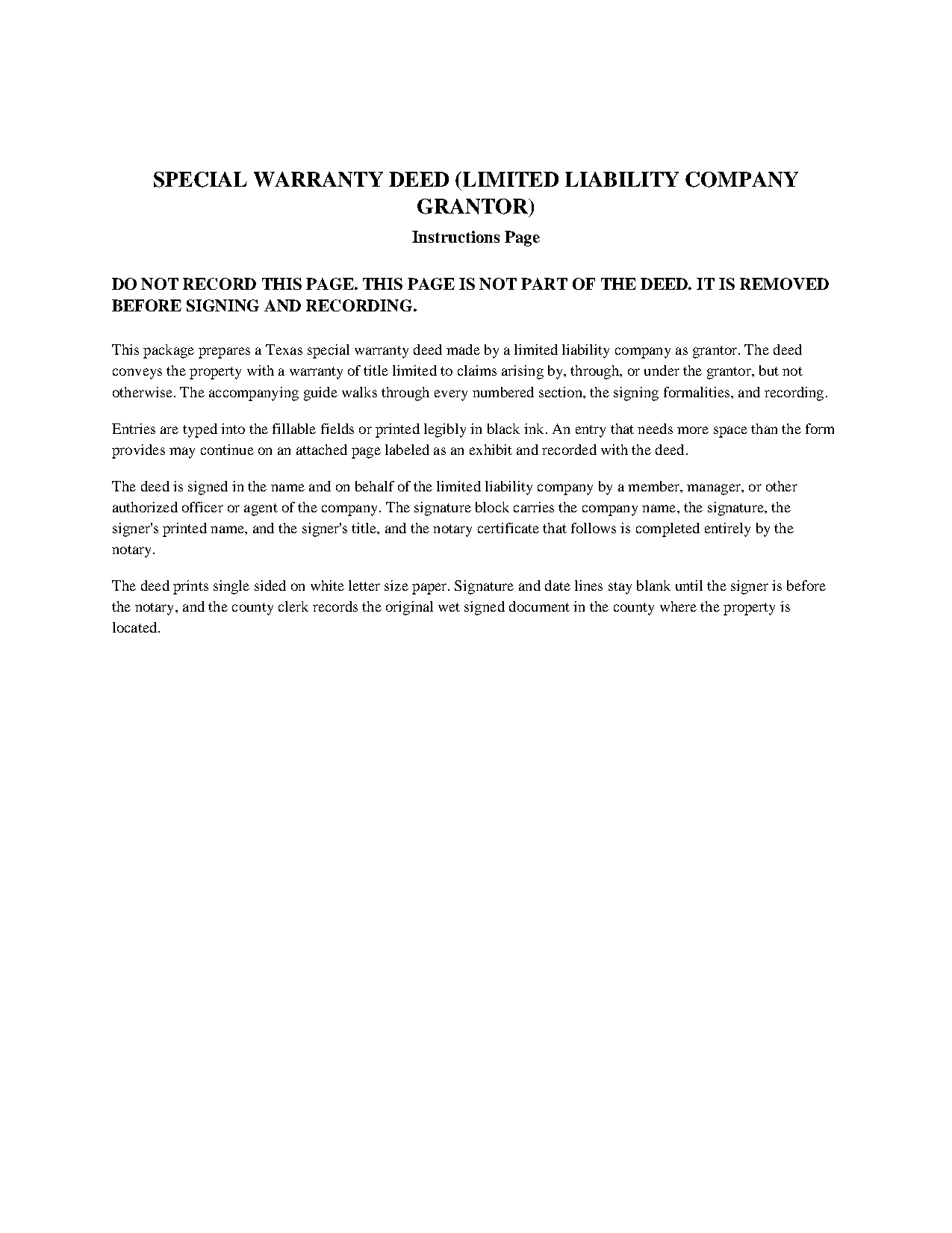
About the Texas Special Warranty Deed (LLC Grantor)
How to Use This Form
- Select your county from the list
- Download the county-specific form
- Fill in the required information
- Have the document notarized if required
- Record with your county recorder's office
What Others Like You Are Saying
"Wow, this was a breeze!! Best experience and fast. Great way to record documents in a matter of minu…"
"Very easy to use and organized. When I needed the form I needed it immediately. I didn't want to get…"
"Highly Pleased- Strongly Recommend Deeds.com Long review... sorry:-) Originally I was very skeptical…"
"Easy to use,thanks"
"This is an excellent resource. I was surprised because the price is so low I thought the products mi…"
4.8/5 from 4,828 reviews. Read all
A Texas limited liability company that conveys real property needs a deed drafted for an entity grantor, and the special warranty deed is the instrument the commercial market reaches for most often. The form recites exactly one entity grantor executing through an authorized signer under Texas Business Organizations Code Section 101.254, carrying the company name, a representative By line, and the entity acknowledgment certificate the county records require.
How the warranty is measured by the company's tenure
Texas Property Code Section 5.022 lets the parties calibrate a deed's warranty by its language, and the special warranty uses that room. The deed conveys the Property with the statutory words of grant, GRANTS, SELLS, AND CONVEYS, and binds the grantor to WARRANT AND FOREVER DEFEND all and singular the Property against every person lawfully claiming it, when the claim is by, through, or under Grantor, but not otherwise. Everything that happened on the company's own watch falls inside the promise: liens the LLC created or suffered, any prior conveyance the company made. Defects rooted before the company acquired the property stay outside the warranty and belong to the buyer's title examination and to any title insurance policy in the transaction.
Section 5.023 implies that a grantor using the words grant or convey has not previously conveyed the estate and that the estate is free from encumbrances. This deed expressly limits those implied covenants to the same by, through, or under scope as the express warranty and makes them subject to the reservations and exceptions the deed states, so the whole warranty package speaks with one voice. The express limitation is the mechanism every Texas no-broader-than-special-warranty deed uses to prevent the implied covenants from silently expanding the grantor's obligation.
A conveyance, not a quitclaim
Texas characterizes a deed as a true conveyance or a quitclaim by whether its language passes the property itself or only the grantor's right, title, and interest. Geodyne Energy Income Production Partnership v. Newton Corp., 161 S.W.3d 482 (Tex. 2005). Because the classification has real consequences for later purchasers and title insurance, this form conveys the Property described above with full words of grant, not merely the company's interest. A quitclaim structure belongs on a different instrument; this one is a true conveyance with a limited covenant, a distinction the deed's language makes clear.
One authorized signer, one entity certificate
The form recites one authorized signer, executing in a representative capacity under Section 101.254 and not individually. The signature block carries the company name, a By line for the wet-ink signature, and printed name and title lines. The acknowledgment certificate follows Texas Civil Practice and Remedies Code Section 121.008's short form for an entity: the named signer, the title, the company name, and the on-behalf-of relationship. Because the grantor is an entity, no spousal joinder question arises under Family Code Section 5.001, which operates on married individual owners.
Recorded in the county where the property sits
The deed is recorded with the county clerk of the county where the property is located. An unrecorded conveyance is binding on the parties but void as to creditors and subsequent purchasers for value without notice under Property Code Section 13.001. The confidentiality notice required by Property Code Section 11.008 appears at the top of the first page. Senate Bill 16 added a photo identification requirement at the recording counter for instruments filed in person on or after December 4, 2025.
The download includes the blank deed as a fillable PDF, a completed example showing the full instrument filled in for a Bexar County fact pattern, and a plain language guide covering every numbered section, the entity signing formalities, and recording with the county clerk. The materials are informational and are not legal advice; a Texas attorney can apply these statutes to a specific title or transaction.
Important: County-Specific Forms
Our special warranty deed (llc grantor) forms are specifically formatted for each of the 254 counties in Texas.
After selecting your county, you'll receive forms that meet all local recording requirements, ensuring your documents will be accepted without delays or rejection fees.