Texas Special Warranty Deed (Individual Grantor)
County Specific Legal Forms Validated as recently as October 15, 2026 by our Forms Development Team
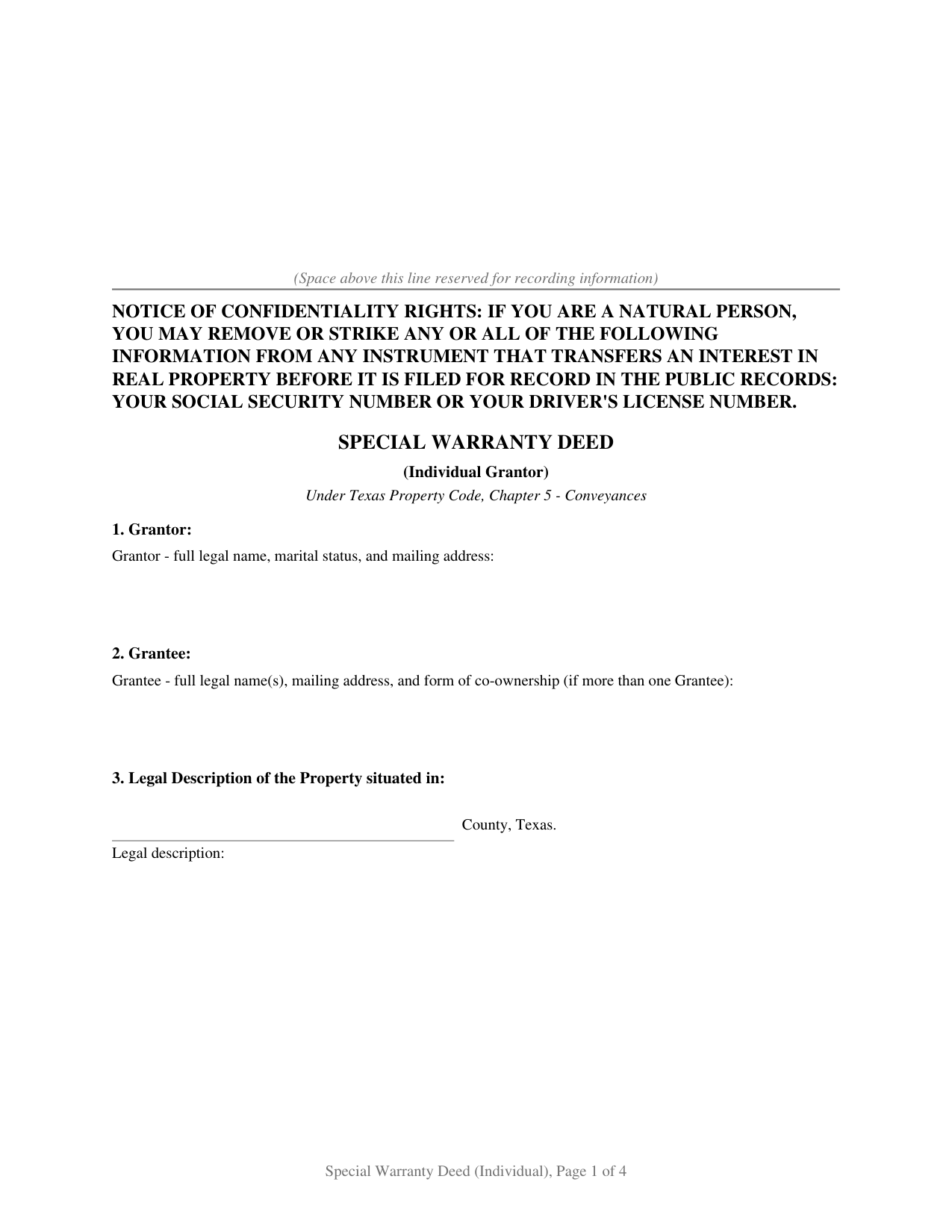
About the Texas Special Warranty Deed (Individual Grantor)
How to Use This Form
- Select your county from the list
- Download the county-specific form
- Fill in the required information
- Have the document notarized if required
- Record with your county recorder's office
What Others Like You Are Saying
"Very prompt service. Thank you."
"Thank you for your excellent service"
"This was a very easy and pleasant experience using your website. I needed a legal document and with …"
"Very courteous staff, and helpful didn't take any time for someone to assist me on my needs Thank yo…"
"This site was perfect in a time when travel is almost impossible. They asked a few questions to make…"
4.8/5 from 4,828 reviews. Read all
A Texas special warranty deed for one individual grantor carries a single grantor signature line: one natural person, named in Section 1 as making the deed in the grantor's own right and not in a representative capacity, conveys the property and signs before one notary. The second signature block on the form belongs to nobody unless the property is the grantor's homestead and the grantor is married; then Texas Family Code Section 5.001 brings the grantor's spouse to the deed.
One grantor, one signature, one certificate
The form recites exactly one grantor. Section 1 prints the configuration as deed text and leaves a three line blank for the name, any status wording the transaction carries, and the mailing address. No marital status and no form of existing ownership is preprinted, and no second grantor block exists on the instrument. The grantee section is open the same way: one or more grantees, the mailing address of each, and whatever co-ownership designation two grantees take under, written in rather than selected, since Texas survivorship between co-owners takes a signed writing under Estates Code Chapter 111 or 112. A sole owner, a cotenant conveying an undivided interest, and a spouse conveying separate property each present the single grantor pattern the deed recites. An entity, a trustee, two record owners conveying together, and an agent under a power of attorney each present a different pattern, and this form is not set up as any of them.
The joinder block that stays blank until a homestead is conveyed
Family Code Section 5.001 provides that whether the homestead is separate or community property, neither spouse may sell, convey, or encumber it without the joinder of the other spouse. For a single grantor that rule has one live case: a married person conveying a homestead held in that person's own name. Section 10 of the deed answers it. The spouse named in the JOINING SPOUSE block joins in the execution of the deed and in the conveyance to satisfy Section 5.001, makes no covenant or warranty of title, and is not a grantor. Where the grantor is unmarried, or the property is not the grantor's homestead, Section 10 states that it does not apply and the joinder block and its certificate remain unsigned. The spouse's certificate is a separate short form acknowledgment under Civil Practice and Remedies Code Section 121.008, the form's layout rather than a statutory requirement.
A warranty that stops at the grantor's own tenure
Property Code Section 5.022 prints a general warranty form and then provides that a covenant of warranty is not required and that the parties may use any form not in contravention of law. This deed keeps the statutory words of grant, GRANTS, SELLS, AND CONVEYS, and the habendum, so the instrument passes the property itself and reads as a conveyance rather than a quitclaim. The covenant is where it narrows: the grantor warrants and forever defends the property against every person lawfully claiming it, when the claim is by, through, or under the grantor, but not otherwise. In Chicago Title Insurance Co. v. Cochran Investments, Inc., 602 S.W.3d 895 (Tex. 2020), the court held that those words limit the grantor's liability for a failure of title to claims traced through the grantor. Section 9 then does what Section 5.023 invites: the statute implies covenants of prior non-conveyance and freedom from encumbrances wherever a deed says grant or convey, unless the conveyance expressly provides otherwise, and the deed expressly limits those implied covenants to the same scope.
What the clerk sees
The deed records with the county clerk of the county named in Section 4. The first page opens with the notice of confidentiality rights of Property Code Section 11.008 in 12 point capitals, followed by the identifying heading Local Government Code Section 191.007 asks for. A person who walks the deed into the clerk's office on or after December 4, 2025 shows photo identification under the 2025 deed fraud legislation. Texas imposes no transfer tax, so the deed and any exhibit page are the whole filing.
The download includes the blank deed as a fillable PDF, a completed example on a Williamson County fact pattern in which a married grantor conveys a homestead and the spouse joins, and a plain language guide covering every numbered section, the forms of co-ownership two grantees may take, the joinder formalities, and recording. The materials are informational and are not legal advice.
Important: County-Specific Forms
Our special warranty deed (individual grantor) forms are specifically formatted for each of the 254 counties in Texas.
After selecting your county, you'll receive forms that meet all local recording requirements, ensuring your documents will be accepted without delays or rejection fees.