Utah Quitclaim Deed (Corrective)
County Specific Legal Forms Validated as recently as September 25, 2026 by our Forms Development Team
About the Utah Quitclaim Deed (Corrective)
How to Use This Form
- Select your county from the list
- Download the county-specific form
- Fill in the required information
- Have the document notarized if required
- Record with your county recorder's office
What Others Like You Are Saying
"Very good site! I found everything I needed right here on Deeds.com. Excellent quality forms, easy a…"
"Very useful information"
"Quick and efficient"
"Very user friendly. I was totally amazed. Thank you so much."
"Great service with all the added resources on the form I requested. Question: How long do the forms …"
4.8/5 from 4,836 reviews. Read all
The mistake is already on record, and Utah decides by statute how much of it a later filing can reach. This configuration of the Utah quitclaim deed answers the errors that clarifying paperwork cannot: it names the instrument already recorded, states the particular being corrected, and then conveys again in the statutory words of Utah Code Section 57-1-13.
Where Utah stops clarifying and starts conveying
Utah Code Section 57-3-106 offers two ways to reach a recorded error without a new conveyance. Subsection (9) allows minor typographical or clerical errors in a document of record to be corrected by recording an affidavit or other appropriate instrument. Subsection (8) puts the same instrument back on record, but only after every party who signed it signs again, each fresh signature is notarized anew, and the document states in brief why it is being rerecorded.
Subsection (10)(a) then draws the boundary both routes share: subject to federal law and to a narrow trust deed exception, neither one divests a grantee of a real property interest, alters an interest in real property, or returns an interest to the grantor. The statewide recording standard on affidavits of correction, published through the County Recorder Standards Board, carries that line to the counter, placing a change of grantee, a change in the tenancy grantees hold, and a change of grantor outside the affidavit and answering each with a new deed. A corrective deed, also searched as a correction deed or a corrected quit claim deed, is that new deed.
The earlier deed keeps its place in the index
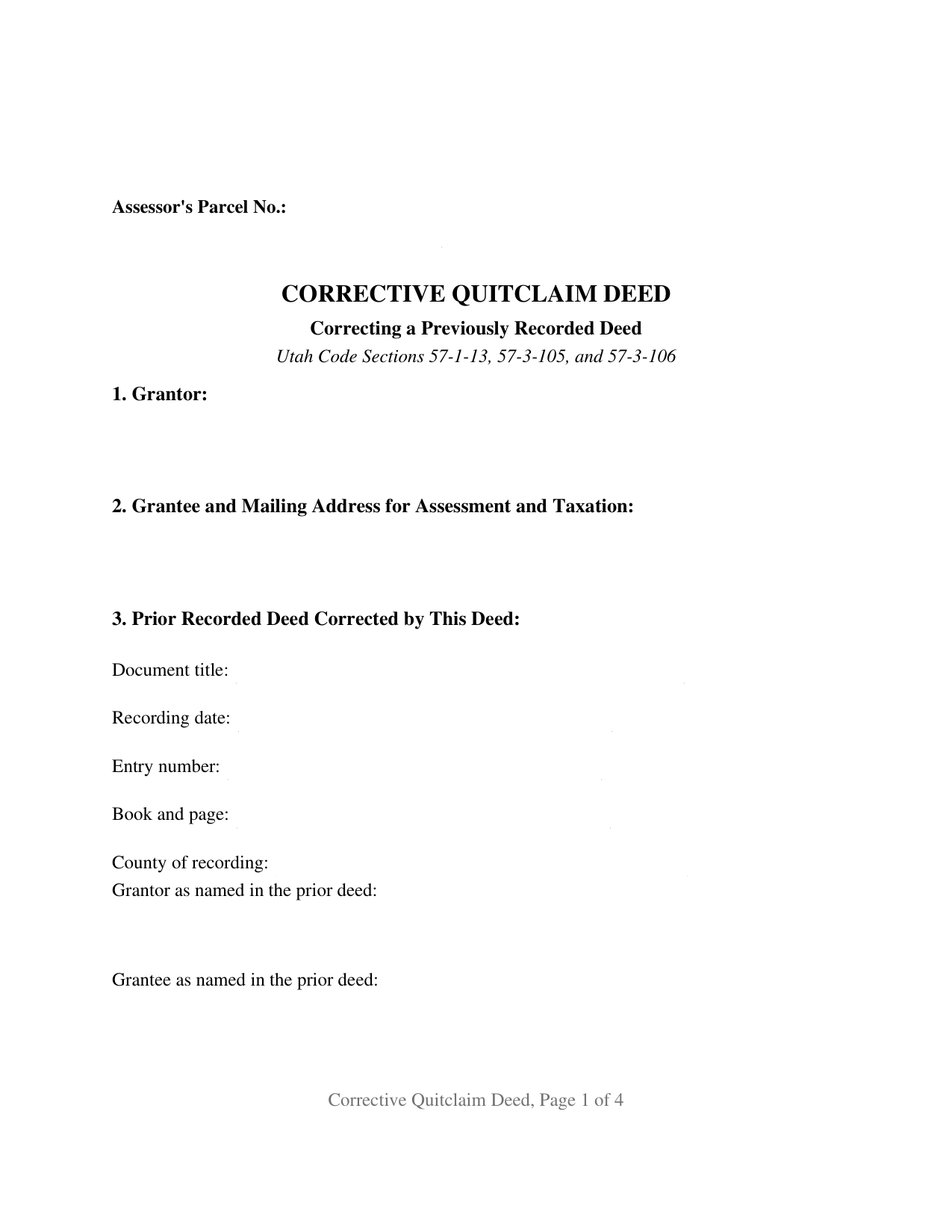
Nothing recorded in Utah is erased. This deed is written to be read beside the instrument it corrects rather than in place of it: the operative section states that the deed is given to correct the identified prior deed in the particular set out on its face, and that it does not amend, replace, cancel, or rerecord that deed, which keeps its own entry number and its own line in the index. A title examiner finds two instruments and a stated relationship between them, which is why the prior deed's title, date, entry number, book and page, county, and parties each get a labeled blank.
One grantor, one certificate, two entries that carry the correction
Section 1 names a single grantor, and Section 10 draws a single signature block whose printed name line feeds the index under Utah Code Section 17-71-403; one acknowledgment certificate follows, written to the Statutory Short Form of Acknowledgment in Utah Code Section 57-2a-7. The correction lives in two blanks: one states the particular as the recorded deed states it, the other states the same particular as this deed corrects it, so the change reads in the record on its own. A recorded deed describing the lot in the wrong subdivision phase, a description that omitted a strip the parties meant to include, and a conveyance whose grantee side needs restating in an instrument that can lawfully restate it all present the pattern this deed recites. The form is not arranged for two grantors signing together, and it is neither an affidavit nor a rerecording of the earlier instrument.
A correction that still carries no warranty
The operative word remains quitclaims, and it moves the grantor's right, title, interest, and estate as of the date of this deed, with the appurtenances, and with no covenant about the title's quality. Utah presses the point further than most states: Section 57-1-10(2) leaves quitclaim deeds outside the after acquired title rule, so what the grantor picks up later never travels back through the correction.
Bringing it to the county recorder
Utah will not record a title conveyance without a legal description and grantee names carrying an address for valuation and tax notices, both fixed by Utah Code Section 57-3-105, and Section 57-3-106(2) wants a first page caption naming the instrument, which the CORRECTIVE QUITCLAIM DEED title supplies. Page geometry answers the menu of Section 17-71-402, with the serial number in the margin space subsection (5) allows. No transfer tax attaches to a Utah deed, and Section 17-71-407 prices the filing at 40 dollars for up to ten legal descriptions, plus the 5 dollars several counties add.
The package holds the fillable Utah form, a completed example built on a Wasatch County record correcting a plat phase, and a guide covering the numbered sections, the correction entries, the notarization, the grantee vesting menu, and recording. Everything in it describes Utah statutes in general terms and is not legal advice.
Important: County-Specific Forms
Our quitclaim deed (corrective) forms are specifically formatted for each of the 29 counties in Utah.
After selecting your county, you'll receive forms that meet all local recording requirements, ensuring your documents will be accepted without delays or rejection fees.