Utah Quitclaim Deed (Interspousal)
County Specific Legal Forms Validated as recently as October 8, 2026 by our Forms Development Team
About the Utah Quitclaim Deed (Interspousal)
How to Use This Form
- Select your county from the list
- Download the county-specific form
- Fill in the required information
- Have the document notarized if required
- Record with your county recorder's office
What Others Like You Are Saying
"Loved your easy to follow instructions along with the paperwork forms that I was looking for. Would …"
"Always helpful!"
"Great product delivered immediately at very reasonable price. Highly recommend !"
"The Quit Claim Deed for the state of Ohio worked for me, saving me the cost of an attorney doing it.…"
"Great forms and information"
4.8/5 from 4,831 reviews. Read all
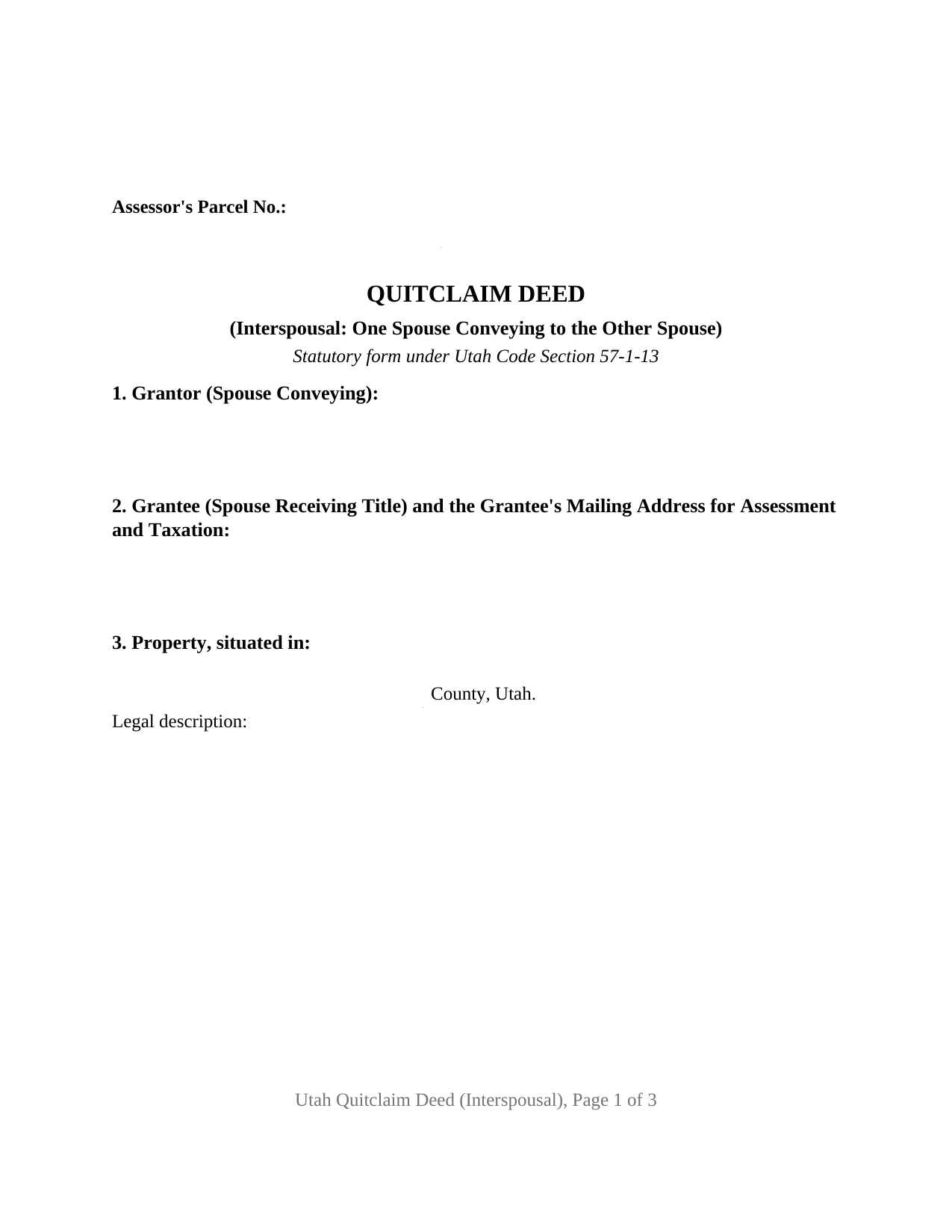
One spouse conveys, the other spouse receives, and the deed says so on its face. This Utah quitclaim deed is arranged for that single direction: a grantor spouse, a grantee spouse, a recital that the two are married to each other, and the operative word Utah Code Section 57-1-13 supplies, quitclaims, moving whatever interest the conveying spouse holds across to the receiving spouse.
Utah treats a deed between spouses like any other deed
Utah Code Section 81-3-103, renumbered from former Section 30-2-3 when family law moved into Title 81 effective September 1, 2024, provides that a conveyance, transfer, or lien executed by an individual to or in favor of that individual's spouse is valid to the same extent as between other persons. Buyers search this as an interspousal transfer deed or a quit claim deed between husband and wife; in Utah it is a quitclaim deed whose grantor and grantee are married. Because Utah Code Section 75-2-112 abolished dower and curtesy, nothing is released for the marriage and no release language appears on the page.
What crosses over, and what stays behind
The operative act is the statutory word quitclaims, and it reaches the grantor spouse's present interest only, with no covenant of title and no promise about a lien, easement, or trust deed already of record. Two Utah rules sharpen that posture inside a marriage. Under Utah Code Section 57-1-10, after acquired title never rides through a quitclaim, so an interest the conveying spouse gains later stays with that spouse. Under Utah Code Section 57-1-5, a grant to two or more people in their own right has been presumed a joint tenancy with rights of survivorship since May 1, 2024, and a conveyance by one joint tenant severs that tenancy; when spouses hold that way and one quitclaims across, severance and transfer land in the same instrument, leaving the receiving spouse with the whole record interest.
A grantee who is a party to the deed without signing it
The architecture follows one direction. Section 1 names the conveying spouse; Section 2 names the receiving spouse with the mailing address used for assessment and taxation, a content condition Utah Code Section 57-3-105 attaches to a recordable conveyance of title. Section 8 recites the marriage, performs the quitclaim, and states that no warranty passes. One signature block follows, carrying the printed name line Utah Code Section 17-71-403 has the recorder index, and one certificate written to the acknowledgment form of Utah Code Section 46-1-6.5. A spouse releasing an interest so the other holds record title alone, a spouse who owned the house before the wedding passing it across, and a spouse added by an earlier deed passing that interest back present the pattern this deed recites. The form is not arranged for co-grantors who both convey, and its grantee section names one spouse rather than a list of takers.
The one joinder rule Utah keeps for lifetime deeds
Utah asks for no spousal signature on an ordinary conveyance, with one recorded document exception. Utah Code Section 78B-5-504(4) provides that where a homestead declaration has been recorded for the property and the owner is married, a conveyance is not valid unless both husband and wife join in it. Here the other spouse is already a party as the named grantee, a wrinkle no Utah appellate decision located for this build has addressed; the guide sets out the text and the open question.
At the county recorder's counter
The page is built to the format menu a Utah county may adopt under Utah Code Section 17-71-402: white letter paper, the stamp space at the top right of page one, one inch margins, and a caption naming the instrument. A serial number line rides in the margin space Section 17-71-402(5) allows. Utah collects no transfer tax on a deed, so the cost is a flat document fee: Utah Code Section 17-71-407 sets $40 for up to ten legal descriptions, with $5 added in counties of the second through sixth class, which is why several Utah fee schedules read $45. Recording is what protects the receiving spouse against later purchasers under Utah Code Section 57-3-103, not what makes the deed good between the spouses.
This package holds the fillable Utah interspousal quitclaim deed, a completed example filled in on a Weber County fact pattern, and a guide covering the numbered sections, the notarization, the grantee vesting menu, and the recording steps. Everything in it describes Utah statutes in general terms and is not legal advice.
Important: County-Specific Forms
Our quitclaim deed (interspousal) forms are specifically formatted for each of the 29 counties in Utah.
After selecting your county, you'll receive forms that meet all local recording requirements, ensuring your documents will be accepted without delays or rejection fees.