Utah Quitclaim Deed (Married Couple as Grantors)
County Specific Legal Forms Validated as recently as October 12, 2026 by our Forms Development Team
About the Utah Quitclaim Deed (Married Couple as Grantors)
How to Use This Form
- Select your county from the list
- Download the county-specific form
- Fill in the required information
- Have the document notarized if required
- Record with your county recorder's office
What Others Like You Are Saying
"All worked out well."
"Very good, very expensive. I hope that this is what my lawyer needed for us to finish our wills. Geo…"
"So glad I found this form. Very easy to download and looks like all the instructions are there to co…"
"Creating my enhanced lifde estate deed was rather easy but I am not happy. After buying the 3 form p…"
"I love that this service is available. Uploading my document took no time at all. I love that we hav…"
4.8/5 from 4,829 reviews. Read all
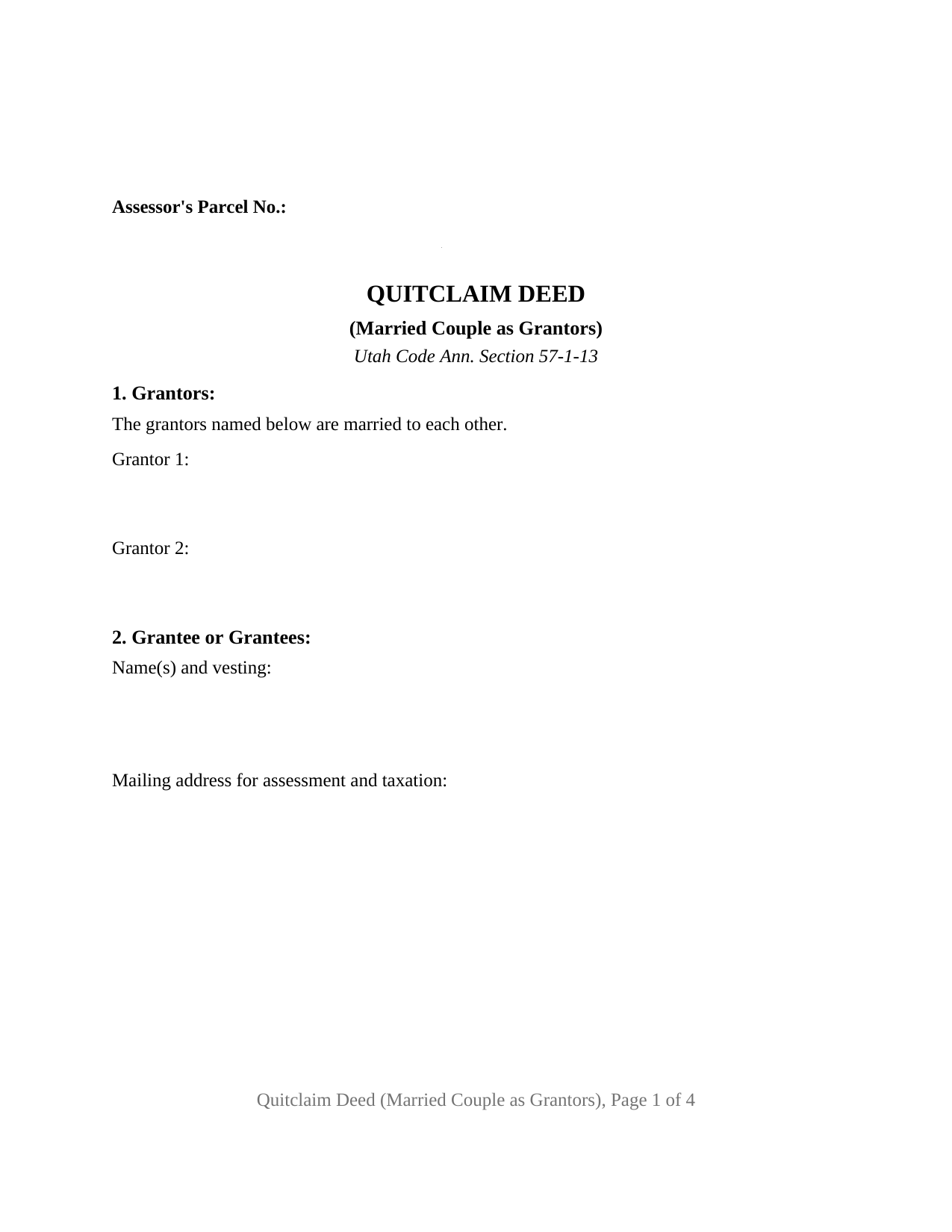
A Utah quitclaim deed drafted around a married couple: the form names two spouses as its grantors, states on its face that they are married to each other, and moves their combined interest in Utah real property through one recorded instrument carrying the statutory quitclaim words of Utah Code Section 57-1-13.
One instrument for the whole marital title
Since May 1, 2024, Utah Code Section 57-1-5 has presumed that real estate granted to two or more persons in their own right is held in joint tenancy with rights of survivorship, so a couple who bought together, even without survivorship wording in their vesting deed, ordinarily holds a survivorship title. That presumption is what gives the second signature its weight. A conveyance signed by one joint tenant severs that signer's interest and delivers only an undivided half; a deed both spouses execute carries the entire title, survivorship attribute included, out of the couple's names in a single step. The form pairs each spouse with a labeled grantor entry, a signature block whose printed name line feeds the recorder's index under Utah Code Section 17-71-403, and a notarial certificate completed by the officer who takes that spouse's acknowledgment.
Spouses moving the family home into their revocable living trust, a couple deeding an investment parcel to an adult child, and married owners retitling land into a family business entity present the pattern this deed recites. The form is not arranged as a sole owner's conveyance, and it does not recite co-grantors who are unmarried; its grantor section, its recital, and its certificates are built for a married pair.
A second signature that means ownership, not marital rights
Utah abolished dower and curtesy by statute, Utah Code Section 75-2-112, so no inchoate marital interest attaches to Utah land and no marital release rides a Utah deed. Each spouse signs this form as a record owner conveying that spouse's own interest. Utah does keep one lifetime joinder rule nearby: under Utah Code Section 78B-5-504(4), when a homestead declaration has been recorded for the property and the owner is married, a conveyance is valid only if both spouses join in it. The two-grantor architecture of this deed is the configuration that satisfies that rule wherever it applies.
What quitclaim words move
The operative word is quitclaims, and it conveys the grantors' right, title, interest, and estate as of the conveyance date, with no covenant about what that interest turns out to be. A quit claim deed, as the instrument is often searched, makes no promise to defend the title and none about encumbrances. Utah reinforces the boundary by statute: the after-acquired title rule of Utah Code Section 57-1-10 passes over quitclaim deeds entirely, keeping later-acquired interests with the spouse who acquires them. What passes is measured by the record, which is why the form collects a source of title entry identifying the instrument that vested the couple.
Recording at the county recorder's counter
Utah Code Section 57-3-105 attaches two content conditions to a deed conveying title: the full legal description and the grantee names with a mailing address used for assessment and taxation. Both have dedicated blanks in the numbered sections, and a parcel number line rides at the upper left of the first page in the margin space Utah Code Section 17-71-402(5) allows for the county's abstracting number. The layout follows the format menu counties adopt under Section 17-71-402: white letter paper, a recorder's stamp space in the first page's upper right corner, one inch margins on every side, and black single sided text. Because each spouse has an independent certificate, the two acknowledgments may happen on different days or in different states without rearranging the document. Utah levies no transfer tax on deeds; the statewide base recording fee is 40 dollars, and counties of the second through sixth class may add 5 dollars, so many recorder schedules publish 45.
The purchase delivers the form as a fillable PDF, a completed example prepared on a Washington County fact pattern in which a married couple deeds their home to themselves as trustees of a revocable trust, and a plain language guide covering every numbered section, Utah's grantee vesting options, the notarization, and the recording steps. The materials describe Utah law in general terms and are not legal advice.
Important: County-Specific Forms
Our quitclaim deed (married couple as grantors) forms are specifically formatted for each of the 29 counties in Utah.
After selecting your county, you'll receive forms that meet all local recording requirements, ensuring your documents will be accepted without delays or rejection fees.