Utah Quitclaim Deed (Reserving Life Estate)
County Specific Legal Forms Validated as recently as September 30, 2026 by our Forms Development Team
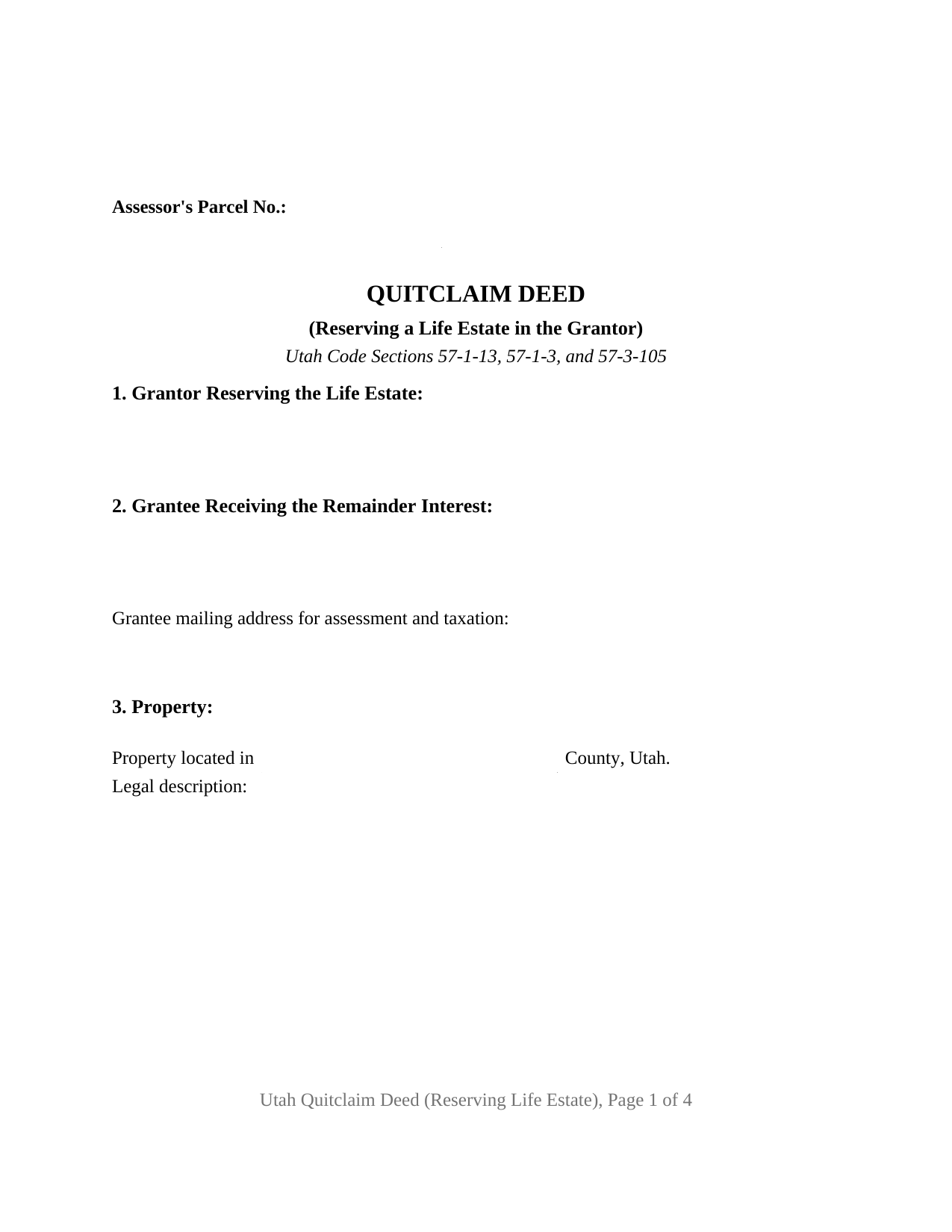
About the Utah Quitclaim Deed (Reserving Life Estate)
How to Use This Form
- Select your county from the list
- Download the county-specific form
- Fill in the required information
- Have the document notarized if required
- Record with your county recorder's office
What Others Like You Are Saying
"Deeds.com provided the document template and instructions I needed, right when I needed them. I was …"
"It would be good to be able to print several documents at 1 time by highlighting them in the list wi…"
"Signing up was easy and the form was amazing. The ability to type on it (I am on a MAC) was beyond m…"
"L-o-v-e your site. Great over-all usable docs. thanks"
"I was very impressed with how user friendly, convenient, and efficient the whole process was. I will…"
4.8/5 from 4,830 reviews. Read all
A Utah deed that moves ownership while keeping possession: the grantor quitclaims the property to a named grantee and, in the same sentence, reserves a life estate for the grantor's own lifetime. Title changes hands the day the deed is delivered; the right to live in the house or take the rents stays behind until the grantor dies. This configuration of the Utah quitclaim deed performs the statutory act of Utah Code Section 57-1-13.
What the reservation clause holds back
Utah Code Section 57-1-3 presumes that a conveyance of real estate passes a fee simple title unless it appears from the conveyance that a lesser estate was intended. The reservation wording in Section 9 of this form is what makes that lesser estate appear: the deed conveys the described tract, then reserves to the grantor its possession, use, rents, and profits for the term of the grantor's natural life. Without those words the presumption carries the whole fee across.
A remainder that passes now and possesses later
The interest the grantee takes is the remainder, and it passes on the date of the conveyance rather than at the grantor's death. A grantor acting alone cannot call it back; unwinding the arrangement takes a conveyance from the person holding it. At the death the remainder becomes an estate in possession. Utah Code Section 57-1-5.1 supplies the record mechanics: a life estate interest terminates upon the death of the tenant holding it, and a recorded affidavit citing that interest, describing the land, referencing the creating instrument, and attaching a death certificate discloses it. That affidavit is prepared separately after the death, outside this package.
No warranty travels with the reservation
The operative word is quitclaims. A Utah quit claim deed, as buyers often spell it, measures what it moves by the record, not by a promise: Section 57-1-13 gives it the effect of a conveyance of the grantor's whole right, title, interest, and estate in the premises described, with their privileges and appurtenances, as of the day of the conveyance. An easement, a plat restriction, or a recorded trust deed rides through untouched, so the remainder is worth whatever the title is worth. Utah adds an edge: under Section 57-1-10 the after acquired title statute reaches warranty, special warranty, and trust deeds and expressly skips quitclaim deeds, so an interest the grantor picks up later never reaches the remainder holder.
One grantor, and a grantee who signs nothing
Section 1 names the single owner who both conveys and reserves, and the measuring life is that owner's own, fixed in the operative language rather than a blank. Section 2 takes one grantee or several, with a co-ownership designation after the names; the survivorship presumption of Utah Code Section 57-1-5 has governed grants to two or more individuals in their own right since May 1, 2024, so a remainder split between two grantees carries survivorship unless the deed says otherwise. Section 8 holds terms the parties want on the record, such as who carries taxes, insurance, and upkeep during the life estate. One signature block follows, its printed name the entry the recorder indexes under Utah Code Section 17-71-403, then one certificate on the Statutory Short Form of Acknowledgment of Utah Code Section 57-2a-7. An owner deeding the family home to adult children while keeping the right to live there, and an owner passing farm ground to the next generation while keeping the rents, present the pattern this deed recites. The form is not arranged for co-grantors conveying together, and it places the life estate in no one but the grantor.
Recording, and the two items the recorder checks
Utah Code Section 57-3-105 conditions the recording of a conveyance of title on two items: a legal description, and grantee names carrying the mailing address to be used for assessment and taxation. Numbered blanks collect both, and the page answers the format menu a county may adopt under Section 17-71-402, with the parcel number in the margin space subsection (5) allows. Section 17-71-407 prices the document, not the page: 40 dollars for up to ten legal descriptions, plus the 5 dollars collected in second through sixth class counties.
The purchase delivers the fillable Utah form, a completed example on an Iron County pattern where an owner conveys a platted lot and keeps a life estate, and a plain language guide covering the numbered sections, the remainder vesting choices, the acknowledgment, and recording. Nothing here is legal advice; the package describes Utah statutes in general terms.
Important: County-Specific Forms
Our quitclaim deed (reserving life estate) forms are specifically formatted for each of the 29 counties in Utah.
After selecting your county, you'll receive forms that meet all local recording requirements, ensuring your documents will be accepted without delays or rejection fees.