Utah Quitclaim Deed (Divorce)
County Specific Legal Forms Validated as recently as October 15, 2026 by our Forms Development Team
About the Utah Quitclaim Deed (Divorce)
How to Use This Form
- Select your county from the list
- Download the county-specific form
- Fill in the required information
- Have the document notarized if required
- Record with your county recorder's office
What Others Like You Are Saying
"Very pleased! Forms easy to understand and use. Thank you!"
"Worked great. Not being real tech savey was no problem."
"I got what I needed and did exactly what I needed. All legal and no hassle. Thanks Deeds.com, you ma…"
"My experience so far is quite good. Useful documents. It would be very helpful if the labels on the …"
"This service is amazing! We have tried several other online recording services which all disappointe…"
4.8/5 from 4,833 reviews. Read all
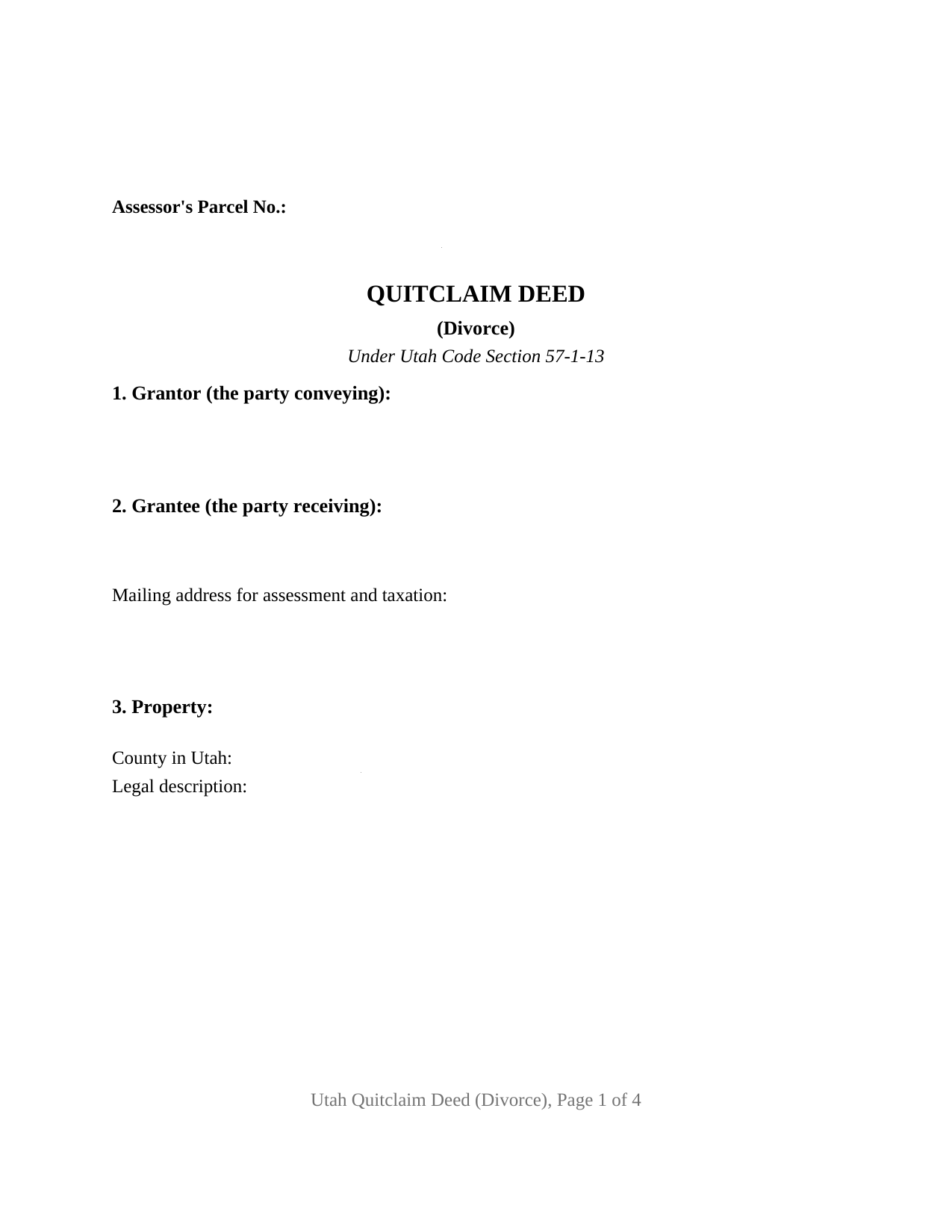
Utah severs a divorcing couple's survivorship by operation of statute, and the county index never hears about it. Under Utah Code Section 75-2-804, divorce or annulment turns former spouses' joint tenancy with right of survivorship into a tenancy in common, and the same section shelters a third party who relies in good faith on apparent survivorship until a writing declaring the severance is recorded. This configuration of the Utah quitclaim deed is drafted for that gap: one spouse or former spouse conveys, the other takes, and the deed names the divorce file it accompanies.
What the decree decides, and what the land records show
A Utah decree can award the marital home to one party, and under Utah Rule of Civil Procedure 70 a court may enter a judgment divesting one party's title and vesting it in another, with the effect of a conveyance executed in due form of law. Neither event puts a grantor and a grantee into the recorder's index, which runs on recorded instruments. Until such an instrument arrives, a search on the parcel keeps returning the old vesting deed with two names on it.
One signature, and the four entries that tie the deed to the case
Section 1 names the conveying spouse or former spouse; Section 2 names the party receiving, with the mailing address for assessment and taxation Utah Code Section 57-3-105 requires on a conveyance of title. Section 6 holds four entries from the court file: the court, the county and state of the court, the case number, and the date of the decree or order, so the deed and the case read together without the decree going on record. Section 10 performs the quitclaim and reaches any survivorship right and homestead right of the grantor. One signature block follows, its printed name line the entry Utah Code Section 17-71-403 has the recorder index, then one certificate on the Statutory Short Form of Acknowledgment at Utah Code Section 57-2a-7. A decree awarding the residence to one party while the other signs the paper that records it, a stipulation reached while the case is open, and a title search years later that still shows a former spouse of record all present the pattern this deed recites. The form is not arranged for two record owners signing together, and its grantee section names one taker rather than a list.
A conveyance measured by the record, not by a promise
The operative word is the one Utah Code Section 57-1-13 supplies: quitclaims. A Utah quit claim deed, as buyers often spell it, carries the grantor's right, title, interest, and estate as of the day it is delivered, with the appurtenances belonging to the land, and promises nothing about its quality. A recorded trust deed stays on the parcel. Utah closes a door many states leave to case law: under Section 57-1-10(2) the after acquired title rule skips quitclaim deeds, so an interest a former spouse picks up afterward never travels back through this one.
Signing while the case is open, or after the decree
An ordinary Utah conveyance carries no marital release, because Section 75-2-112 abolished dower and curtesy. The single lifetime joinder rule is Utah Code Section 78B-5-504(4): where a declaration of homestead stands recorded before the conveyance and the owner is married, the conveyance is valid only if both husband and wife join. A deed executed after entry of the decree falls outside that premise; one executed while the case is pending does not, and here the other party is already named as grantee.
At the Utah recording counter
Utah counties may adopt a document format menu under Section 17-71-402, and this deed is built to it: letter size white stock, a clear 2.5 by 4.5 inch corner at the head of page one for the stamp, inch margins, one sided black text, and a caption naming the instrument. The parcel number sits in the margin space subsection (5) permits. No transfer tax attaches to a Utah deed, and Section 17-71-407 prices the document rather than the page: 40 dollars for up to ten legal descriptions, plus the 5 dollars collected in second through sixth class counties.
Included with the purchase: the fillable Utah deed, a completed example on a Juab County file where a former spouse signs after a decree, and a plain language guide covering the numbered sections, the divorce entries, Utah's vesting menu, the notarization, and recording. The package describes Utah law in general terms and is not legal advice.
Important: County-Specific Forms
Our quitclaim deed (divorce) forms are specifically formatted for each of the 29 counties in Utah.
After selecting your county, you'll receive forms that meet all local recording requirements, ensuring your documents will be accepted without delays or rejection fees.