Utah Quitclaim Deed (Trustee Grantor)
County Specific Legal Forms Validated as recently as October 21, 2026 by our Forms Development Team
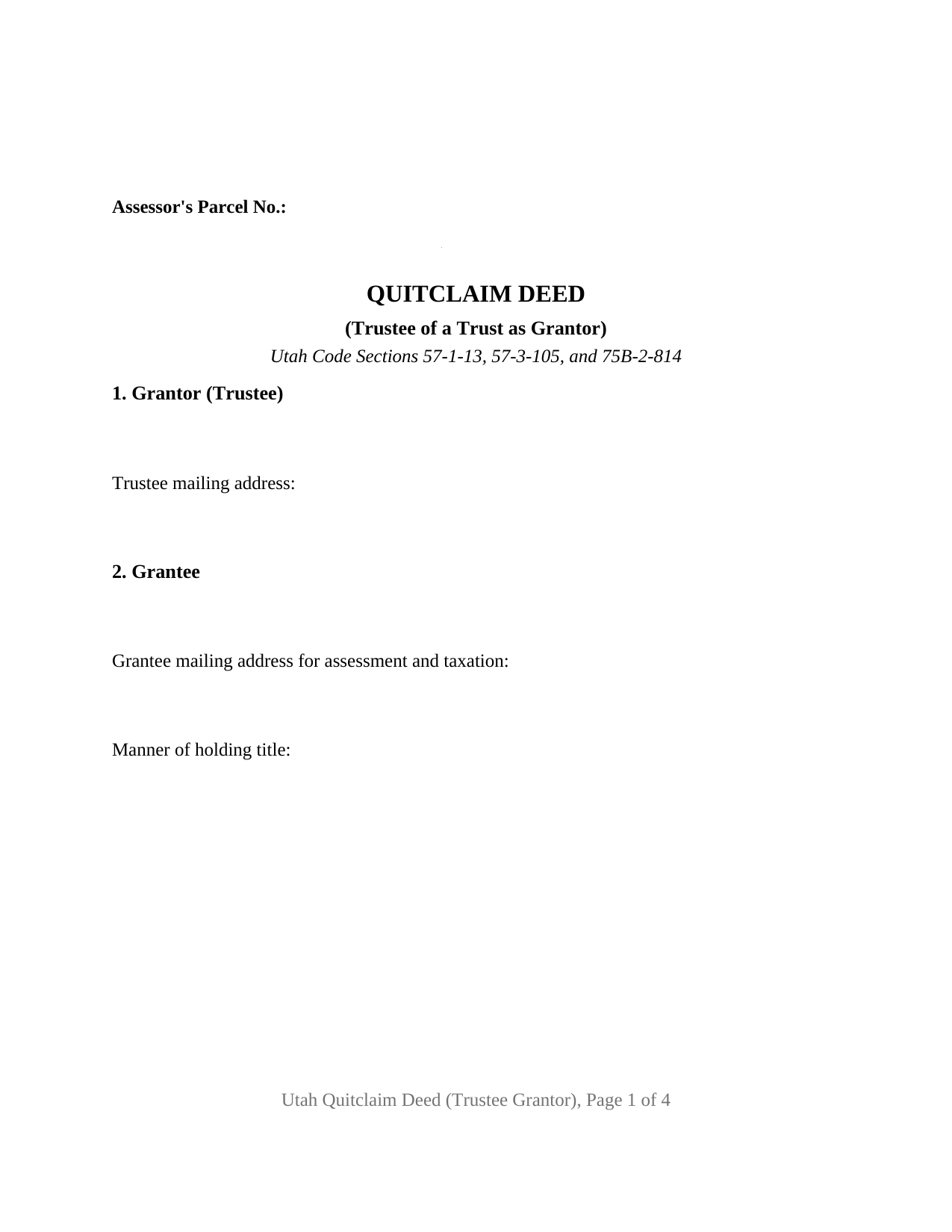
About the Utah Quitclaim Deed (Trustee Grantor)
How to Use This Form
- Select your county from the list
- Download the county-specific form
- Fill in the required information
- Have the document notarized if required
- Record with your county recorder's office
What Others Like You Are Saying
"Deeds.com made the recording of our Deed in a county where we do not reside, VERY easy! Customer ser…"
"I liked getting the forms but I was charged twice for some reason. I'm not sure what happened with t…"
"Much easier than going to the courthouse!"
"Well worth the $20.00 for the Transfer on Death Deed, if you are willing to do the leg work to notar…"
"It all looked pretty easy to navigate. Forms are just now downloaded so I'll see how opening, fillin…"
4.8/5 from 4,833 reviews. Read all
Record title stands in a trustee, and the trustee alone signs to move the parcel out. This Utah quitclaim deed is configured for that grantor: one trustee, named as trustee of a named trust, conveying whatever interest the trust holds, with no covenant or warranty of title. The operative word is the one Utah Code Section 57-1-13 supplies, quitclaims.
Three items Utah puts on a trust deed before the operative words
A deed signed by a trustee answers to a recording rule an ordinary deed never meets. Utah Code Section 75B-2-814, recodified from former Section 75-7-814 by the 2025 Estate Planning Recodification, lets a trustee convey real property as trustee or in the name of the trust, and then adds this: for recording purposes, the name of the trustee, the address of the trustee, and the name and date of the trust go on every recorded document affecting real property in which the trust is a party in interest. The statewide recording standard on title to real property held in trust, effective April 30, 2023, describes that designation appearing in the grantor section and in the signature block. Section 1 is laid out for it.
One trustee, one capacity, one certificate
The architecture follows a single signer. Section 1 carries one grantor designation. Section 6 collects the source of the trustee's authority: an article of the trust instrument, a recorded certification of trust, or the powers the statute supplies. Section 8 states that the grantor acts as trustee and not in an individual capacity, then performs the quitclaim. Section 9 pairs one signature line with one certificate written to the Statutory Short Form of Acknowledgment in Utah Code Section 57-2a-7, whose blank takes the person acknowledging together with a title or representative capacity. That parenthetical is why the certificate's name blank runs the page's full width, and Utah Code Section 57-2a-2 treats an acknowledgment by a trustee as one made by proper authority in the stated capacity.
A trustee distributing a parcel to the beneficiaries a revocable trust names, a trustee moving land from one trust to another, and a trustee releasing the trust's undivided share to a co-owner present the pattern this deed recites. The form is not arranged for cotrustees who hold record title together, and it is not arranged for a settlor conveying land into a trust, where the trust information belongs to the receiving side of the deed.
Whether the trust terms ever reached the record
Utah Code Section 75B-2-816 gives the grantee's side of a trustee conveyance a rule worth knowing. Where title was granted to a person as trustee, the terms of the trust may be set out in the deed of transfer or in a separate recorded instrument; where they were never made public, a conveyance from the trustee is absolute in favor of purchasers for value who take without notice of them. The certification of trust under Section 75B-2-1013 is the short instrument trustees furnish to evidence authority in a pending transaction; it is prepared or recorded separately and is not part of this package.
What quitclaim words reach
A Utah quit claim deed, as buyers often search it, promises nothing about the interest it moves: Section 57-1-13 passes all right, title, interest, and estate of the grantor at the date of the conveyance, with the appurtenances. Utah then closes a door many states leave to case law: the after-acquired title rule of Section 57-1-10 passes over quitclaim deeds entirely.
At the county recorder's counter
The page follows the format menu a Utah county may adopt under Section 17-71-402: white letter paper, the 2.5 by 4.5 inch stamp space clear at the top right of page one, one inch statutory margins, single sided black text, and a caption naming the instrument. A parcel number line rides in the first page margin space the statute allows for it, and Section 2 collects the grantee mailing address for assessment and taxation that Section 57-3-105 makes a recording condition. Utah charges no transfer tax and prices the document rather than the page: Section 17-71-407 sets $40 for up to ten legal descriptions.
The purchase delivers the fillable form, a completed example prepared on a Summit County fact pattern in which a trustee distributes the family home to two beneficiaries, and a plain language guide covering every numbered section, the trust identification, the notarization, the vesting options Utah recognizes, and the recording steps. The materials describe Utah law in general terms and are not legal advice.
Important: County-Specific Forms
Our quitclaim deed (trustee grantor) forms are specifically formatted for each of the 29 counties in Utah.
After selecting your county, you'll receive forms that meet all local recording requirements, ensuring your documents will be accepted without delays or rejection fees.