Utah Quitclaim Deed (Two Grantors)
County Specific Legal Forms Validated as recently as October 7, 2026 by our Forms Development Team
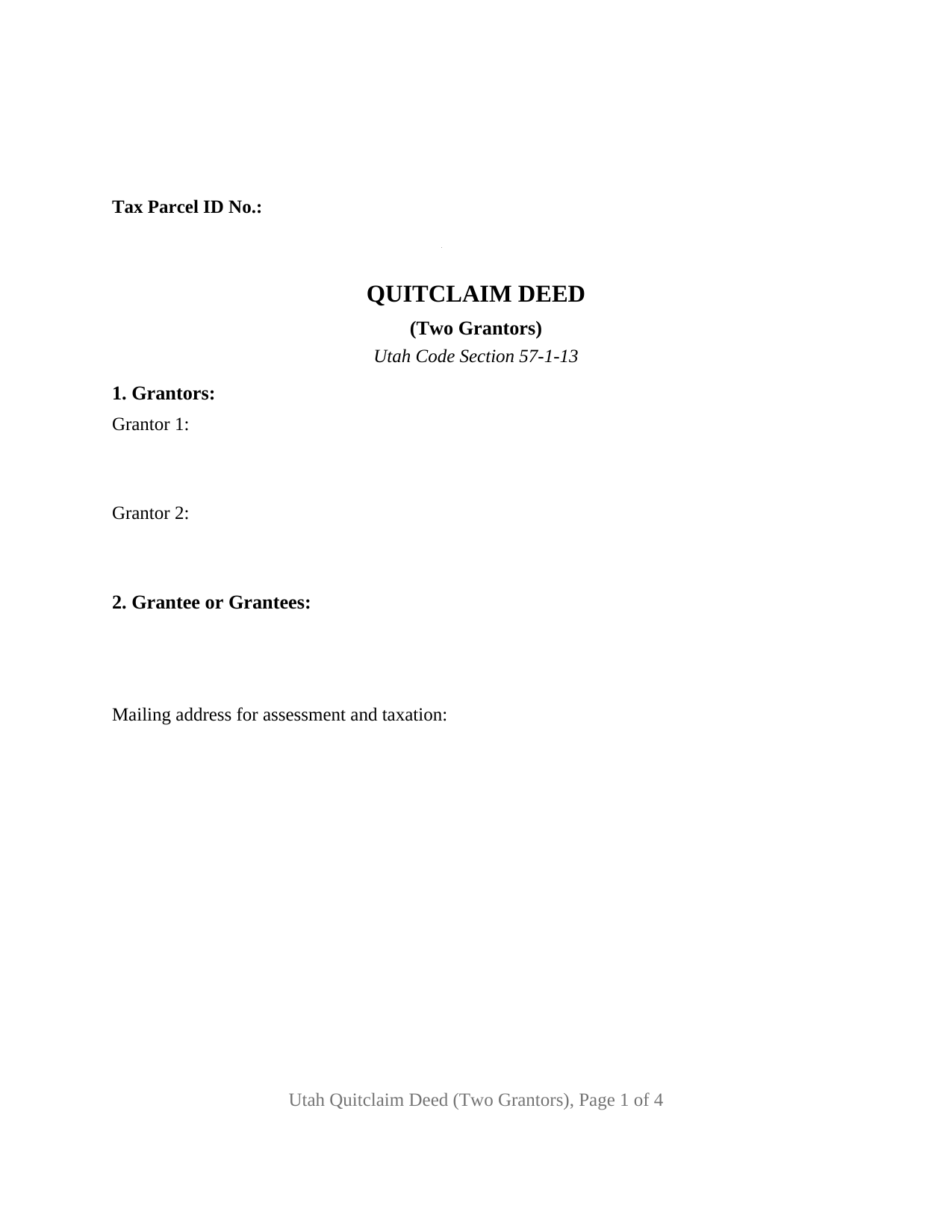
About the Utah Quitclaim Deed (Two Grantors)
How to Use This Form
- Select your county from the list
- Download the county-specific form
- Fill in the required information
- Have the document notarized if required
- Record with your county recorder's office
What Others Like You Are Saying
"First time user. Great service. If I need other forms, I'll definitely be using Deeds."
"Super easy to download and Deeds dot com had the documents I was looking for and set up in a manner …"
"easy to use website."
"The process of using and understanding the requirements of Deeds.com was fairly easy The final resul…"
"Outstanding products and interface. DCM, IL Attorney"
4.8/5 from 4,836 reviews. Read all
Two record owners, one conveyance: this Utah quitclaim deed is configured for exactly two grantors, with a labeled entry, a signature block, and an acknowledgment certificate for each. Both owners join in the same instrument, a statutory-form conveyance under Utah Code Section 57-1-13 arranged for the recording counter of any Utah county.
Both undivided interests move in one instrument
Where two people share title, a deed signed by only one of them reaches only that signer's share. This form recites two grantors and performs the statutory operative act, quitclaims, for both at once: each grantor's right, title, interest, and estate at the date of the conveyance passes through a single recorded document, whether the pair held as joint tenants or as tenants in common. Two heirs who took equal undivided shares and now convey the whole parcel to one relative, co-owners winding up a shared purchase by deeding the entire title to a single buyer, and divorced co-owners who both join one deed to an outside third party all present the two-grantor pattern this deed recites. The form is not set up as a sole owner's conveyance, and it does not recite three or more grantors.
Two signatures, two certificates, two calendars
Each grantor's signature block is paired with that grantor's own acknowledgment certificate, carrying the operative sentence of Utah's Statutory Short Form of Acknowledgment from Utah Code Section 57-2a-7. Because the certificates are independent, the grantors are not tied to a single signing appointment: one may acknowledge before a notary in Provo one week and the other in Salt Lake City the next, or before an out-of-state officer under Utah's Recognition of Acknowledgments Act. Beneath every signature sits a printed name line, the entry Utah Code Section 17-71-403 has the recorder index.
A no-warranty conveyance with a statutory edge
A quitclaim deed, also searched as a quit claim deed, carries no covenant of title from either grantor: the grantee takes exactly the interest the record gives, and neither signer promises anything about its quality. Utah adds a rule that matters when two chains of title meet in one deed: under Utah Code Section 57-1-10, the after-acquired title statute does not apply to quitclaim deeds, so an interest either grantor first acquires after the conveyance stays with that grantor rather than flowing through the recorded instrument.
The grantee side and the 2024 survivorship default
The grantee section takes one name or several. Utah Code Section 57-1-5 supplies the receiving-side default: on or after May 1, 2024, a grant to two or more individuals in their own right creates a joint tenancy with rights of survivorship unless the deed expressly declares a different form, so a co-ownership designation entered after the grantee names is what makes a tenancy in common or another arrangement of record. The form also collects the grantee mailing address used for assessment and taxation and the full legal description, the two recordability conditions Utah Code Section 57-3-105 attaches to a conveyance of title, so the deed arrives at the counter with its statutory contents complete.
Formatted for Utah county recorders
The document follows the format menu a Utah county may adopt under Utah Code Section 17-71-402: letter size white paper, a recorder's stamp space 2.5 inches down and 4.5 inches across at the upper right of the first page, one inch margins, single sided black text, and a first page caption naming the instrument. A tax parcel number line rides in the first page margin space the statute allows for it. Utah imposes no transfer tax on ordinary deeds; the statewide base recording fee is 40 dollars for a document with up to ten legal descriptions, with a 5 dollar addition in counties of the second through sixth class, so the recording package is ordinarily the deed alone.
The purchase delivers this Utah form as a fillable PDF, a completed example prepared on a Utah County fact pattern showing both grantor blocks and both certificates filled in, and a plain language guide covering every numbered section, the grantee vesting choices Utah recognizes, and the recording steps. The materials describe Utah law in general terms and are not legal advice.
Important: County-Specific Forms
Our quitclaim deed (two grantors) forms are specifically formatted for each of the 29 counties in Utah.
After selecting your county, you'll receive forms that meet all local recording requirements, ensuring your documents will be accepted without delays or rejection fees.