Utah Transfer on Death Deed (Single Owner, Multiple Beneficiaries)
County Specific Legal Forms Validated as recently as November 23, 2026 by our Forms Development Team
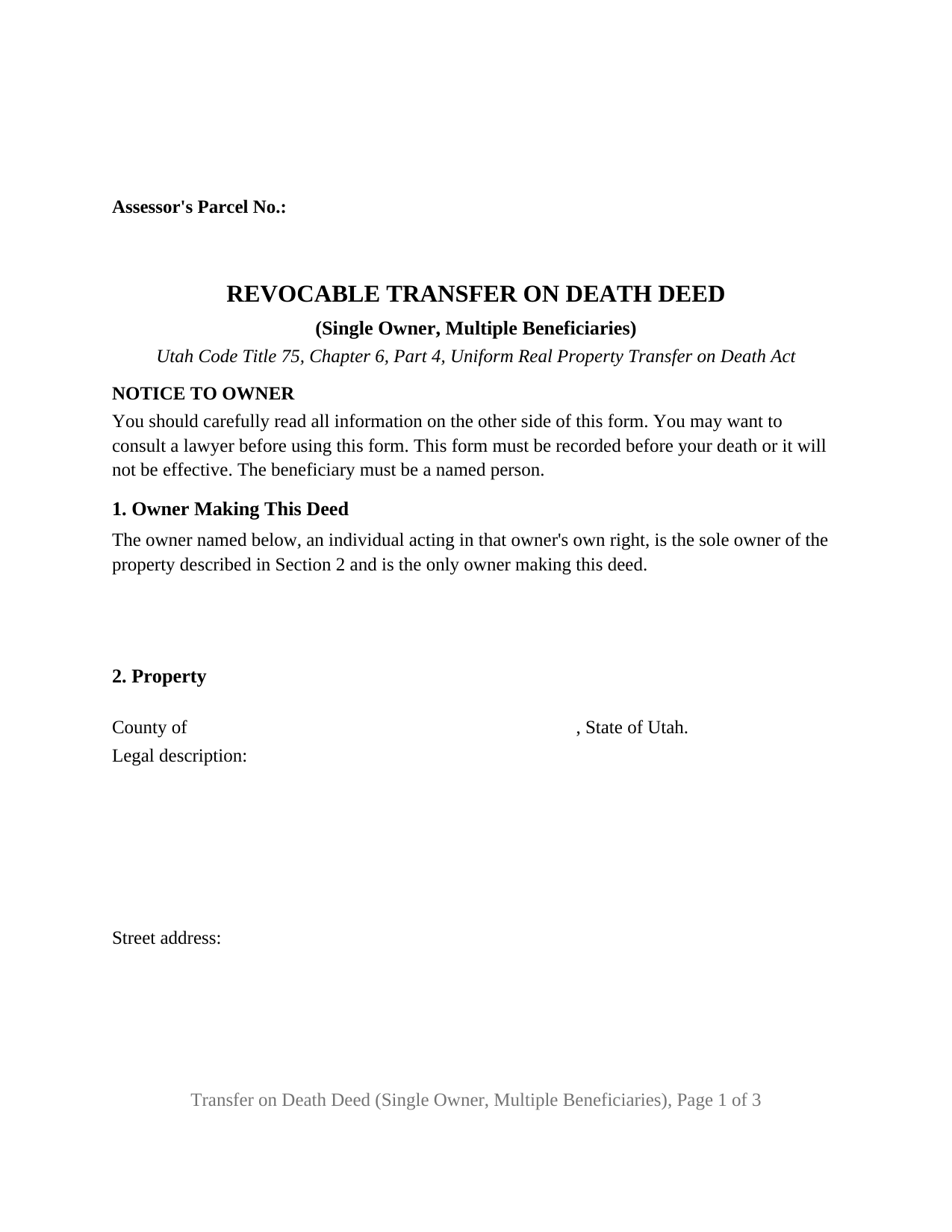
About the Utah Transfer on Death Deed (Single Owner, Multiple Beneficiaries)
How to Use This Form
- Select your county from the list
- Download the county-specific form
- Fill in the required information
- Have the document notarized if required
- Record with your county recorder's office
What Others Like You Are Saying
"I got what I wanted immediately. Thank you."
"very happy with guidance and responses - thank you - not finished yet but confident"
"Very nice. Especially liked that I could re-use the form since I have a couple of properties."
"The service was quick and easy to use. Which is something I really appreciate."
"This was an excellent service to amend a deed. It was a little frustrating at first, but well worth …"
4.8/5 from 4,867 reviews. Read all
This Utah transfer on death deed is written for one owner who holds the property alone and wants it to pass, at death, to several people at once. The form fixes the configuration as deed text: one owner, the sole owner of the described property, designating two or more primary beneficiaries who take in equal and undivided shares. It is delivered as a fillable deed, a seven-page guide, and a completed example, all built to the Uniform Real Property Transfer on Death Act, Utah Code Title 75, Chapter 6, Part 4, and to the optional statutory form in Section 75-6-416 as re-enacted effective May 1, 2024.
Equal shares, and what happens when one beneficiary dies first
Naming several beneficiaries on a single deed raises two questions the act answers directly. Section 75-6-413(1)(c) provides that concurrent interests pass to the beneficiaries in equal and undivided shares with no right of survivorship, unless the deed specifies otherwise, and Section 75-6-413(1)(d) provides that where two or more designated beneficiaries receive concurrent interests, the share of one that lapses or fails for any reason is transferred to the others in proportion to their interests in the remaining part of the property. This form prints both rules as a sentence of the deed, directly below the beneficiary box, so the recorded instrument says on its face how three children, or two siblings and a friend, hold the property after the owner's death and where a lapsed share goes. Each beneficiary's interest is contingent on surviving the owner (Section 75-6-413(1)(b)), measured under the 120-hour rule of Section 75-2-702, and the act sets aside the substitute-gift rule of Section 75-2-706, so a predeceased beneficiary's descendants do not step into that share by statute; the share moves sideways to the surviving beneficiaries instead.
The optional alternate beneficiary section is worded for that arrangement. The statutory form's alternate takes if the primary beneficiary does not survive; with several primaries, this form conditions the alternate on no primary beneficiary surviving, because the lapse rule has already sent a single failed share to the other primaries. An owner who names no alternate completes that section with the word None.
What the beneficiary box accepts
The act requires each beneficiary to be named. A class gift, a transfer to a group described only by relationship such as the owner's children or heirs, may not be made by a transfer on death deed (Section 75-6-405(2)), and the form's Notice to Owner, carried in the statute's own words, says so. Within that limit the beneficiaries may be individuals, a trust designated by its name, or an entity, because the act's definition of a person reaches all of them (Section 75-6-402). The six-line box takes each beneficiary's printed name and mailing address, the two items the statutory form asks for; a relationship label such as my daughter is common and optional. Utah Code Section 57-3-105(3) requires a document executed to convey title to recite the grantees' mailing address for assessment and taxation, which is why the addresses matter to the recorder as well as to the family.
One owner, one signature, one certificate
Section 1 carries a fixed recital that the owner named below, an individual acting in that owner's own right, is the sole owner of the property and the only owner making the deed. The owner's marital status is not part of the recital, so a married owner who holds title alone and an unmarried owner both present the pattern the form recites. Co-owners present a different one: under Section 57-1-5 Utah presumes a joint tenancy with rights of survivorship for an interest granted to two or more persons on or after May 1, 2024, and under Section 75-6-413(3) a joint owner's transfer on death deed takes effect only if that owner is the last surviving joint owner. This form prints no second owner block and no co-owner language, and the guide describes the joint-owner rule rather than the form carrying it.
Execution follows the single-owner configuration: one signature block with the printed name and date, followed by one acknowledgment certificate worded as the affidavit of acknowledgment in Utah Code Section 46-1-6.5(3), the certificate the statutory form directs be attached. The certificate prints State of Utah on its venue line because it is the Utah notary's form; the guide describes the recognition of an acknowledgment taken in another state under Section 57-2a-3 and the certificate that state's officer uses instead.
Recorded now, effective at death
A Utah transfer on death deed, also searched as a TOD deed or beneficiary deed, is effective only if recorded before the owner's death with the recorder of the county where the property is located (Section 75-6-409). Until then it changes nothing: Section 75-6-412 provides that the deed does not affect the owner's right to sell or mortgage the property, the owner's creditors, or public assistance eligibility, and creates no interest in any beneficiary. At death the beneficiaries take subject to every mortgage and lien then on the property and without covenant or warranty of title (Section 75-6-413(2) and (4)). The deed stays revocable, but only by a later acknowledged and recorded instrument under Section 75-6-411; marking through the recorded deed revokes nothing. The revocation instrument, and the post-death affidavit Section 75-6-413(5) calls for in substantially the form of Section 57-1-5.1 with the death certificate attached, are each prepared and recorded separately and are not included in this package.
The form is laid out for Utah recording: letter-size pages, a 2.5-inch reserve across the top of the first page for the recorder's stamp with the parcel number line at its left under Section 17-71-402(5), 1-inch margins, and 12-point body text, with the title the first-page caption Section 17-71-402(3)(c) requires. Utah collects a per-document recording fee under Section 17-71-407 and no transfer tax, so the deed goes to the counter alone.
The completed example
The example fills the same three-page deed for a fictional owner in Orem, Utah County, who holds a platted lot alone and designates her three children as primary beneficiaries and a granddaughter as the alternate, with the parcel number, legal description, signature block, acknowledgment, and return and prepared-by blocks all completed, so the guide's section-by-section walk and the example together show every entry from blank to filled.
The package contains the fillable transfer on death deed with its instructions page, the completed example, and the guide. Everything written here and in the guide is a general description of the form and of the Utah statutes it rests on, offered as information rather than legal advice, and none of it is applied to any particular owner, family, or title.
Important: County-Specific Forms
Our transfer on death deed (single owner, multiple beneficiaries) forms are specifically formatted for each of the 29 counties in Utah.
After selecting your county, you'll receive forms that meet all local recording requirements, ensuring your documents will be accepted without delays or rejection fees.