Utah Transfer on Death Deed (Single Owner, Trust Beneficiary)
County Specific Legal Forms Validated as recently as November 23, 2026 by our Forms Development Team
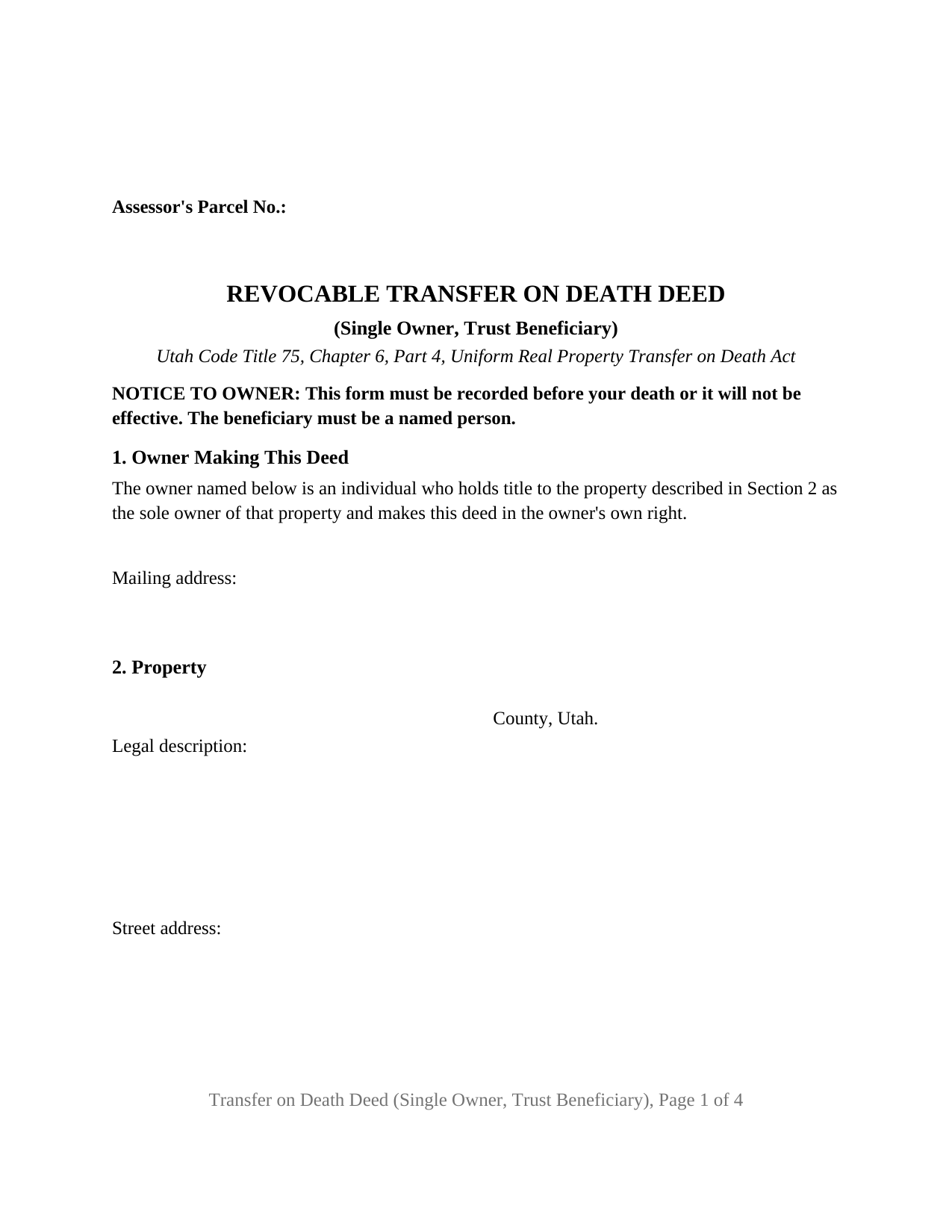
About the Utah Transfer on Death Deed (Single Owner, Trust Beneficiary)
How to Use This Form
- Select your county from the list
- Download the county-specific form
- Fill in the required information
- Have the document notarized if required
- Record with your county recorder's office
What Others Like You Are Saying
"This was a very easy and organized system to use."
"Completed, notarized, and recorded with no issues."
"The website works just as described. I couldn't ask for anything more helpful in drafting an easemen…"
"Awesome!"
"Thank you! You made the process of filing something unusual very easy and efficiently. I will defini…"
4.8/5 from 4,867 reviews. Read all
This Utah transfer on death deed is written for one owner who holds the property alone and wants it to pass, at death, to a trust rather than to a person. The deed recites a single record owner, an individual holding title as the sole owner, and its primary beneficiary section identifies a trust by name, trust instrument date, and trustee. One signature line, one acknowledgment certificate, and a beneficiary that is a trust: that is the whole configuration, built under the Uniform Real Property Transfer on Death Act, Utah Code Title 75, Chapter 6, Part 4.
A trust can be the named beneficiary
The statutory form in Utah Code Section 75-6-416 warns that the beneficiary must be a named person, and Section 75-6-405(2) forbids a class gift, a designation of a group such as my children who are not individually named. A trust clears both rules because of how the act defines its terms. Section 75-6-402(7) defines person to include a trust, alongside individuals, corporations, limited liability companies, and the other entities the subsection lists, and Section 75-6-402(3) defines a designated beneficiary as a person designated to receive property in a transfer on death deed. Naming a trust is therefore a designation of one named person, not a class gift, and it is the designation this deed is built to carry.
The act says nothing about how a trust is to be written into the deed, so the form supplies the three items by which Utah recorded instruments identify a trust: the trust's full name as the trust instrument states it, the date of the trust instrument, and the trustee currently serving. A mailing address line follows, matching the Mailing Address line the statutory form prints beside each beneficiary and the address for assessment and taxation that Utah Code Section 57-3-105(3) calls for in a document conveying title. The completed example writes the trustee entry as the owner herself, as trustee, or the successor trustee then serving, the entry that appears when the owner is also the trustee of her own revocable living trust.
What one sole owner signing alone means on this deed
The owner section opens with a fixed recital: the owner named below is an individual who holds title to the property as its sole owner and makes the deed in the owner's own right. That recital states the configuration the deed is built for. It does not describe a property with two record owners, whether joint tenants with rights of survivorship (the form of title Utah Code Section 57-1-5 presumes for a grant to two or more persons in their own right on or after May 1, 2024) or tenants in common, and the deed prints none of the act's rules for a deed made by more than one transferor or by a joint owner. A property held by one person in that person's own name presents exactly the pattern this deed recites.
No marital status appears in the recital, because Utah law does not ask for one on a transfer on death deed. Utah abolished dower and curtesy in Section 75-2-112, Utah real property carries no community property regime, and the Utah homestead statute that calls for both spouses to join a conveyance, Section 78B-5-504(4), reaches property recorded as a homestead by a declaration filed before the conveyance. Section 75-6-412 adds that during the owner's life the deed affects no interest or right of the owner and creates no interest in the beneficiary. The guide walks through the surviving spouse's elective share and allowances under the Utah Uniform Probate Code, which operate at death, and the estate's limited reach into transferred property under Section 75-6-415.
The statutory sentences the deed carries
Utah printed an optional form in Section 75-6-416, re-enacted effective May 1, 2024, and provides in Section 75-6-416(2) that the act's other sections govern the effect of that form or any other instrument used to create a transfer on death deed. This deed carries the form's sentences where the form does the talking: the notice that the form must be recorded before the owner's death or it will not be effective, the primary beneficiary sentence (I designate the following beneficiary if the beneficiary survives me), the optional alternate beneficiary sentence, and the two operative sentences, At my death, I transfer my interest in the described property to the beneficiaries as designated above, and Before my death, I have the right to revoke this deed. Those two sentences are the statement Section 75-6-409(2) requires and the rule Section 75-6-406 states.
The alternate beneficiary section is optional and open to any named person. Under Section 75-6-413(1)(b) a designated beneficiary's interest is contingent on surviving the transferor and lapses otherwise, so the alternate is the deed's own answer to a primary designation that fails; the completed example names the owner's son as alternate behind the trust.
Acknowledgment in the Utah affidavit form
The statutory form closes by directing an affidavit of acknowledgment under Utah Code Section 46-1-6.5 to be attached, and this deed prints that affidavit, the Section 46-1-6.5(3) form, as its certificate: the venue State of Utah, the sentence that opens On this day of, in the year, before me, a notary public, personally appeared, and the satisfactory-evidence clause that closes it, over the notary's signature, printed name, commission expiration, and a reserved seal area sized to the one inch by two and one-half inch border Section 46-1-16(3)(b) sets for a Utah seal. An owner who signs outside Utah appears before a notary of that place, whose own certificate Utah recognizes under Sections 57-2a-3 and 57-2a-6; the guide describes that path.
Recording before death, and what follows it
Recording is not a formality here but the condition of the deed's effect: Section 75-6-409(3) requires the deed to be recorded before the transferor's death in the office of the county recorder of the county where the property is located. The recording fee under Section 17-71-407 is $40 for a document with up to ten legal descriptions, plus $5 in counties of the second through sixth class, and Utah imposes no transfer tax or transfer declaration. After the owner's death the act calls for an affidavit in the form of Section 57-1-5.1, with a death certificate attached, to be recorded against the property; that affidavit is prepared and recorded separately and is not included in this package.
Not set up as
The deed is not set up as a deed by two or more owners, by a trustee, an entity, a personal representative, or an attorney-in-fact as transferor, or as a deed naming individuals as primary beneficiaries in place of a trust. It does not fund, amend, or restate the trust it names; the trust instrument governs what the trustee does with the property once it passes.
The download contains the fillable transfer on death deed, sometimes searched for as a Utah beneficiary deed or TOD deed, with an instructions cover page that is not recorded; a completed example filled in for a fictional Salt Lake City owner and her revocable living trust; and a guide that explains each section, the governing Utah statutes, signing, and recording. The description and the guide state the law in general terms and are not legal advice.
Important: County-Specific Forms
Our transfer on death deed (single owner, trust beneficiary) forms are specifically formatted for each of the 29 counties in Utah.
After selecting your county, you'll receive forms that meet all local recording requirements, ensuring your documents will be accepted without delays or rejection fees.